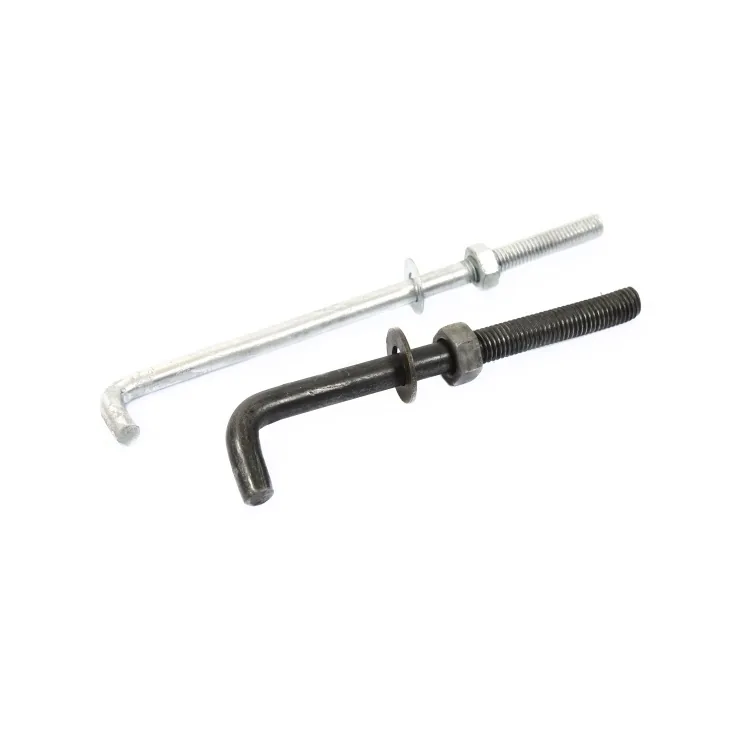
We are Hebei Leeter Import and Export Co., Ltd ("Leeter"), a construction hardware manufacturer in Dingzhou, Hebei, exporting since 2006. We make cast-in anchor bolts — L, J, headed and swedge — with matched nuts and washers, so this guide is the same selection and measurement advice we give buyers, plus a quick anchor bolt selector tool for thread and grade lookups. If you are specifying from a structural drawing rather than measuring a bolt in hand, start with how to read an anchor bolt drawing.
ASTM F1554 grades: 36 vs 55 vs 105
F1554 is the specification written specifically for anchor bolts (it replaced the old habit of calling out A36 or A307 rod). The three grades carry a field colour code on the projecting end, which is how you identify one on site:
| Grade | End colour | Yield | Tensile | Weldable? | Typical use |
|---|---|---|---|---|---|
| 36 | Blue | 36 ksi | 58–80 ksi | Yes, always | General anchorage — sill plates, light columns, most jobs |
| 55 | Yellow | 55 ksi | 75–95 ksi | Only if Supplement S1 is ordered | Higher-load columns, moment frames |
| 105 | Red | 105 ksi | 125–150 ksi | No (heat-treated alloy) | Heavy structural / high-tension anchorage |
The weldability point is the one that causes field problems: Grade 36 welds freely, Grade 55 is weldable only if you specified Supplement S1 when ordering, and Grade 105 should never be welded because the heat destroys its heat-treated properties. If your erector may need to weld to the bolt, specify Grade 36 or Grade 55 S1 up front.
Bolt types: headed, hooked and swedge
- Headed or plate-anchored bolts develop their strength through bearing of the head or a welded plate against the concrete. They are the strongest and most predictable in tension.
- L-bolts and J-bolts are bent rods that anchor through the hook. They are cheap and common for lighter anchorage, but the hook is the weakest mechanism — under real tension it can straighten. ACI and AISC practice now favour headed or plate anchors for tension, and many suppliers quietly decline to certify hooks structurally.
- Swedge bolts have a deformed (swaged) shank that grips grout, used in some setting-plate details.
The honest rule: use a hooked L/J bolt for sill plates and light fixtures; use a headed or plate bolt where the connection carries real uplift or moment.
How to measure an existing anchor bolt
This is the question almost no page answers well — you have a bolt sticking out of concrete and need to order a match. The procedure:
- Clean the threads — a wire brush, or running a nut up and down, clears rust and debris so the measurement is honest (a tap or die cleans them best).
- Measure the diameter across the thread crests with a caliper. That reading is the nominal size (e.g. 0.75 in = ¾").
- Find the thread pitch — count the threads over one inch, or use a thread pitch gauge. Anchor bolts are almost always UNC (coarse): ¾" is 10 TPI, 1" is 8 TPI, and so on.
- Measure the projection (how far it stands above the concrete) and, if you can see it, the hook length or head.
- Assume Grade 36 unless proven otherwise. Anchor rods are frequently unmarked; unless you find the blue/yellow/red end colour, a stamp, or documentation, treat it as F1554 Grade 36 and confirm with the engineer — you cannot read a grade off a bare rod.
Our anchor bolt selector will give you the UNC thread and tap drill once you know the diameter.
Thread, diameter and the galvanized-nut trap
Anchor bolt threads are UNC, and the nut and washer are part of the spec, not an afterthought: F1554 sets use ASTM A563 nuts (Grade A hex for Gr 36/55; heavy-hex Grade DH for Gr 105) and ASTM F436 hardened washers.
The single most common field failure with galvanized anchors is the nut binding. Hot-dip galvanizing adds roughly 2–7 mils (0.05–0.18 mm) to the bolt threads, so a standard nut will not spin on. The fix is built into the standard: the nut must be tapped oversize after galvanizing (per ASTM A563), and the mating galvanized bolt still protects the re-tapped threads by cathodic action — the nut does not need re-galvanizing. Two rules follow for buyers:
- Order galvanized nuts matched to galvanized bolts (over-tapped), never a plain nut on a galvanized bolt.
- Never chase or re-cut the bolt threads to make a nut fit — that removes the zinc where you need it most. If galling is a worry, use a dissimilar-coated nut or an anti-seize lubricant.
Embedment, projection and edge distance
These are structural quantities — the numbers below are rules of thumb to plan around, and the final values belong to your engineer, per ACI 318 and AISC Design Guide 1:
- Projection (thread above the concrete) ≈ grout pad + base-plate thickness + washer + nut(s), plus about two threads or half a bolt diameter of spare. Order an inch or two extra thread to absorb field variation — it is far cheaper than a short bolt.
- Embedment and edge distance govern the concrete's ability to hold the bolt (breakout, pull-out). They depend on bolt size, concrete strength and spacing under ACI 318 — there is no single universal figure.
- The classic failure is bolts set too short to seat the nut, usually because the pier or grout was poured high. Fixes an engineer may accept include a coupling nut and extension, partial thread engagement with analysis, or new drilled-in anchors — all better decided before the pour by using a plywood setting template screwed to the formwork and checked plumb.
Buying anchor bolts from China
For a structural part, certification is the whole game:
- Require an F1554 grade certificate and a mill test report (EN 10204 type 3.1) traced to the heat number — chemistry and mechanical results for the actual batch. An uncertified "grade 36-looking" rod has an unknown yield, which is the core structural risk.
- Buy complete sets — bolt + A563 nut(s) + F436 washer(s), with the galvanized nuts already over-tapped, and a setting template if you want the pattern held during the pour.
- Verify galvanizing to the right standard: ASTM A123 covers the rod, A153/F2329 covers the threaded hardware (they are different specs — a supplier offering A123 for the nuts is citing the wrong one).
- Allow a third-party inspection (SGS/BV) with thread go/no-go gauges checked after galvanizing. A supplier who refuses inspection, offers no MTR, or ships a plain nut on a galvanized bolt is showing you the risk.
As the manufacturer we supply F1554 Grades 36/55/105 with 3.1 mill test reports, matched A563/F436 hardware and templates, plain or hot-dip galvanized — confirm grade, quantity and finish on your order.
Frequently asked questions
How do I measure an anchor bolt that's already set in concrete?
Clean the threads, then measure the diameter across the thread crests with a caliper to get the nominal size (e.g. ¾"). Find the thread pitch by counting threads over one inch or using a pitch gauge — anchor bolts are almost always UNC, so ¾" is 10 TPI and 1" is 8 TPI. Measure the projection above the concrete and note any hook or head. Anchor rods are usually unmarked, so assume ASTM F1554 Grade 36 unless a colour code, stamp or drawing says otherwise.
What grade is my anchor bolt, and how can I tell?
You often cannot tell from a bare rod. ASTM F1554 marks the projecting end with a colour code — Grade 36 blue, Grade 55 yellow, Grade 105 red — or a stamped grade under supplementary requirements, but many anchor rods carry no mark at all. Without a colour, stamp, or mill test report, treat the bolt as Grade 36 (the most common) and confirm the design requirement with the structural engineer.
L-bolt vs J-bolt — which is stronger?
Neither is strong in tension. L-bolts and J-bolts anchor through a bent hook, which is the weakest anchorage mechanism and can straighten under real uplift. The difference between L and J is mainly the hook shape. For any connection carrying meaningful tension, a headed or plate-anchored bolt is preferred by ACI and AISC practice; keep hooked bolts for sill plates and light fixtures.
How much anchor bolt projection do I need?
Enough to stack the grout pad, base-plate thickness, washer and nut(s), plus about two threads or half a bolt diameter of spare. In practice, ordering an inch or two of extra thread is the cheap insurance against field variation, because a bolt that projects too little to seat the nut is a costly repair after the pour.
My anchor bolts are too short — can I fix it without re-pouring?
Sometimes, with the engineer's approval. Options include threading a coupling nut and an extension onto the bolt, accepting partial thread engagement backed by analysis (AISC allows reduced engagement if proven), or installing new drilled-in anchors nearby. The real fix is prevention: set the bolts with a plywood template screwed to the formwork and confirm the pier/grout elevation before the pour.
Why won't my galvanized nut thread onto the galvanized bolt?
Because hot-dip galvanizing adds roughly 2–7 mils to the bolt threads, a standard nut binds. The nut must be tapped oversize after galvanizing (per ASTM A563) so it clears the extra zinc — order galvanized nuts matched to galvanized bolts. Never re-cut the bolt threads to force a fit, since that strips the zinc; use anti-seize if galling is a concern.
