Container load calculator
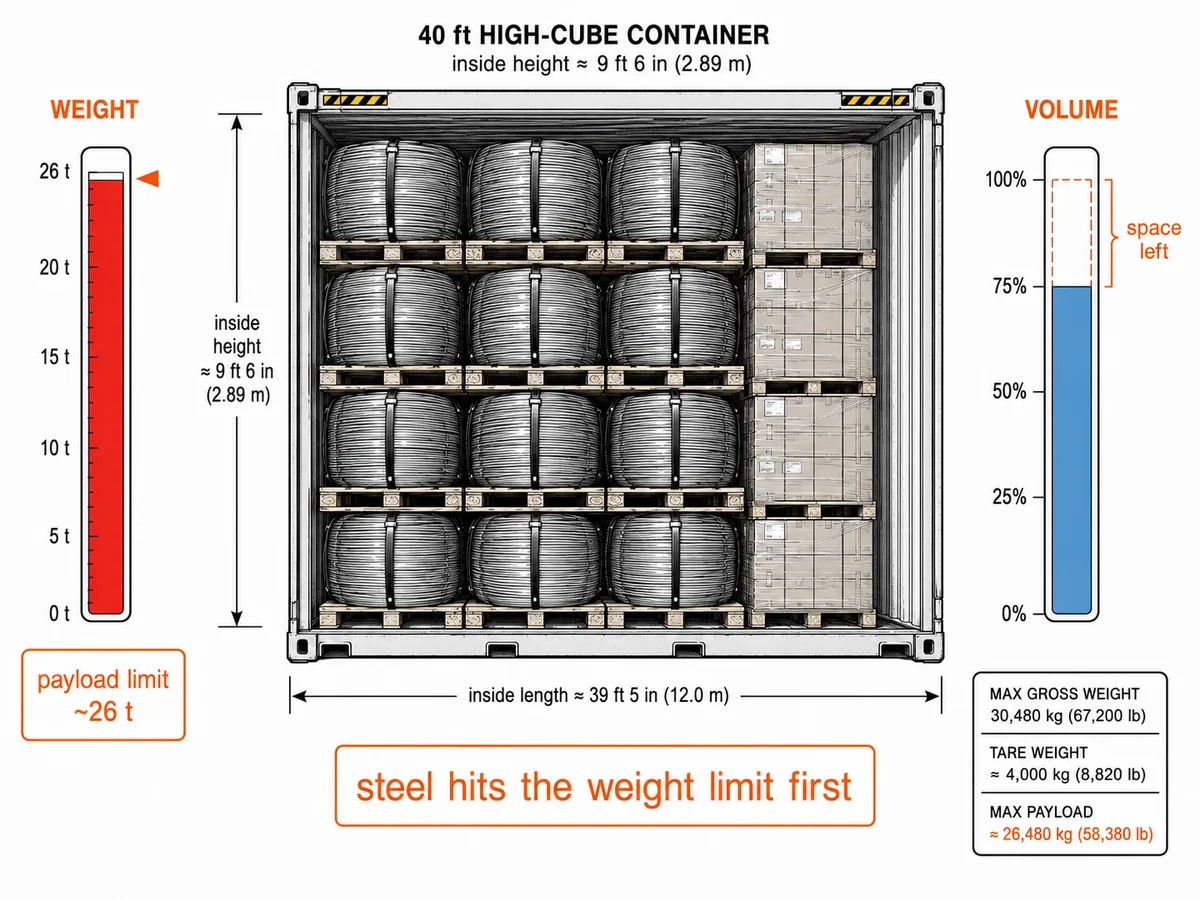
How many coils, rolls or pallets fit a container — by weight, not just volume. Steel is dense, so you almost always hit the payload limit long before the container is full.
Ask Leeter AI ↓40HQ: ~26,330 kg payload · ~76 m³
How this is calculated
- 1Model
For a uniform unit of weight w and packed volume v, units that fit = min( floor(P/w), floor(V/v) ), where P = usable payload and V = internal cube; the smaller floor is the binding constraint. Utilisation: weight% = units·w/P, volume% = units·v/V.
- 2Definitions
Max gross (on the CSC plate) is the heaviest the container may legally weigh; tare is the empty weight; payload = max gross − tare. Typical figures used: 20ft ≈ 21,700 kg / 33 m³, 40ft ≈ 26,730 kg / 67 m³, 40HQ ≈ 26,330 kg / 76 m³.
- 3Why weight binds
Dense wire, mesh and fasteners hit the payload ceiling long before the box is full. Example: 25 kg tie-wire coils of 0.02 m³ in a 40HQ → by weight floor(26,330/25) = 1,053, by volume floor(76/0.02) = 3,800 → 1,053 coils, weight-limited, filling 100% of payload but only ~28% of the cube.
- 4Caveats
The result is cargo payload, not truck-legal weight — road axle/GVW limits (US ~36 t combination, EU 40–44 t) often bind first, so a fully loaded 20ft of steel may be un-truckable. A heavy-tested 20ft rated to 30,480 kg gross can carry ~28 t (vs the 21,700 kg conservative default). It assumes one SKU and ignores floor point-loads and the ~10–20% real stow loss to dunnage and pallet gaps; declare the SOLAS VGM (cargo + tare) for shipping.
Leeter provides the tool, not a warranty of the result. Every figure above is a planning estimate for reference only — confirm structural, code and customs decisions with your engineer, inspector or broker.




From estimate to firm quote
These tools size the job. Send us the spec and we'll price the material, packing and lead time.