
Wire gauge → mm converter
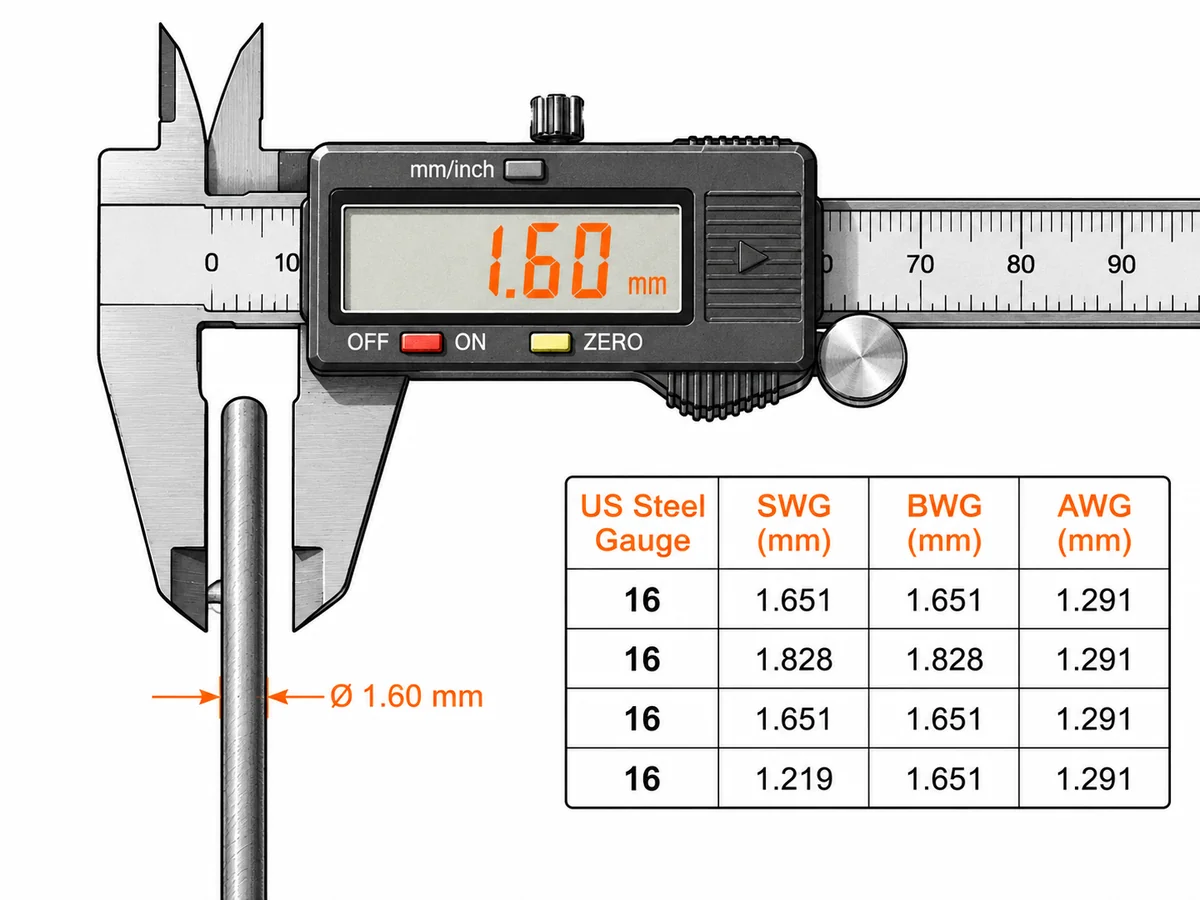
The same gauge number means different diameters in SWG, BWG, AWG and the US Steel Wire Gauge — so a “16 gauge” wire is not one size. Convert before you order.
Ask Leeter AI ↓At 16 gauge the diameter spans 1.29–1.65 mm depending on the system — which is exactly why you should confirm the wire diameter in millimetres on the order.
How this is calculated
- 1What a gauge is
A wire-gauge number is an ordinal index into a fixed lookup table, not a measurement — higher number = thinner wire (a historical count of drawing passes). Four incompatible tables are in daily use, so one gauge number maps to four different diameters. The tool stores each system’s defining value and converts to mm = inches × 25.4.
- 2The four systems
AWG (American Wire Gauge) is the only geometric one — d(in) = 0.005×92^((36−n)/39), anchored at #36 = 0.005 in; it governs copper/aluminium conductors (ASTM B258) and must not be used for steel. SWG (Imperial) is a legal fixed-inch table (UK, 1883). BWG/Stubs is the oldest empirical table (tube and hardened wire). US Steel Wire Gauge (Washburn & Moen) is the fixed table US welded mesh, tie wire, nails and fencing are actually quoted in — the tool’s default.
- 3Why they differ
AWG is a constant-ratio geometric series while SWG/BWG/Steel are hand-built legacy tables, so the same number diverges — most at heavy gauges: at 6 gauge the diameter ranges 4.12 mm (AWG) to 5.16 mm (BWG), a 25% spread for the same number.
- 4Worked example
“16 gauge tie wire”: AWG 1.29 / SWG 1.63 / BWG 1.65 / US Steel 1.59 mm — the last is correct for US tie wire; ordering 16 AWG would give wire ~19% thinner. The reverse lookup returns, per system, the gauge whose stored diameter is nearest the millimetre value entered.
- 5Caveats
Gauge numbers are dimensionless — always convert to mm on a PO; never cross-reference AWG against the Steel gauge for ferrous wire; the mm value is nominal, as real wire carries a diameter tolerance of roughly ±0.05–0.08 mm.
Leeter provides the tool, not a warranty of the result. Every figure above is a planning estimate for reference only — confirm structural, code and customs decisions with your engineer, inspector or broker.






From estimate to firm quote
These tools size the job. Send us the spec and we'll price the material, packing and lead time.