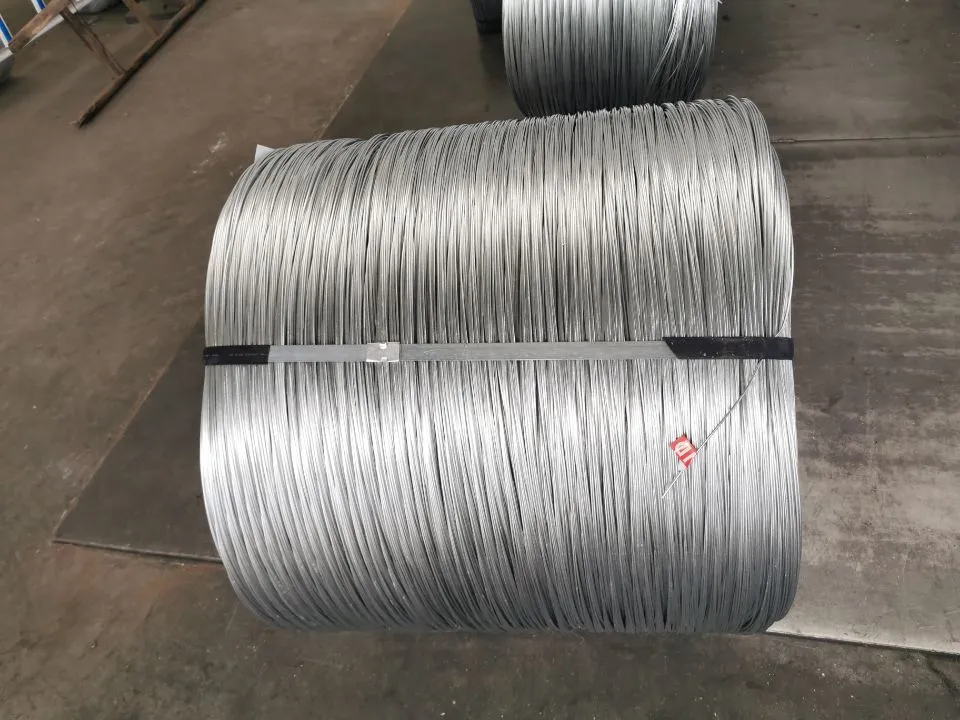
We are Hebei Leeter Import and Export Co., Ltd ("Leeter"), a construction wire and mesh manufacturer in Dingzhou, Hebei, China, exporting since 2006, and we draw galvanized wire and black annealed wire to a diameter in mm, not to a gauge label.
Why higher gauge means thinner wire
Gauge numbering comes from the drawing process: wire is pulled through progressively smaller dies, and the gauge number counts the draws. More draws means a thinner wire and a higher number. So 8 gauge is heavy wire around 4mm, while 22 gauge is fine wire under 1mm. This is counter-intuitive for buyers used to thinking "bigger number, bigger part," and it is the single most common source of wire ordering errors. When someone says "heavy" or "thick" wire, they mean a low gauge number.
SWG vs BWG: the conversion table
The two systems were defined by different bodies and never reconciled. SWG was the legal imperial standard in Britain; BWG (also called Stubs Iron Wire Gauge) came from the Birmingham steel trade and became the default for annealed and galvanized steel wire worldwide. Use this table to translate any gauge into a real diameter.
| Gauge | SWG (mm) | SWG (in) | BWG (mm) | BWG (in) |
|---|---|---|---|---|
| 8 | 4.064 | 0.160 | 4.191 | 0.165 |
| 9 | 3.658 | 0.144 | 3.759 | 0.148 |
| 10 | 3.251 | 0.128 | 3.404 | 0.134 |
| 11 | 2.946 | 0.116 | 3.048 | 0.120 |
| 12 | 2.642 | 0.104 | 2.769 | 0.109 |
| 13 | 2.337 | 0.092 | 2.413 | 0.095 |
| 14 | 2.032 | 0.080 | 2.108 | 0.083 |
| 15 | 1.829 | 0.072 | 1.829 | 0.072 |
| 16 | 1.626 | 0.064 | 1.651 | 0.065 |
| 17 | 1.422 | 0.056 | 1.473 | 0.058 |
| 18 | 1.219 | 0.048 | 1.245 | 0.049 |
| 19 | 1.016 | 0.040 | 1.067 | 0.042 |
| 20 | 0.914 | 0.036 | 0.889 | 0.035 |
| 21 | 0.813 | 0.032 | 0.813 | 0.032 |
| 22 | 0.711 | 0.028 | 0.711 | 0.028 |
The gap is small but real: at 12 gauge the difference between SWG (2.642mm) and BWG (2.769mm) is 0.127mm, enough to shift the weight per coil and the fit in a fastening tool. Note also that SWG and BWG happen to agree at 15, 21 and 22 gauge and cross over around 20 — proof that you cannot assume which system a quote uses.
Why you must confirm diameter in mm on export orders
A gauge label alone is ambiguous across borders. A buyer in the UK who orders "16g" is thinking SWG (1.626mm); a mill in China or India quoting the same wire may deliver BWG (1.651mm) or a rounded metric 1.6mm. Over a 20-tonne order those tolerances change the coil count, the meterage per kilo and whether the wire feeds a rebar tying tool. The fix is simple: specify the target diameter in millimetres with a tolerance (for example 1.60mm ±0.03mm) and treat the gauge number as a label, not the spec. We quote and inspect every black annealed wire and galvanized coil to the millimetre value on the order, backed by pre-shipment measurement.
Typical gauges for common products
Different products cluster around predictable gauges, which is a useful sanity check when a spec looks wrong.
| Product | Typical gauge (BWG) | Diameter (mm) |
|---|---|---|
| Rebar tie wire (annealed) | 16–18 | 1.24–1.65 |
| Soft binding / craft tie wire | 18–22 | 0.71–1.25 |
| Chicken / hexagonal mesh | 19–22 | 0.71–1.07 |
| Welded mesh (light) | 14–16 | 1.65–2.11 |
| Field / farm fencing line wire | 12–14 | 2.11–2.77 |
| Chain-link fabric | 9–11 | 3.05–3.76 |
| Nail wire (drawn to nails) | 8–16 | 1.65–4.19 |
Tie wire for rebar is almost always 16 or 18 BWG soft black annealed, because it must bend by hand and hold; mesh runs finer; and fencing and chain-link move to the heavy, low-gauge end for strength. If a "tie wire" enquiry lists 12 gauge, someone has confused it with fencing wire — the millimetre value catches that instantly.
From gauge to weight
Buyers pay by weight, so diameter drives cost. Because mass rises with the square of the diameter, a small gauge change moves the weight a lot: 1kg of 16 BWG wire (1.651mm) runs roughly 590 metres, while the same kilo of 18 BWG (1.245mm) runs about 1,040 metres — nearly double the length for the same money. That is why confirming the exact mm diameter matters not just for fit but for the meterage your customer actually receives per tonne.
Frequently asked questions
Is SWG the same as BWG?
No. SWG (Standard Wire Gauge) is the British imperial standard defined in BS 3737, while BWG (Birmingham or Stubs Wire Gauge) comes from the steel-wire trade and is the default for annealed and galvanized wire. The two give different diameters at most gauges — for example 16 SWG is 1.626mm but 16 BWG is 1.651mm. Always confirm which system a quote uses, or specify millimetres.
Does a higher gauge number mean thicker or thinner wire?
A higher gauge number means thinner wire. Gauge counts the number of times wire is drawn through a die, so more draws produce a smaller diameter and a bigger number. An 8-gauge wire is around 4mm and heavy, while a 22-gauge wire is under 1mm and fine. When a customer asks for "heavier" wire, they want a lower gauge number.
How do I convert wire gauge to mm?
Use a conversion table for the correct system, because gauge is a label, not a formula. In BWG, 8 gauge is 4.191mm, 12 gauge is 2.769mm and 16 gauge is 1.651mm; in SWG the same numbers give 4.064mm, 2.642mm and 1.626mm. On export orders, state the diameter in millimetres with a tolerance so the mill and the buyer agree on the actual size.
What gauge is standard rebar tie wire?
Rebar tie wire is standardly 16 or 18 BWG soft black annealed wire — about 1.24 to 1.65mm. That range is soft enough to twist by hand or feed a tying tool yet strong enough to hold reinforcing bars in position before the pour. Heavier gauges belong to fencing and chain-link, not tying, so a tie-wire order calling for 12 gauge is usually a mislabelled fencing spec.
Why specify millimetres instead of a gauge number?
Because a gauge number is ambiguous across the SWG, BWG and metric systems and can differ by 0.1mm or more, which changes weight per coil, meterage per kilo and tool fit. Specifying a millimetre diameter with a tolerance — such as 1.60mm ±0.03mm — removes the ambiguity, so the wire you draw, inspect and ship matches exactly what the buyer expects on a large export order.
