
Tie wire quantity calculator
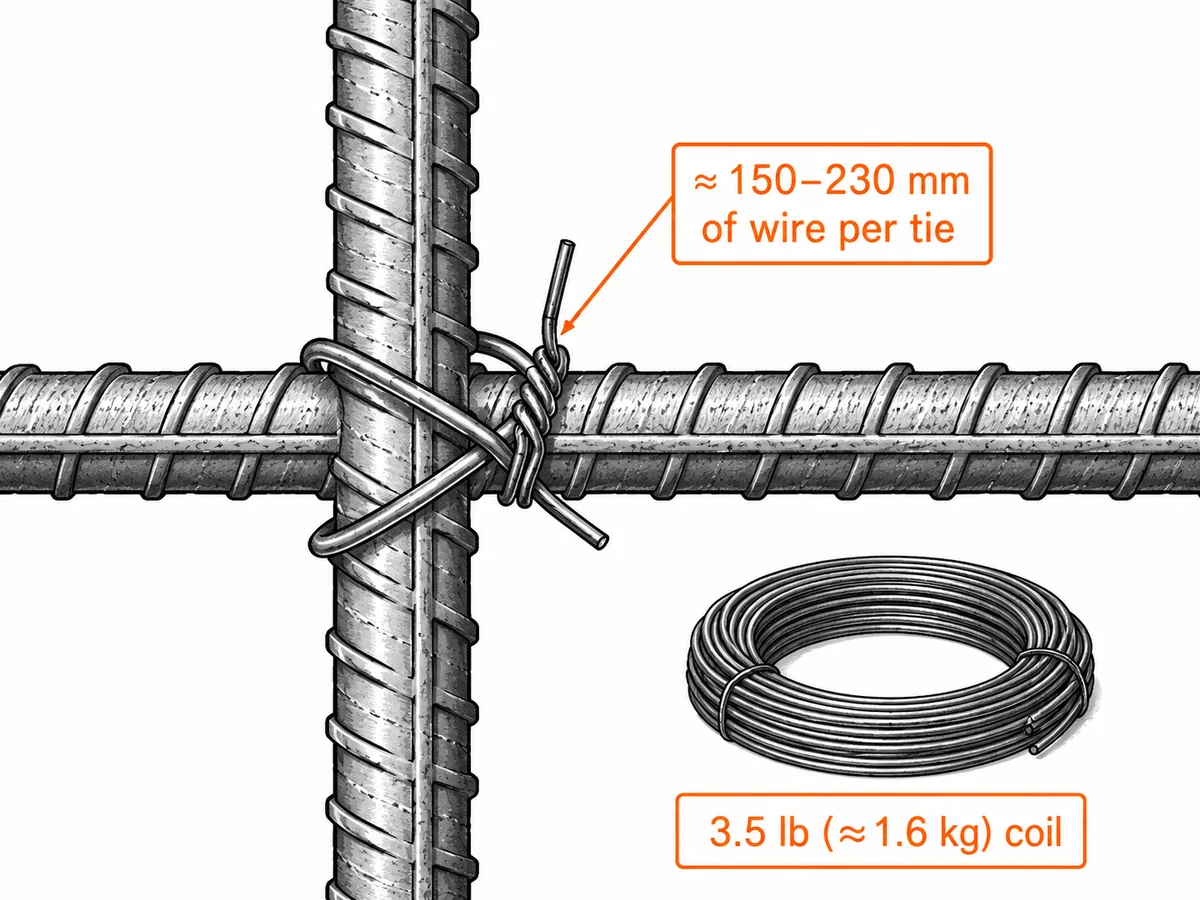
Estimate the tie wire you need per tonne of rebar. Pick your bar size and how much of the intersections you tie — we do the rest.
Ask Leeter AI ↓For 10 t of 10–16 mm rebar, tying every intersection. That is roughly 10 kg/tonne before adjustment.
How this is calculated
- 1Model
Instead of counting every crossing, this uses the reinforcement tonnage as a proxy — the method quantity surveyors use on tender: Wire (kg) = tonnes × rate × pattern.
- 2
The rate falls as bars get thicker, because a tonne of thin bar contains far more intersections than a tonne of thick bar: 8 mm ≈ 12, 10–16 mm ≈ 10, 20–25 mm ≈ 8, 28–32 mm ≈ 7 kg per tonne. Independent estimating tables put the typical figure in the 9–13 kg/tonne range, which brackets these bands.
- 3
Pattern factor is 1.0 for tying every intersection and 0.6 for a checkerboard/half pattern (not 0.5, because the perimeter and laps are still fully tied). A ±15% band is reported as an explicit uncertainty covering tie technique, spacing and offcuts.
- 4Worked example
3.2 t of 12 mm bar tied at every crossing → 3.2 × 10 × 1.0 = 32 kg (≈27–37 kg with the band); a half pattern ≈ 19 kg.
- 5Assumptions & limits
The rate assumes typical slab/wall spacing, so it is diameter-driven and does not track spacing explicitly — for very tight (<125 mm) or very wide (>300 mm) grids, cross-check with the intersection-count method (Slab reinforcement estimator). It excludes wire for splice cages, starters and column ties beyond normal slab/wall work.
Leeter provides the tool, not a warranty of the result. Every figure above is a planning estimate for reference only — confirm structural, code and customs decisions with your engineer, inspector or broker.



From estimate to firm quote
These tools size the job. Send us the spec and we'll price the material, packing and lead time.