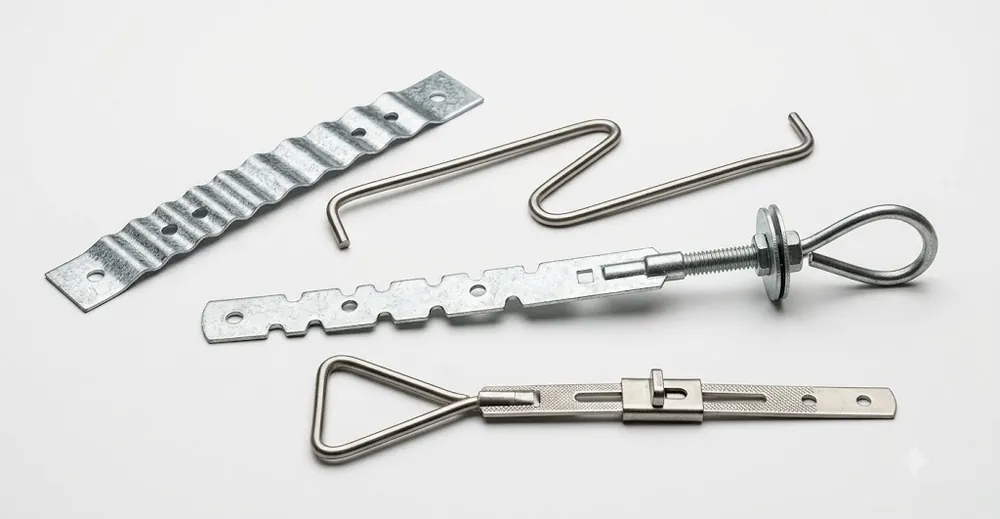
What are brick veneer ties and why do they matter?
Brick veneer ties transfer lateral loads, mostly wind and seismic pressure, from the exterior brick face back into the structural wall while still allowing the two layers to move independently. Because a brick veneer is non-structural, it needs a mechanical connection every few square feet or it will bow, crack, and eventually separate from the building.
The tie does two jobs at once. It resists tension when wind tries to pull the brick away from the wall, and it resists compression when wind pushes the brick inward. A good tie is stiff along that push-pull axis yet tolerant of the small vertical movements caused by thermal expansion and moisture. Get the tie wrong and you either restrain the wall too rigidly, which invites cracking, or too loosely, which invites deflection.
We think of tie selection as three questions stacked in order. First, what is the backing made of? Second, do the brick courses align with the backup joints? Third, what corrosion environment will the wall face over its life? Answer those and the product almost picks itself.
Which brick veneer ties work with stud-framed backing?
Corrugated wall ties are the standard choice for brick veneer over wood or steel stud framing, and they are the most widely used tie in North American residential construction. The corrugated tie is a flat, ribbed strip, usually 7/8 inch or 1 inch wide, that fastens to each stud through the sheathing with a nail or screw, then bends 90 degrees and beds into the brick mortar joint.
The corrugations are not decoration. They lock the strip into the mortar so it resists pull-out, and they let the installer make a controlled bend at the sheathing line. We commonly supply corrugated ties in 22 gauge for light residential work and 16 gauge where codes or engineers ask for a heavier section. The heavier gauge matters more than most crews expect, because a thin corrugated tie loses stiffness quickly once it corrodes.
There is a known limitation, and we are honest about it with customers. A corrugated tie only performs well when the air gap between sheathing and brick is small, typically under 1 inch, and when the tie is nailed close to the bend. Long unsupported lengths let the strip flex, and a flexible tie in compression does very little. For wider cavities or drainage-plane assemblies, buyers often move to a two-piece design instead.
Corrugated tie gauges and dimensions
| Tie type | Common width | Common gauge | Typical backing | Notes |
|---|---|---|---|---|
| Corrugated strip | 7/8 in | 22 ga | Wood stud | Light residential |
| Corrugated strip | 7/8-1 in | 16 ga | Wood or steel stud | Heavier, engineer-specified |
| Corrugated strip, slotted | 1 in | 16 ga | Steel stud | Screw-fixed, vertical adjustment |
We galvanize the standard product to a G60 or G90 zinc coating, and we run Type 304 or 316 stainless for coastal and high-humidity jobs. When a request crosses our desk without a corrosion spec, we ask, because a corrugated tie that outlasts its coating becomes a crack waiting to happen.
Which brick veneer ties work with masonry backup?
Z-ties and rectangular box ties are the go-to anchors when the backup is concrete block, poured concrete, or a second masonry wythe rather than studs. These are wire ties, not strips, and they are laid directly into the mortar bed joints of both the backup and the veneer, so both ends are fully embedded rather than fastened to a face.
A Z-tie is a length of wire bent into a flattened Z shape, with the two hooked ends bedding into opposing mortar joints. It is simple, cheap, and effective when the backup and veneer courses line up. We typically form Z-ties from 3/16 inch (roughly 4.8 mm) wire, which gives a stiff, load-worthy section that will not buckle under compression. Thinner wire exists, but for structural veneer work we steer buyers toward the heavier diameter.
Rectangular ties, sometimes called box ties, are a closed loop of the same wire. The closed shape resists twisting better than a Z and gives more embedment surface, which is why engineers often prefer it for taller walls or higher wind zones. The trade-off is a slightly fussier install, since the mason has to align a loop rather than drop in a hook.
Both wire ties share one requirement worth repeating: the mortar joints on each side have to be at the same height, or close to it. When the backup is block laid in 8 inch courses and the brick runs in roughly 2 2/3 inch courses, perfect alignment happens only every third brick. That mismatch is exactly the problem the next family solves.
When should you use adjustable two-piece ties?
Adjustable ties are the right answer whenever brick veneer courses do not align with the backup joints, which is the normal condition in most cavity walls. An adjustable tie splits into two parts: an anchor fixed to the backup, and a wire pintle or tie section that beds into the brick joint and slots into the anchor at whatever height the coursing requires.
This two-piece design buys the installer vertical play, commonly around 1 to 1.25 inches, so the brick joint can land where the coursing dictates while the backup anchor stays where the structure dictates. That flexibility is why adjustable systems dominate commercial cavity-wall construction, where a steel or concrete backup almost never matches the brick module.
The families we build fall into a few groups. Barrel-and-pintle and eye-and-pintle types use a wire loop dropped over a pin. Seismic versions add a continuous wire or a clip that ties the pintle to horizontal joint reinforcement, giving the wall extra in-plane strength. Screw-on and slotted-plate anchors fix to steel stud or concrete and accept a wire tie at any height along a slot.
There is a design caution we pass along. Adjustable ties introduce a small amount of free play at the connection, and excessive play under load reduces stiffness. Codes limit that clearance for good reason, so the pintle should sit firmly in the anchor, not float loosely in an oversized eye. When we quote an adjustable system, we confirm the pintle and anchor are a matched pair from the same series, because mixing brands is where field problems start.
Backing suitability at a glance
| Backing type | Best tie family | Why |
|---|---|---|
| Wood stud | Corrugated strip | Nails to stud, cheap, proven |
| Steel stud | Corrugated or screw-on adjustable | Screw fixing, cavity tolerance |
| Concrete block | Z-tie, rectangular, or adjustable | Bed-joint embedment |
| Poured concrete | Adjustable anchor with pintle | Fixes to face, adjusts to coursing |
| Second masonry wythe | Z-tie or rectangular | Both ends bedded in mortar |
How do you select the right brick veneer ties?
Selecting brick veneer ties comes down to matching the tie family to the backing first, then confirming gauge, coating, and spacing against your project's wind and corrosion demands. In our experience shipping to North American and European contractors, the backing decision resolves most of the confusion, and the rest is detail.
Start with material. Wood or steel studs point you toward corrugated or screw-on adjustable ties. Concrete or block backup points you toward wire Z-ties, rectangular ties, or a full adjustable anchor. Once the family is set, size the section: 16 gauge for heavier corrugated duty, 3/16 inch wire for structural Z and rectangular ties, and a matched pintle diameter for adjustable sets.
Then handle corrosion honestly. Interior and dry climates tolerate hot-dip galvanized steel. Coastal, humid, or high-exposure walls justify Type 304 or 316 stainless, and the upgrade is far cheaper than tearing out a failed veneer a decade later. Finally, check spacing and embedment against the governing local code and the project engineer's drawings, since tie count per square area and minimum mortar embedment are the two numbers inspectors check first. We supply the hardware; the spacing schedule belongs to your designer.
If you are still weighing options across the whole assembly, our fuller overview of brick wall ties lays out the coatings and pack sizes we stock. When you have a spec in hand, request a quote and we will confirm gauge, coating, and lead time against your drawings.
Frequently asked questions
What gauge should corrugated brick veneer ties be?
For light residential brick veneer over wood studs, 22 gauge corrugated ties are common, while 16 gauge is the heavier option engineers specify for taller walls, higher wind zones, or steel-stud backing. The thicker gauge holds stiffness longer as coatings age. Always defer to your project engineer and local code for the required section.
Can I use Z-ties over wood stud framing?
We do not recommend it. Z-ties are designed to bed into mortar joints on both ends, which suits masonry or concrete backup. Wood and steel stud walls have no backup mortar joint to embed the far end, so a corrugated strip or a screw-on adjustable tie is the correct choice for framed construction.
Why choose adjustable ties over fixed Z-ties?
Adjustable two-piece ties let the brick joint and the backup anchor sit at different heights, which matters because brick courses rarely align with block or concrete coursing. Fixed Z-ties demand aligned joints. In most commercial cavity walls, that alignment does not exist, so adjustable systems avoid forced, out-of-plane bends in the tie.
Do brick veneer ties need to be stainless steel?
Not always. Hot-dip galvanized steel serves dry interior and moderate climates well. Stainless grades 304 or 316 are worth the cost in coastal, humid, or heavily exposed walls, where road salt or sea air would attack a zinc coating. Since ties are buried in the wall, replacing corroded ones means demolition, so match the coating to the exposure.
How far apart should brick veneer ties be placed?
Spacing is set by your governing building code and structural engineer, not by the tie supplier. Ties are typically distributed on a grid measured in square feet of wall area, with tighter spacing around openings and at wall edges. We provide the hardware to the specified gauge and coating; your designer provides the spacing schedule.
Talk to us about your next order
Choosing between corrugated, Z-tie, and adjustable brick veneer ties gets straightforward once you know your backing, your exposure, and your coursing. We have been making these anchors since 2006 and stock them across gauges and coatings for export. Send your spec and request a quote, and we will match the right tie to your wall.
