We are Hebei Leeter Import and Export Co., Ltd ("Leeter"), a construction wire, mesh and fastener manufacturer in Dingzhou, Hebei, China, exporting since 2006, and construction nails including hardened concrete nails are one of our founding lines.
What "carbon grade" means on a concrete nail
The grade markings — 45#, 55#, 65Mn, 70# — are the Chinese steel designations for the carbon (or manganese) content of the wire before heat treatment, and they are the single most important spec on a concrete nail. Higher carbon means the nail can be quenched and tempered to a higher hardness, which is what lets a hardened nail bite into cured concrete instead of buckling. Too much hardness for the job, though, makes the nail brittle and prone to snapping or spalling under a hammer. Matching grade to substrate is therefore the core buying decision, not an afterthought.
- 45# (0.42–0.50% C): medium-carbon, tempers to about HRC 50–52. Tough and forgiving, drives well into mortar joints, block and fresh ("green") concrete.
- 55# (0.52–0.60% C): the general-purpose grade, HRC 52–55. The default for a mixed export assortment.
- 65Mn (manganese spring steel): tempers to HRC 54–57 with good toughness, a strong choice where buyers want hardness plus resistance to snapping.
- 70# (0.67–0.75% C): high-carbon, HRC 55–58. Hardest and stiffest, for cured, high-strength concrete — but the least forgiving of off-angle blows.
Grade → substrate table
| Carbon grade | Approx. hardness (HRC) | Best substrate | Notes |
|---|---|---|---|
| 45# | 50–52 | Mortar joints, brick, block, green concrete | Toughest, most forgiving; bends before it snaps |
| 55# | 52–55 | General concrete, block, most jobsites | The all-round default grade |
| 65Mn | 54–57 | Medium-to-hard concrete | Spring steel; hardness with better toughness |
| 70# | 55–58 | Cured, high-strength concrete, pre-cast | Hardest and stiffest; drive straight or it snaps |
Green concrete keeps curing for weeks and is far softer at 3–7 days than at 28 days, so a nail spec that works on a fresh slab may bounce on the same slab a month later — a common source of "the nails suddenly stopped driving" complaints. When in doubt, buyers who serve mixed sites stock 55# as the middle grade and add 70# for pre-cast and cured work.
Sizes, gauges and length coding
Concrete nails run 3/4 inch to 4 inches (19–100mm), in wire gauges from 12 BWG (about 2.8mm) at the short end to 7 BWG (about 4.5mm) at the long, heavy end. Diameter climbs with length so the shank stays stiff enough to drive. Penetration into the concrete should be at least one inch (25mm) for a reliable hold, so pick length as fixture thickness plus a minimum inch of embedment.
| Length | mm | Typical gauge (BWG) | Wire dia (mm) |
|---|---|---|---|
| 3/4" | 19 | 12 | 2.8 |
| 1" | 25 | 11–12 | 2.8–3.0 |
| 1-1/2" | 38 | 10–11 | 3.0–3.4 |
| 2" | 50 | 9–10 | 3.4–3.8 |
| 2-1/2" | 63 | 9 | 3.8 |
| 3" | 75 | 8 | 4.0 |
| 4" | 100 | 7 | 4.5 |
Shank type: fluted, smooth or knurled
The shank profile controls holding power and how hard the nail is to drive. Three patterns are standard:
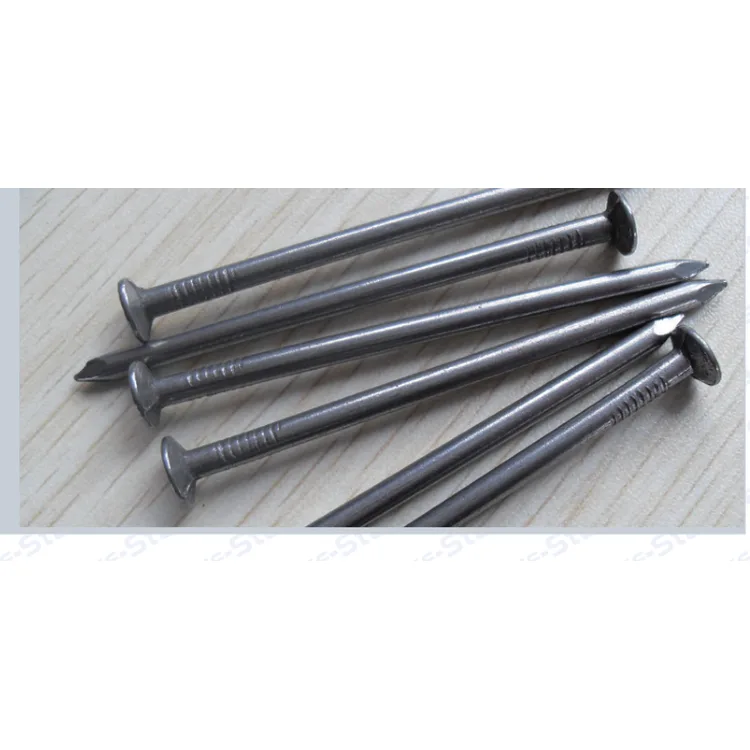
- Fluted shank: vertical grooves ("flutes") run the length of the nail. As it drives, the flutes displace and compact the concrete, then the material grips back into the grooves for high withdrawal resistance. This is the volume concrete-nail pattern and the one most buyers mean by "concrete nail."
- Knurled (diamond/twilled) shank: a cross-hatched or diamond knurl gives extra bite in dense concrete and is common on shorter, heavier nails.
- Smooth shank: plain round shank, easiest to drive and cheapest, used for softer masonry, mortar and temporary fixing where maximum hold is not needed.
Match shank to hold: fluted for permanent fixing into concrete, smooth for mortar and light or temporary work, knurled where the substrate is hard and pull-out matters.
Finish: black or electro-galvanized
Concrete nails ship in two standard finishes. Black (self-color / oiled) is bare hardened steel with a light oil film — the lowest cost, correct for interior and dry-service fixing where corrosion is not a concern. Electro-galvanized (EG) adds a thin bright-zinc layer that delays rust in storage and light exposure, and it is the usual upgrade for damp interiors or short outdoor exposure. Note that hardened concrete nails are rarely hot-dip galvanized — the hot-dip bath's temperature can affect the heat treatment — so for genuinely wet or exterior structural fixing, a mechanical anchor or a corrosion-rated construction fastener is the better call than a galvanized concrete nail.
How to drive them: hammer versus powder-actuated
By hand, use a heavier hammer (a 20–24 oz framing or club hammer) and hit square and straight — a hardened nail struck at an angle will snap or ricochet, so eye protection is mandatory. Start with short, controlled taps to set the point, then drive with firm blows; do not over-strike a fully seated nail. For production fixing, a powder-actuated tool (PAT) or a gas/pneumatic concrete nailer drives the nail in one shot, which is faster, straighter and safer than hammering, and it is how battens, furring and track are fixed to concrete on commercial sites. PAT drive pins are a related but distinct product with their own knurled shank and plastic flute; standard hand concrete nails and PAT pins are specified and stocked separately.
How buyers spec a concrete nail
Give the mill five things and the order is unambiguous: carbon grade (45#/55#/65Mn/70#), length + gauge (e.g. 2-1/2" x 9 BWG), shank (fluted/smooth/knurled), finish (black/EG), and packing (bulk cartons or retail boxes). As the manufacturer we draw the wire, cut and head the nail, and quench-and-temper to the ordered grade — and we hold and verify hardness on every concrete-nail lot, because hardness is the spec that separates a nail that drives from one that bends or snaps. Mill test reports, AQL sampling and pre-shipment inspection are available, with MOQ from about one pallet and lead times of 15–35 days.
Frequently asked questions
What carbon grade of concrete nail do I need?
Concrete nail carbon grades run 45#, 55#, 65Mn and 70#, and the right one depends on the concrete. 45# is a tough medium-carbon nail for mortar, block and green concrete; 55# is the general-purpose default; 65Mn is spring steel with hardness plus toughness; and 70# is the hardest, for cured, high-strength concrete. Harder concrete needs a higher grade; softer substrate needs a tougher, lower grade.
How hard are hardened concrete nails?
Hardened concrete nails are typically heat-treated to about HRC 50–58 on the Rockwell C scale. The exact hardness follows the carbon grade: 45# tempers to roughly HRC 50–52, 55# to 52–55, 65Mn to 54–57, and 70# to 55–58. This hardness is what lets the shank drive into masonry without bending, but it also makes the nail brittle if struck off-angle, so square hammer blows and eye protection matter.
What sizes do concrete nails come in?
Concrete nails run from 3/4 inch to 4 inches, which is 19 to 100mm, in wire gauges from about 12 BWG (2.8mm) at the short end to 7 BWG (4.5mm) at the long, heavy end. Diameter increases with length to keep the shank stiff. Choose length as the fixture thickness plus at least one inch (25mm) of penetration into the concrete for a secure hold.
Can you hot-dip galvanize concrete nails?
Hardened concrete nails are usually supplied black (self-color) or electro-galvanized, not hot-dip galvanized. The hot-dip bath runs hot enough to affect the nail's heat treatment and reduce its hardness, so it is generally avoided on hardened stock. For wet or exterior structural fixing, use a corrosion-rated mechanical anchor or a suitable coated fastener rather than a galvanized concrete nail.
Should I use a hammer or a powder-actuated tool?
For occasional fixing, a heavy framing hammer works if you strike square and straight and wear eye protection, since hardened nails can snap or ricochet. For production or commercial fixing of battens, furring and track to concrete, a powder-actuated or gas/pneumatic tool is faster, straighter and safer. Note that powder-actuated drive pins are a separate product from hand-driven concrete nails and are specified on their own.
