We are Hebei Leeter Import and Export Co., Ltd ("Leeter"), a wire, mesh, anchor, and support manufacturer founded in 2006 in Dingzhou, Hebei. We ship concrete reinforcing mesh and reinforcing bar to contractors across North America and Europe every week, and we field this exact question constantly. This guide lays out the trade-offs the way we explain them to buyers on the phone.
What is concrete reinforcing mesh?
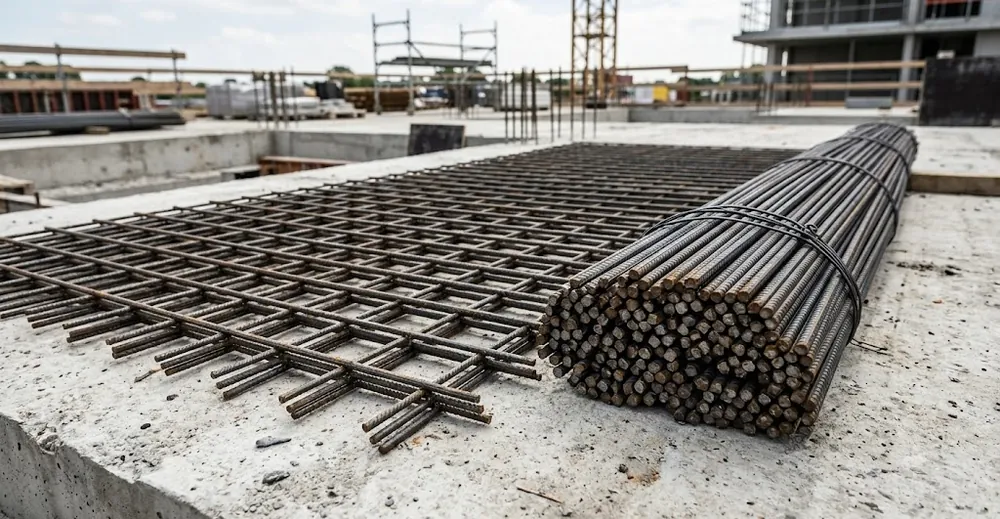
Concrete reinforcing mesh, also called welded wire reinforcement or welded mesh reinforcement, is a factory-made grid of steel wires joined at every intersection by electric resistance welding. In North America the product is governed by ASTM A1064, the standard specification for carbon-steel wire and welded wire reinforcement, plain and deformed, for concrete. That standard sets the wire properties, weld shear strength, and dimensional tolerances.
Because the spacing is fixed at the factory, mesh arrives ready to place. A common example is a sheet with wires every 6 inches in both directions, designated something like 6x6 W2.9xW2.9 in the older imperial style, where the W number gives the cross-sectional area of each wire. Sheets and rolls both exist. Sheets stay flatter and are easier to position; rolls cover ground quickly on long pours but want de-coiling time to relax.
The appeal is uniformity. Every intersection is welded, every opening is the same size, and the steel percentage across a slab is predictable. That consistency is hard to match by hand-tying loose bars, and it is the core reason mesh dominates slab-on-ground work.
What is rebar and where does it win?
Rebar, short for reinforcing bar, is deformed steel bar sold in discrete diameters and cut lengths. In imperial sizing a #4 bar is nominally 1/2 inch in diameter, a #5 is 5/8 inch, and so on up through heavy #11 and larger bars used in serious structural work. Rebar is placed bar by bar, tied at intersections with wire, and can be bent into stirrups, hooks, and complex cages.
Rebar wins wherever loads concentrate. Beams carry bending forces that pull hard on the bottom face at midspan and the top face over supports, and you want large-diameter bars placed precisely to answer those forces. Columns need vertical bars wrapped in ties to handle compression and buckling. Footings, pile caps, retaining walls, and suspended structural slabs all rely on rebar because an engineer can specify an exact bar size, count, and position for each load path.
You simply cannot get a #8 bar's cross-section out of a sheet of light mesh. When the design calls for heavy steel in a defined location, rebar is the tool.
Reinforcing mesh vs rebar: the head-to-head comparison
The clearest way to weigh reinforcing mesh vs rebar is side by side. Neither product is universally better; each is optimised for a different job. Mesh trades placement flexibility for speed and consistency, while rebar trades speed for structural range and precision. The table below is the summary we hand buyers when they are deciding.
| Factor | Reinforcing mesh | Rebar |
|---|---|---|
| Best use | Flat slabs, pavements, screeds, toppings | Beams, columns, footings, walls, heavy slabs |
| Placement | Fast, sheets or rolls dropped in | Slower, bar-by-bar tying |
| Spacing consistency | Factory-fixed, uniform | Depends on crew workmanship |
| Steel range | Light to medium wire areas | Small to very heavy bars |
| Bending/shaping | Limited, mostly flat | Highly flexible, cages and stirrups |
| Labour cost | Lower on wide areas | Higher, skilled tying |
| Lap detailing | By overlapping squares | Engineered lap lengths per bar |
| Waste | Some offcuts on odd shapes | Less on custom-cut orders |
How much labour and time does each one save?
Labour is where mesh earns its keep on flat work. A crew can roll or drop full sheets across a slab and tie only at the laps, covering large areas in a fraction of the time it takes to place and tie an equivalent grid of loose bars. Every welded intersection in a mesh sheet is a joint you did not have to tie by hand on site, and on a big pour that adds up to real hours.
Rebar asks more of the crew. Each bar is positioned, spaced, and tied, and skilled steel fixers are neither cheap nor always available. That effort buys precision you often need in structural members, but it is effort all the same. For a residential slab or a warehouse floor, spending that labour on hand-tied bars rarely pays back.
Our practical read: if the design allows mesh, mesh usually wins the schedule. If the design demands rebar, budget for the placement time and the skilled labour rather than fighting it.
Which gives more consistent spacing and cover?
Consistency favours mesh, and it matters more than many buyers expect. Cracking in slabs is driven partly by how evenly the steel is distributed, and factory-welded mesh guarantees the same opening size across the whole sheet. Hand-placed bars drift. A tired crew at the end of a shift leaves gaps and bunching that a mesh sheet never will.
That said, consistent spacing is only half the job. The steel has to sit at the correct depth in the slab, and mesh dumped on the ground and pulled up during the pour is a chronic failure we see in the field. Use chairs, bar supports, and spacers so the mesh or the bars stay where the engineer put them. Good welded wire mesh placed flat on proper supports gives cover you can trust; the same mesh trampled into the subgrade does nothing.
What about cost and lap rules?
On material alone, mesh and rebar prices track the underlying steel market closely, so neither is dramatically cheaper per kilogram. The real cost difference lives in labour and waste. Mesh cuts placement labour on wide flat areas but generates offcuts on irregular shapes, since you trim rectangular sheets to fit odd corners. Rebar cut to order wastes little but costs more to fix in place.
Lap rules differ in character. With mesh you overlap sheets by a set number of squares, commonly at least one full mesh opening plus an allowance, so that welded cross-wires engage across the joint. With rebar, lap lengths are engineered from bar diameter, concrete strength, and bar position, and can run many bar diameters long. Always follow the project drawings and the governing code for laps; the generic principle is that the splice must transfer the full force between overlapping steel.
A simple decision guide
Use this quick logic when you are stuck on mesh or rebar for a slab or structure. It is not a substitute for an engineer's design, but it reflects how most jobs actually sort out.
Choose mesh when
Choose mesh for flat slabs-on-ground, driveways, footpaths, industrial floors, and concrete toppings where the steel job is crack control and even distribution across a wide area. If the surface is broad and the loads are spread rather than concentrated, mesh is faster, more consistent, and lighter on labour.
Choose rebar when
Choose rebar for beams, columns, footings, pile caps, retaining walls, and suspended structural slabs, or anywhere the engineer specifies a defined bar size in a defined position. When loads concentrate and steel must be shaped into stirrups or cages, rebar is the only real answer.
Use both when
Use both on the very common jobs that mix flat and structural elements. A slab may carry mesh across the field while rebar reinforces its edges, thickenings, and integral beams. A raft foundation often combines a mesh mat with heavy bar bands under column loads. Combining the two lets each product do what it does best.
Frequently asked questions
Can reinforcing mesh replace rebar in a slab?
Often yes for slab-on-ground where the job is crack control, but not always. Light and medium mesh handles distributed loads across flat surfaces well. Where the slab carries concentrated loads, spans between supports, or acts structurally, an engineer will call for rebar, sometimes in addition to mesh. Follow the structural drawings rather than swapping products yourself.
Is welded mesh reinforcement stronger than rebar?
Neither is inherently stronger; they use similar steel. The difference is form and placement. Rebar comes in far larger diameters and can be positioned exactly where forces concentrate, so it carries structural loads mesh cannot. Mesh spreads a moderate amount of steel evenly and quickly. Strength depends on matching the product to the load, not on the product alone.
How much should mesh sheets overlap?
Mesh sheets are lapped so the welded cross-wires engage across the joint, commonly at least one full mesh square plus an allowance, though the exact figure comes from your project specification and governing code. Never butt sheets edge to edge without a lap. A proper overlap lets the steel transfer force continuously across the joint.
What standard covers concrete reinforcing mesh?
In North America, welded wire reinforcement is specified under ASTM A1064, which covers carbon-steel wire and welded wire reinforcement, both plain and deformed, for concrete. It defines wire strength, weld shear values, and dimensional tolerances. Rebar follows separate standards such as the ASTM A615 and A706 families. Always confirm which standards your project drawings reference.
Does mesh or rebar cost less overall?
Per kilogram, both track steel prices closely, so material cost is similar. Mesh usually wins on total installed cost for wide flat slabs because it cuts placement labour sharply. Rebar can be more economical where custom-cut bars reduce waste and the design genuinely needs heavy, shaped steel. The cheapest option is the one that suits the job without over-specifying.
Still weighing mesh or rebar for your next pour? Send us the drawings or a rough scope and we will help you spec the right steel, sheet sizes, and quantities. Request a quote and our team will follow up with options built for your project.
