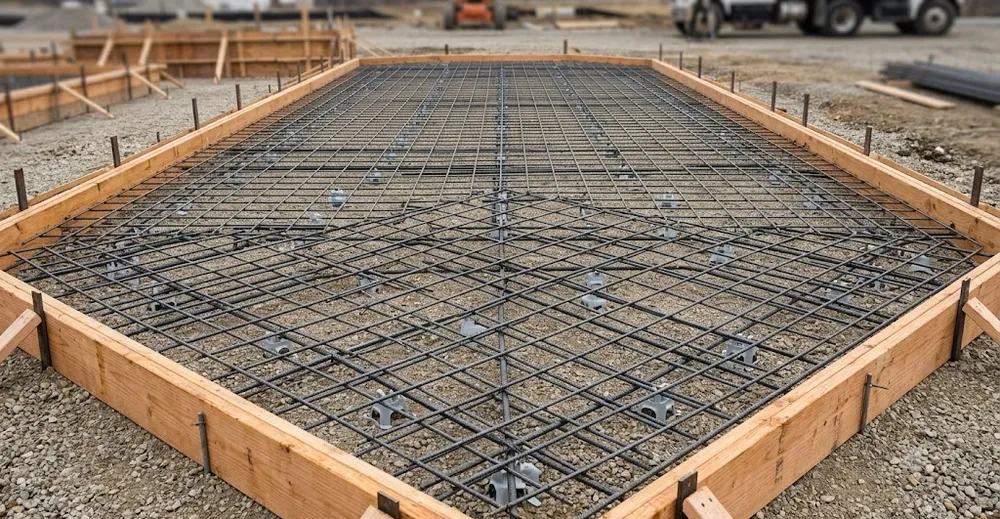
What does concrete slab reinforcement actually do?
Concrete is strong in compression and weak in tension. A plain slab can carry heavy downward loads, but it cracks and separates the moment it is stretched or bent. Reinforcement adds tensile strength where concrete has almost none. That is the whole idea.
There are two separate goals people often confuse. The first is crack control: keeping the small shrinkage and thermal cracks that every slab develops tight and evenly spread, rather than wide and random. The second is structural capacity: letting the slab span, cantilever, or carry concentrated loads without failing. Mesh and fiber lean toward the first goal. Rebar is the tool for the second. Getting the two goals mixed up is the most common mistake we see in inquiries.
We should say this clearly up front: nothing below replaces a structural engineer. Bar size, spacing, cover, and slab thickness for any load-bearing element are design decisions. Our job is to explain the materials so you can talk to your engineer and specify the right product.
How does welded wire mesh reinforce a slab?
Welded wire mesh is a grid of steel wires resistance-welded at every intersection. Laid flat inside the slab, it ties the concrete together across a wide plane and holds shrinkage cracks tight and evenly distributed. It is the standard choice for flatwork: driveways, floors, footpaths, and industrial ground slabs.
Mesh shines because it covers the entire slab area at once. Instead of controlling cracks along a few lines, it spreads that control across the whole surface. The welded intersections keep the grid rigid during the pour, so spacing stays consistent instead of drifting. For most flat, ground-supported slabs where the goal is crack management rather than spanning a load, welded wire mesh is the workhorse.
Sheet mesh versus rolled mesh
Sheet mesh comes in flat panels and stays flat, which makes it easier to place at the correct height and keep there. Rolled mesh ships in coils and suits long, narrow runs, but it wants to spring back to its curled shape and needs more effort to flatten. For quality-critical floor slabs, flat sheets are usually the cleaner option.
Getting the position right
Mesh only works if it sits at the right depth. Left lying on the subgrade, it does almost nothing, because it ends up on the tension face only by accident and often stays at the bottom where the top of the slab needs it. It must be lifted into the slab and held there through the pour. That is a placement issue, not a material issue, and we return to it below.
When is rebar the right choice for a slab?
Rebar, or reinforcing bar, is deformed steel bar sized and spaced to carry calculated tensile and bending forces. It is the reinforcement you specify when a slab must do structural work: support a building, span between beams or piles, resist heavy point loads, or form a foundation. Where mesh manages cracking, rebar provides real load capacity.
The difference is a matter of engineering intent. Rebar comes in a range of diameters and grades, so a designer can place exactly the steel area a load path demands, in the exact location the bending moment requires. That control is why footings, ground beams, suspended slabs, and heavily loaded industrial floors are detailed with rebar rather than light mesh. The bars are tied into cages or mats, lapped to code, and given proper concrete cover for durability and fire resistance.
Rebar is not automatically "better" than mesh. It is heavier, slower to fix, and overkill for a simple garage floor. The right question is not which is stronger but which matches the job. A driveway does not need a rebar mat, and a loaded foundation should never rely on light mesh alone.
Is fiber-reinforced concrete a real substitute?
Fiber-reinforced concrete mixes short strands, steel or synthetic, directly into the wet mix so they disperse in three dimensions throughout the slab. Fibers are excellent at controlling early plastic and shrinkage cracking, because they act everywhere in the matrix at once. As a supplement, fiber is genuinely useful. As a full replacement for structural steel, it is not.
Here is where we push back on some marketing. Fiber does a great job on micro-cracking and can reduce surface crazing, and for some lightly loaded slabs on well-prepared ground a fiber dose may be specified in place of light mesh. But fiber does not provide the concentrated, directional tensile capacity that a bending slab needs. It cannot be placed on the tension face where a designer wants steel, because it floats everywhere and nowhere in particular. Treat fiber as crack-control insurance and a complement to mesh or rebar, not as a structural swap for them.
Two more practical notes. Steel fibers can leave stray strands at the surface that need finishing attention. Synthetic macro-fibers avoid that but behave differently under load. Whichever type, the dose rate should come from the mix designer or engineer, not from a rule of thumb.
Crack control versus structural capacity: what is the difference?
Every slab cracks; the goal is controlling how. Concrete shrinks as it cures and moves with temperature, and those forces exceed its tiny tensile strength. Reinforcement does not stop cracks forming. It keeps them narrow, tight, and distributed instead of wide and unsightly. That is crack control, and it is a serviceability and durability concern.
Structural capacity is a different animal. It is about whether the slab can safely carry the loads placed on it without excessive deflection or failure. This is governed by design calculations, slab thickness, and the amount and position of steel. Light mesh contributes little here; rebar sized by an engineer is what does the work. Confusing the two, assuming a mesh sheet makes a slab "structural," is how slabs get under-built. Keep the goals separate and choose the reinforcement that serves the one you actually need.
Why does positioning on chairs matter so much?
Reinforcement placed at the wrong height barely reinforces at all. Steel only resists tension if it sits where the tension is, usually near the top for a ground slab controlling shrinkage, or on the calculated tension face for a structural member. Supports called chairs and bar chairs lift the steel off the subgrade and hold it at the specified depth through the entire pour.
This is where many otherwise good slabs go wrong. Crews lay mesh on the ground, pour over it, and assume it works. It does not, because it stays at the bottom and provides little control at the surface where shrinkage cracks open. Proper rebar chairs and mesh supports, spaced closely enough that the steel does not sag between them, keep the reinforcement at the correct height and give the slab the cover it needs for durability. Hooking mesh up with a rake mid-pour is not a substitute; the height ends up uneven and unreliable.
We make this point in almost every technical conversation because it is the single cheapest way to protect an expensive slab. Good steel in the wrong place performs like no steel at all.
How do you choose? A slab reinforcement decision guide
The choice follows the job, not fashion. Start by asking what the slab must do, then match the method to that duty. The table below sums up how we generally see these materials used. Treat it as orientation for a conversation with your engineer, not as a design.
| Method | Best for | Main strength | Watch-outs |
|---|---|---|---|
| Welded wire mesh | Flat ground-supported slabs, driveways, floors, footpaths | Even crack control across the whole slab area | Must be lifted onto chairs; needs correct sheet placement |
| Rebar | Foundations, footings, suspended and heavily loaded slabs | Concentrated, directional structural load capacity | Heavier and slower to fix; requires engineered detailing |
| Fiber | Supplementing mesh or rebar; reducing shrinkage crazing | Distributes micro-cracking throughout the matrix | Not a structural replacement; dose set by mix designer |
A few plain rules of thumb we stand behind. For a simple flat slab on good ground where you mainly want tidy crack control, mesh on chairs is the usual answer. For anything that carries a building, spans, or takes heavy concentrated loads, rebar detailed by an engineer is non-negotiable. Fiber earns its place as a supplement, tightening up early shrinkage cracking on top of whatever primary steel the design calls for. And whichever you pick, position is everything: budget for supports, not just steel.
If you are sourcing materials and want to sanity-check quantities, spacing, or product form before you buy, we are happy to help you specify. You can always request a quote and send us your drawings.
Frequently asked questions
Can I use welded wire mesh instead of rebar in a slab?
Sometimes, but only for crack control, not for structural load. Mesh keeps shrinkage cracks tight across a flat, ground-supported slab. It cannot replace engineered rebar in a foundation, footing, or suspended slab that must carry calculated loads. Match the reinforcement to the slab's job, and let your engineer confirm.
Does fiber-reinforced concrete eliminate the need for mesh?
Not usually. Fiber controls early plastic and shrinkage micro-cracking throughout the mix, which is valuable, but it does not provide the concentrated tensile capacity mesh or rebar give a bending slab. Some lightly loaded slabs may specify fiber in place of light mesh, but that is a design call. Treat fiber as a supplement.
Where should reinforcement sit inside a concrete slab?
At the height your design specifies, held there by chairs, not lying on the subgrade. For a typical ground slab controlling shrinkage, steel usually sits in the upper portion; for structural members it goes on the calculated tension face. Steel resting on the ground provides almost no benefit, so support spacing matters as much as the steel itself.
Do I really need chairs and supports?
Yes. Chairs lift mesh and rebar to the correct depth and hold that position through the pour, giving both crack control and proper concrete cover. Without them, reinforcement ends up at the bottom of the slab and performs poorly. Supports are inexpensive compared with the slab, and skipping them is a false economy we see too often.
Which reinforcement is best for a driveway or garage floor?
For most driveways and garage floors on well-prepared ground, welded wire mesh on chairs handles crack control well. Fiber can be added to reduce surface crazing. Rebar is generally unnecessary unless the slab carries unusually heavy vehicles or spans poor ground, in which case an engineer should specify the steel.
Talk to us before you buy
Choosing between mesh, rebar, and fiber gets far simpler once the slab's real duty is clear. We supply construction wire, welded mesh, and rebar supports to buyers across North America and Europe, and we are glad to help you match product and spacing to your drawings. Send your details and request a quote, and we will point you to the right products for the job.
