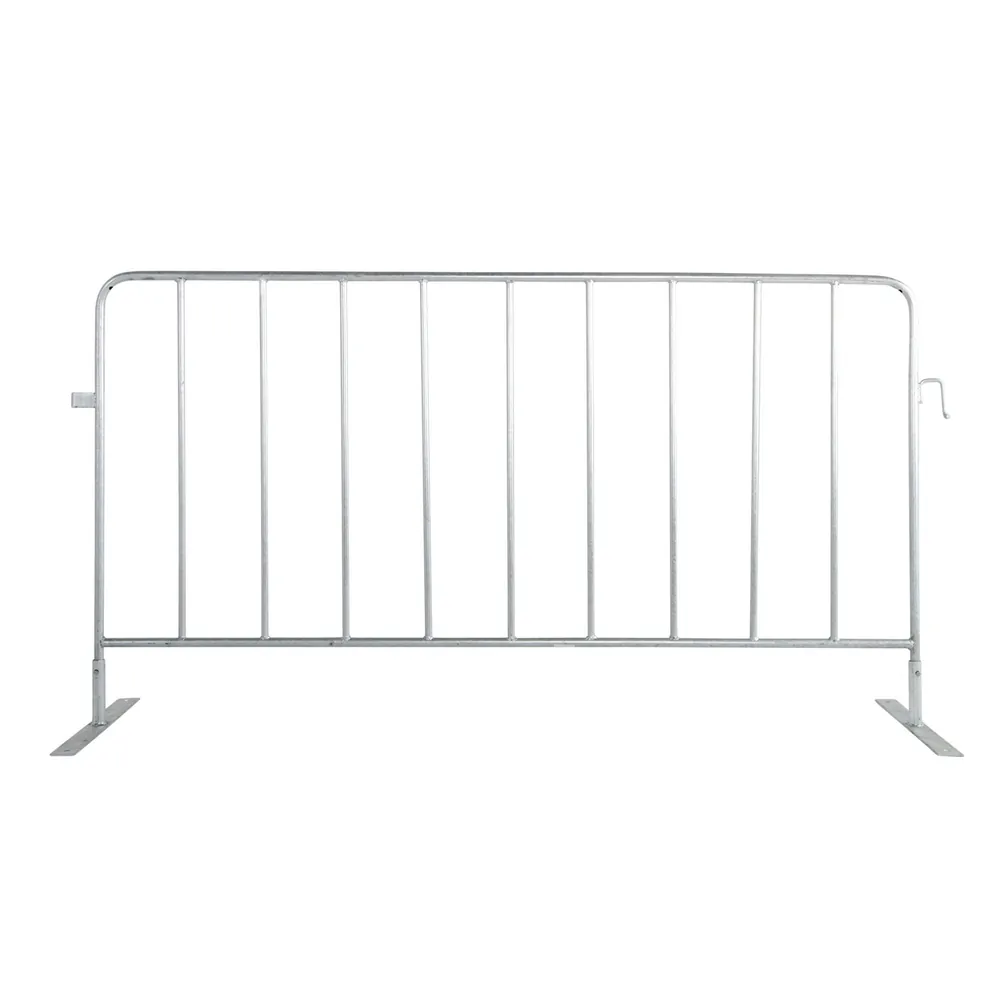
We are Hebei Leeter Import and Export Co., Ltd ("Leeter"), a construction wire, mesh and fencing manufacturer in Dingzhou, Hebei, China, exporting since 2006 to buyers across North America and Europe. Below are the working specs we quote to importers, distributors and event-rental buyers ordering by the container.
Standard crowd control barrier dimensions
| Spec | Metric | Imperial | Notes |
|---|---|---|---|
| Height | 1.1m | 43 in | Standard pedestrian height |
| Length | 2.0–2.5m | 6.6–8.2 ft | 2.0m and 2.15m are the most common |
| Top rail tube | 38–42mm | 1.5–1.65 in | Round or oval hollow section |
| Vertical bar tube | 16–19mm | 0.63–0.75 in | Typically 14–17 verticals |
| Frame wall thickness | 1.2–2.0mm | 0.05–0.08 in | Heavier gauge for rental durability |
| Weight (each) | 15–22 kg | 33–48 lb | Varies with gauge and feet |
| Foot type | Flat or bridge | Flat or bridge | Bridge feet allow pedestrian pass-through |
Dimensions are typical export specs and can be adjusted to your market. UK and European buyers often specify a 2.0m or 2.3m length, while North American event and municipal buyers frequently order the 8ft (2.44m) barricade.
What a crowd control barrier is made of
The frame is welded hollow-section steel tube, then hot-dip galvanized (HDG) so it resists rust through years of outdoor storage and repeated deployment. Galvanizing is the norm for rental and municipal use because barriers live outside between events. Powder-coat colours (safety yellow, orange, blue) can be applied over the zinc for branding or high-visibility crowd management.
The infill is a row of vertical bars welded between a top and bottom rail. This open design lets crowds and stewards see through the line, reduces wind load, and keeps each barrier light enough for one person to lift and carry.
Interlocking ends and feet
The defining feature is the hook-and-eye end: one end has looped hooks, the other has eyes, so barriers link end to end into a continuous run without tools. The interlock also lets a line flex around corners and be pulled apart quickly for emergency egress, which is why event and stadium buyers prefer it.
Feet come in two styles:
- Flat feet: a simple flat bar base, lowest cost and most compact for stacking and shipping.
- Bridge feet: an inverted-U base that lifts the bottom rail so pedestrians and cleaning equipment can pass, and so linked barriers stand more stably on uneven ground.
Bridge-foot barriers stack and nest slightly less densely than flat-foot units, which matters when you are counting pieces per container.
Use cases and how to order
Crowd control barriers handle pedestrian queue management, event perimeters, parade and marathon routes, construction pass-bys and temporary traffic control. Because they are a high-turnover rental and municipal item, buyers usually order in full-container wholesale lots and value consistent weld quality and galvanizing over the lowest unit price.
When you request a quote, specify length, height, tube diameters, wall thickness, foot type and finish. Ask for the per-unit weight and a container stuffing count, since the interlocking ends and feet determine how tightly barriers nest and therefore your landed cost per piece.
Frequently asked questions
What are the dimensions of a crowd control barrier?
The standard pedestrian crowd control barrier is about 1.1m (43 in) high and 2.0 to 2.5m (6.6 to 8.2 ft) long. The 2.0m and 8ft (2.44m) lengths are the most widely ordered. Top rails are typically 38 to 42mm tube with 16 to 19mm vertical bars.
How much does a crowd control barrier weigh?
A typical steel-tube crowd control barrier weighs about 15 to 22 kg (33 to 48 lb) each. Weight rises with heavier tube gauge, longer 8ft frames and bridge feet, and falls with lighter-gauge event-grade specs. Ask your supplier for the exact per-unit weight before booking freight.
What is a crowd control barrier made of?
It is made of welded hollow-section steel tube, hot-dip galvanized for corrosion resistance, with a vertical-bar infill and interlocking hook-and-eye ends. An optional powder-coat finish adds colour or high-visibility branding over the zinc coating.
What is the difference between flat feet and bridge feet?
Flat feet are a simple flat base that is cheapest and packs most densely for shipping. Bridge feet form an inverted-U that raises the bottom rail so pedestrians can step through and the line stands more stably on uneven ground. Bridge feet nest slightly less tightly in the container.
