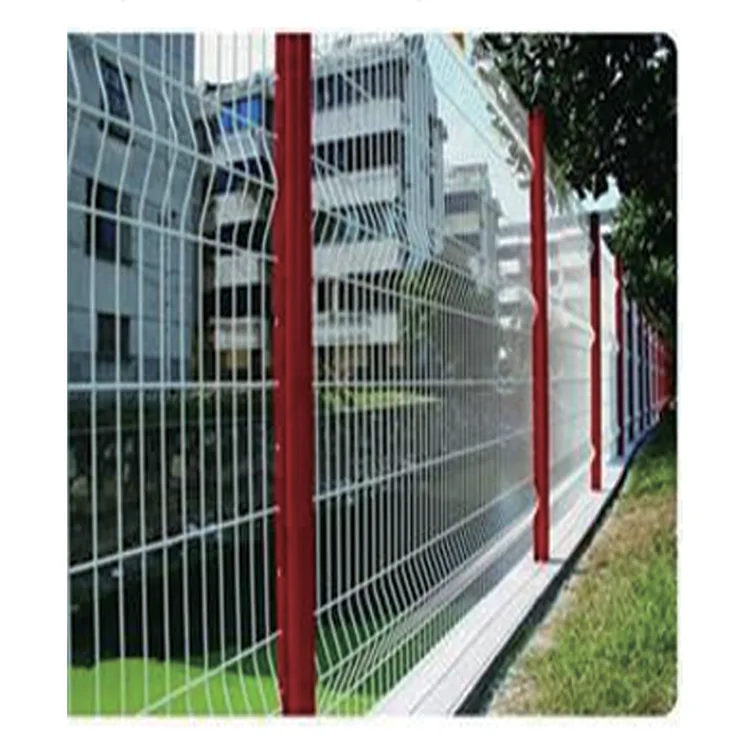
We are Hebei Leeter Import and Export Co., Ltd ("Leeter"), a welded-mesh and fencing manufacturer in Dingzhou, Hebei, China. We produce high-security welded fence panels and perimeter systems for export, so the specifications below are how we quote a critical-infrastructure job — including the coating and topping details that inspectors check.
358 anti-climb welded mesh
"358" is the mesh geometry: 3 in × 0.5 in × 8 gauge, which is 76.2 mm × 12.7 mm × 4.0 mm. The narrow 12.7 mm horizontal aperture is the whole point — a finger will not fit, so there is no toehold to climb, and the gap is too tight to insert bolt cutters or wire cutters onto a wire. Each intersection is resistance-welded for a rigid panel that does not flex like chain link.
| 358 mesh spec | Options |
|---|---|
| Mesh aperture | 3 in × 0.5 in (76.2 mm × 12.7 mm) |
| Wire diameter | 8 ga (4.0 mm) standard; 6 ga (4.88 mm) heavy; 10 ga (3.25 mm) light |
| Typical heights | 3.0–3.6 m (commercial, utilities); up to 5.2 m (prison, military) |
| Finish | Hot-dip galvanized, or galvanized + polyester powder coat |
| Topping | Razor concertina or barbed wire on extension arms |
358 is the choice when you want a screen that a camera or a taut-wire detection system can see through, and that is genuinely hard to climb or cut. It suits data-center compounds, substations, airports, water and telecom sites.
Steel palisade
Palisade is a line of vertical steel pales bolted to two or three horizontal rails, with spiked tops. It resists attack through the thickness of the steel rather than a small aperture, and the pointed top deters scaling. In the UK it is specified to BS 1722 Part 12, which fixes the post, rail, pale gauge and galvanizing.
| Palisade spec | Options |
|---|---|
| Pale profile | W-section (2–3 mm) or D-section (3–4 mm; heavier, more secure) |
| Top | Triple-point, single-point, rounded or notched |
| Rails | 2 rails to ~1.8 m; 3 rails above |
| Typical heights | 1.8–3.0 m |
| Finish | Hot-dip galvanized to BS 1722-12, optional powder coat |
Palisade is chosen where a heavier, more visually deterrent barrier is wanted and see-through detection is less important — utility depots, industrial estates and secure yards.
358 vs palisade — which to specify
| 358 anti-climb mesh | Steel palisade | |
|---|---|---|
| Barrier principle | Tiny aperture — no foothold, no cutter access | Thick spiked pales resist cut and impact |
| Visibility / detection | High (see-through, camera friendly) | Lower (vertical bars) |
| Anti-climb | Excellent (no toehold) | Good (spiked top, but pales give some grip) |
| Look | Clean industrial screen | Heavy, imposing |
| Best for | Data centers, substations, airports | Depots, industrial yards, utilities |
For most modern data-center and substation work we see 358 specified because it pairs cleanly with cameras and detection; palisade still wins where the client wants a visibly aggressive barrier. Either way, add a razor or barbed-wire topping and confirm the coating for the site's climate — see our razor wire profiles guide for the topping and the welded wire mesh buying guide for panel and coating detail.
What to put on the purchase order
A clean high-security perimeter spec states: the system (358 mesh or palisade), the panel or pale dimensions and gauge, the height, the post size and spacing, the coating (hot-dip galvanized and/or powder-coat colour), the topping (razor/barbed on extension arms), and any project standard. We supply mill and coating certificates and match the fixings; we do not certify to programme-specific anti-terrorism schemes, so where a project requires a named certification we will tell you up front what we can and cannot document.
Frequently asked questions
What is 358 anti-climb fencing?
358 fencing is a welded steel mesh panel with a 3 in × 0.5 in aperture (76.2 mm × 12.7 mm) in 8-gauge (4.0 mm) wire. The openings are too small for a finger to grip or for bolt cutters to reach the wire, so the panel is very difficult to climb or cut. It is used for high-security perimeters at data centers, prisons, airports, substations and utilities, usually hot-dip galvanized and often powder-coated.
Which is more secure, 358 mesh or palisade?
Both are high-security systems that defeat casual climbing and cutting. 358 mesh resists attack through its tiny aperture and gives clear see-through visibility for cameras and detection, which is why data centers and substations often prefer it. Palisade resists attack through thick spiked pales and looks more imposing, which suits industrial yards and depots. The "more secure" choice depends on whether visibility/detection or a heavy visual barrier matters more for the site.
How tall should a data center perimeter fence be?
Commercial and utility perimeters are commonly 3.0–3.6 m, and higher-security sites go up to about 5.2 m, usually with a razor or barbed-wire topping on extension arms. The final height and topping are driven by the client's security assessment and any insurer or regulator requirements for the site.
What coating should critical-infrastructure fencing have?
Hot-dip galvanizing is the baseline so the steel survives decades outdoors; a polyester powder-coat is added over the zinc for colour and extra corrosion life in wet or coastal environments. State the climate and the required colour and coating grade on the order, and ask for coating certificates with the shipment.
