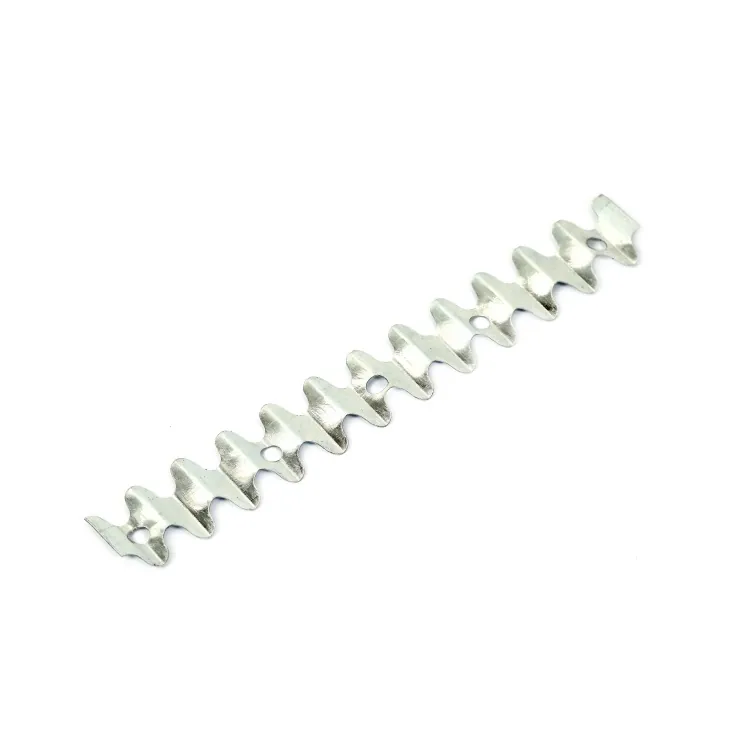
That single idea, a slot cast into the concrete rather than a hole drilled into it, is what makes the dovetail system different from almost every other tie on the market. As a manufacturer supplying wire, mesh, and masonry accessories to builders across North America and Europe since 2006, we at Hebei Leeter Import and Export Co., Ltd ("Leeter") get more questions about dovetail anchors than almost any other connector we ship. This guide answers them.
What a dovetail slot and anchor system actually is
A dovetail system has two parts that work together: a galvanized or stainless steel slot embedded in the concrete, and a flat metal anchor whose head is folded into a shape that matches the slot's tapered profile. The slot is named for its cross-section, which flares wider at the back like a carpenter's dovetail joint. The anchor's head cannot pull straight out because the taper mechanically locks it inside the channel.
The slot ships as a length of formed sheet metal, usually 24 gauge to 26 gauge, with a foam or paper filler strip that keeps wet concrete out of the channel during the pour. It nails to the inside face of the formwork. When the forms come off, the installer scrapes out the filler and the open keyway is exposed.
The anchor itself is a separate flat strip, commonly called a dovetail brick tie or dovetail flat tie. One end folds into a triangular or square tab that drops into the slot; the other end runs out into the mortar bed joint of the brick veneer. Some versions are corrugated for extra mortar grip, and some pair with a wire tie or a triangle tie for adjustable two-piece assemblies.
The parts you order together
Because the slot and the anchor are separate products, they are usually quoted and shipped separately. A complete job needs three things:
- Dovetail slot in the required length and gauge, with filler installed
- Dovetail anchors sized to reach through the air cavity into the veneer
- End caps or closures where slots meet openings, if the specification calls for them
Getting the pairing right matters. A slot and an anchor from different profiles will not lock, so it is worth confirming the head geometry before you place a full-building order.
How does the vertical adjustment work?
Vertical adjustment is the defining advantage of the dovetail masonry anchor. Because the slot is continuous, the anchor can be positioned at any height along it. Masonry and concrete never rise at the same rate or land on the same coursing, so the mason simply drops an anchor into the slot at whatever elevation the next bed joint reaches. There is no need to pre-plan fastener locations to match brick courses.
This solves a real coordination problem. Brick courses are typically laid at roughly 2-5/8 inches per course plus a mortar joint, while a concrete wall is a single monolithic pour with no coursing at all. A drilled-in anchor forces the installer to place a fastener exactly where a bed joint will fall, which means measuring and marking every location. The dovetail slot removes that constraint. The mason lays brick, reaches a bed joint, slides in an anchor, and moves on.
Horizontal spacing still follows the specification and the applicable code, commonly one anchor per a defined area of wall with maximum vertical and horizontal spacing limits. The dovetail system does not change those spacing rules; it only removes the vertical alignment headache within them.
The continuous slot also tolerates thermal and structural movement. Because the anchor grips the slot by shape rather than by a rigid bolt, small differential movements between the veneer and the backing are accommodated within the joint. That flexibility is one reason dovetail anchors have stayed in continuous use on cast concrete backing for decades.
Where dovetail anchors beat post-installed ties
Dovetail anchors win whenever the backing is cast-in-place concrete and the schedule allows the slot to be set before the pour. Their biggest edge is that they never require drilling into cured concrete, which protects rebar, avoids blowouts near edges, and eliminates the dust and noise of post-installed anchoring. On a tall wall with hundreds of tie points, that time saving adds up quickly.
Post-installed ties, meaning expansion anchors or screw anchors drilled after the concrete cures, have their place. They are the right call when the concrete is already standing, when a retrofit is under way, or when nobody set slots during construction. But they carry trade-offs the dovetail system avoids.
| Factor | Dovetail slot anchor | Post-installed drilled tie |
|---|---|---|
| Backing preparation | Slot cast into forms before pour | Drill hole after concrete cures |
| Vertical adjustment | Continuous along the slot | Fixed at each drilled hole |
| Rebar risk | None; nothing is drilled | Possible strike on reinforcement |
| Dust and noise | Minimal | Significant during drilling |
| Retrofit suitability | Poor; requires pre-planning | Good; works on existing walls |
| Coordination needed | Slot layout before pour | Layout matched to brick courses |
The honest summary: choose dovetail anchors on new cast concrete when you control the pour, and choose post-installed ties for existing structures or when slots were never installed. Neither is universally better. The decision follows the construction sequence.
A note on concrete masonry unit backing
Dovetail slots are made for solid cast concrete, not hollow concrete masonry units. If your backing is CMU block, the dovetail slot has nothing solid to embed into, and you should specify a different tie such as a masonry veneer anchor or an adjustable two-piece tie designed for block. Matching the anchor to the backing material is the first decision, before slot versus drilled ever comes up.
Materials and finishes
Corrosion resistance drives material choice, because a tie that fails inside a wall cannot be replaced without tearing down brick. Dovetail slots and anchors are supplied in three common material classes: hot-dip galvanized steel, mill galvanized steel, and stainless steel. The right one depends on exposure, local code, and the design life the project demands.
Hot-dip galvanized steel is the workhorse for most exterior brick veneer over concrete. The zinc coating is applied after the part is formed, so cut edges and folds are covered. Specifications often call for a minimum coating weight, and heavier coatings buy more service life in humid or coastal air.
Mill galvanized, sometimes called pre-galvanized, uses steel coated before forming. It is lighter and lower cost but leaves cut edges bare, so it suits drier interior or protected conditions rather than aggressive exposure.
Stainless steel, typically Type 304 or the more corrosion-resistant Type 316, is specified where the design life is long, the environment is severe, or the architect requires it. Type 316 with its molybdenum content is the usual pick for coastal and de-icing-salt exposures. It costs more up front but effectively removes corrosion from the list of failure modes.
A practical rule we share with buyers: match the anchor material to the most corrosive condition the wall will see over its life, not the average. The few dollars of difference per tie are trivial next to the cost of opening a veneer to replace a rusted anchor. If you are unsure which grade fits your climate, request a quote and describe the exposure so the material can be matched to it.
How are dovetail anchors installed?
Installation happens in two stages separated by the concrete pour, and getting the first stage right is what makes the second stage easy. The slot goes in with the formwork; the anchors go in with the brick. Miss the slot stage, and the whole advantage of the system is lost.
Stage one: setting the slot
Before the concrete is placed, the slot is nailed to the inside face of the form at the required horizontal spacing. Slots run vertically, spaced across the wall so that every future tie point falls within reach of one. The filler strip stays in place to keep the channel clear. Where slots meet the top or bottom of a pour, they are held back or capped so concrete does not flood the open ends.
Alignment and plumb matter here. A slot set out of plumb still works, but a badly skewed layout can leave veneer areas too far from any slot. Snapping vertical lines on the form before nailing keeps the spacing honest.
Stage two: placing the anchors
After the forms strip and the filler is cleaned out, brickwork begins. As each bed joint reaches a slot, the mason inserts an anchor head into the channel, gives it a quarter turn or a downward set depending on the head style, and beds the outer leg in fresh mortar. The anchor should sit level or slope slightly down toward the outer veneer so water is not carried inward. The mortar joint then locks the outer end in place as it cures.
Common installation faults are worth naming: anchors sloped toward the backing, ties skipped because a slot was buried under form residue, and anchors bedded in joints too thin to hold them. Each is avoidable with a quick visual check as the wall goes up. A tie that is level, fully seated in the slot, and fully embedded in mortar will do its job for the life of the wall.
Frequently asked questions
What is a dovetail masonry anchor used for?
A dovetail masonry anchor connects a brick or stone veneer to a cast-in-place concrete backing. Its folded head locks into a dovetail slot embedded in the concrete, and its outer leg beds into a mortar joint, tying the veneer back to the structure while allowing vertical adjustment.
Can dovetail slots be used with concrete block backing?
No. Dovetail slots need solid cast concrete to embed into during the pour. Hollow concrete masonry units cannot hold a slot securely, so block backing calls for a different connector such as an adjustable masonry veneer anchor designed for CMU rather than a cast-in dovetail system.
How much vertical adjustment does a dovetail anchor allow?
The anchor adjusts continuously along the full length of the slot. There are no fixed holes, so a mason can seat an anchor at any elevation where a brick bed joint lands. This is the main reason the system coordinates so easily with brickwork that rises on its own coursing.
What material should I specify for exterior walls?
Hot-dip galvanized steel suits most exterior brick veneer over concrete. For coastal air, de-icing salt exposure, or long design life, specify stainless steel, with Type 316 preferred in the harshest conditions. Match the grade to the most corrosive condition the wall will face, not the average.
Are dovetail anchors better than drilled-in ties?
On new cast concrete where you control the pour, yes, because they avoid drilling, protect rebar, and adjust vertically without pre-planning. For existing walls or when slots were never set, drilled post-installed ties are the practical choice. The construction sequence decides which system fits.
Talk to a manufacturer before you specify
Dovetail anchors are simple in concept and unforgiving in the details, from slot gauge to anchor head geometry to finish. Getting the pairing and the material right the first time keeps a veneer standing for decades. Browse our brick wall ties range to see the dovetail slots and anchors we stock, and when you know your backing type and exposure, request a quote with those details so we can match the right system to your wall.
