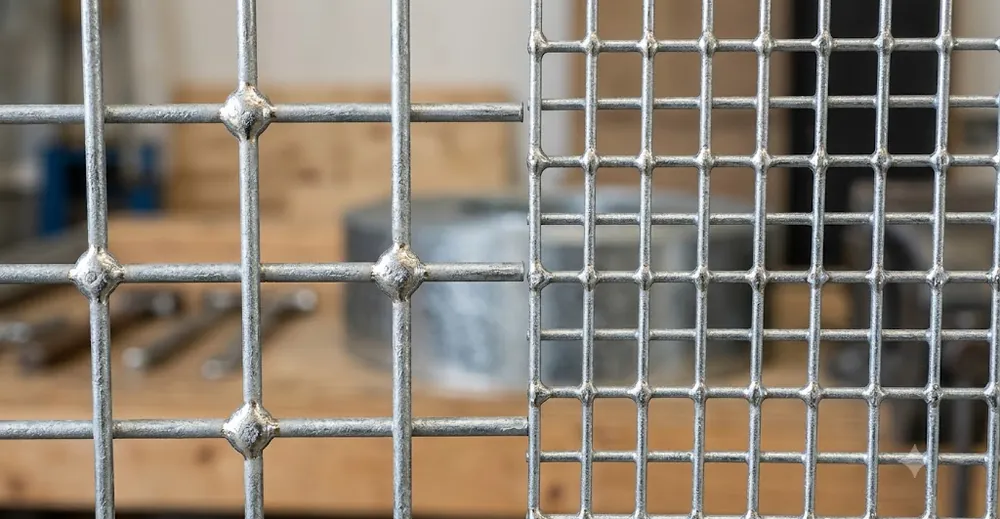
Both processes start with the same steel wire and the same welding machines. What changes is the order of operations. Galvanized before welding uses pre-coated wire and welds it into a grid. Galvanized after welding welds bare wire first, then dips the finished panel or roll into molten zinc. The order sounds like a small detail. In corrosion terms, it is the whole story.
What does galvanized before welding (GBW) actually mean?
Galvanized before welding means the zinc coating goes on the wire first, and the mesh is welded afterward. The wire is usually electro-galvanized or pre-hot-dip galvanized, with a coating weight commonly between 10 and 90 g/m². It is the cheaper, faster route, and it is the default for most indoor and short-life products.
Here is the catch we always flag to buyers. Welding uses heat, and heat vaporizes zinc. At every point where two wires cross and fuse, the coating burns away and leaves bare steel exposed. On a GBW panel, those weld nodes are the first places to rust. You will often see a fine grid of orange dots appear on old GBW mesh long before the wire itself fails.
GBW still has real strengths. The finish is smooth and uniform on the wire runs, the panels are lightweight, and the dimensional accuracy is excellent because nothing shrinks or drips after welding. For crafts, cages, indoor partitions, machine guards, and light garden work, it is a sensible and economical choice.
Where GBW mesh performs well
GBW earns its place in dry or protected settings. Think indoor storage cages, retail fixtures, redistribution shelving, filter frames, and decorative panels that never see rain. In these jobs the bare weld nodes never get wet enough to corrode meaningfully, so the lower price wins.
We also recommend GBW when the part will be painted or powder-coated afterward. A top coat covers the exposed nodes, so paying extra for a hot-dip bath adds little value. The pre-galvanized surface gives paint a clean, consistent base to grip.
What does galvanized after welding (GAW) mean?
Galvanized after welding means the mesh is welded from bare steel wire, then the whole panel or roll is submerged in a molten zinc bath at roughly 450 degrees Celsius. The zinc coats every surface, including the weld joints, so there are no bare spots. Coating weights are far heavier, commonly 200 to 460 g/m² and higher on thick wire.
That total coverage is why GAW lasts longer. The zinc forms a metallurgical bond with the steel and seals the exact weld nodes that fail first on GBW mesh. Even the cut ends and the inner faces of the joints get protected. For any panel that lives outdoors or in a damp, salty, or industrial atmosphere, this is the finish that pays for itself.
GAW does carry trade-offs, and we are upfront about them. The hot-dip process adds cost, both for the zinc and the extra handling. The finish is rougher, with a spangled or matte gray look and occasional zinc runs or small nodules at the joints. Very fine wire can also get slightly stiffened or bridged by zinc buildup, so GAW suits medium and heavy gauges better than delicate light mesh.
Where GAW mesh performs well
GAW is the workhorse for outdoor and structural jobs. Agricultural fencing, gabions, animal enclosures, concrete reinforcement mesh, marine and coastal barriers, and infrastructure gratings all benefit from the sealed joints. Anywhere rain, humidity, soil contact, or road salt is in play, GAW is the safer specification.
We also point contractors toward GAW when replacement is expensive or disruptive. If a panel is buried, embedded in concrete, or mounted somewhere hard to reach, the longer service life removes future call-backs. Paying more once beats digging it up twice.
GBW vs GAW: how do the two processes compare?
The core GBW vs GAW difference is joint protection: GBW leaves weld nodes bare, GAW seals them with a heavy zinc layer that typically runs 200 to 460 g/m² versus the 10 to 90 g/m² common on GBW wire. That gap in coating weight, plus full joint coverage, is why GAW commonly delivers several times the outdoor corrosion life. The table below lays out the practical differences we walk customers through.
| Factor | Galvanized Before Welding (GBW) | Galvanized After Welding (GAW) |
|---|---|---|
| Process order | Zinc first, then weld | Weld first, then hot-dip zinc |
| Weld joint protection | Bare steel, zinc burned off | Fully sealed by zinc bath |
| Typical coating weight | ~10 to 90 g/m² | ~200 to 460 g/m² and up |
| Corrosion life outdoors | Shorter; nodes rust first | Longer; joints protected |
| Appearance | Smooth, bright, uniform | Rougher, spangled, possible runs |
| Dimensional accuracy | Very high | Slight variation from zinc buildup |
| Best gauge range | Fine to medium wire | Medium to heavy wire |
| Relative cost | Lower | Higher |
| Best environment | Indoor, dry, protected | Outdoor, humid, coastal, buried |
Read the table as a decision map, not a scorecard. GBW is not a lower-quality product. It is a different tool for a different job. The wrong choice is buying GBW for a coastal fence, or overpaying for GAW on an indoor display rack.
How much longer does GAW really last?
There is no single multiplier, because service life depends on coating weight and environment, not just the process. As a rule of thumb, zinc corrodes at a fairly predictable rate for a given atmosphere, so more zinc means proportionally more years. A GAW coating several times heavier than a GBW coating will, all else equal, last several times longer before red rust appears.
The joint effect compounds this. On GBW mesh, failure usually starts at the bare weld nodes rather than the wire body, so the panel can look sound while the joints quietly weaken. GAW removes that weak point entirely. In our experience with agricultural and marine orders, this is the difference between a fence that needs replacing in a handful of years and one that stays serviceable for a decade or more.
Which one should you buy for your project?
Choose based on environment and expected service life first, then budget. If the mesh lives outdoors, near the coast, in soil, or in a wash-down area, specify galvanized after welding for the sealed joints and heavier coating. If it stays indoors, dry, or gets painted afterward, galvanized before welding delivers the same job for less money.
A few honest guidelines we give buyers:
- Pick GAW for fencing, gabions, concrete reinforcement, livestock, and any buried or embedded panel.
- Pick GBW for cages, shelving, guards, crafts, filters, and decorative indoor work.
- If corrosion life and total cost of ownership matter more than upfront price, lean GAW.
- If dimensional precision and a bright smooth finish matter most, lean GBW.
- If the part will be powder-coated, GBW plus paint is usually enough.
Coating weight is the number that actually drives longevity, so put it in your specification. Do not just ask for "galvanized" mesh. State the process (GBW or GAW), the wire gauge, the aperture, and the target zinc coating in g/m². That single line removes almost every dispute we ever see between buyer expectation and delivered product.
One more manufacturer tip. Ask your supplier what standard the coating is tested against and request the actual coating weight on the batch, not a marketing range. Reputable mills, ourselves included, will share it. If a supplier cannot tell you the g/m², treat the corrosion claims with caution.
You can see full specifications for both finishes on our welded wire mesh page, and our team is happy to match the process to your climate and service life.
Frequently asked questions
Is galvanized after welding always better than galvanized before welding?
No. GAW resists corrosion longer because the zinc bath seals every weld joint, but it costs more, looks rougher, and can bridge very fine apertures. For dry indoor use, painted parts, or precision light mesh, GBW is often the smarter, cheaper choice. Match the process to the environment, not to a ranking.
Why do galvanized before welding panels rust at the joints first?
Welding heat vaporizes the zinc coating exactly where two pre-galvanized wires fuse together. That leaves bare steel at every weld node while the wire runs stay coated. Once moisture reaches those exposed nodes, they corrode before the rest of the panel, which is why old GBW mesh shows a grid of rust dots.
What zinc coating weight should I specify?
State it in g/m² for your climate. Indoor GBW mesh often runs 10 to 90 g/m², while outdoor GAW mesh commonly runs 200 to 460 g/m² or higher on heavier wire. More coastal salt or humidity means you should specify more zinc. Always ask the mill for the actual measured coating on your batch.
Can I paint or powder-coat galvanized mesh?
Yes, and it changes the economics. A top coat covers the bare weld nodes on GBW mesh, so pairing GBW with paint or powder often matches GAW protection for indoor and semi-protected uses at lower cost. GAW can also be painted, though its rougher surface may need light preparation for a clean finish.
Which is better for coastal or marine use?
Galvanized after welding, without question. Salt air attacks bare steel fast, and the exposed weld nodes on GBW mesh become failure points within a short time. The heavy, fully sealed GAW coating protects the joints and gives the panel a realistic service life in that harsh environment. Hot-dip galvanized after welding is the standard specification there.
Talk to us before you order
Still unsure whether GBW or GAW fits your project, climate, and budget? Tell us the environment, the wire gauge, the aperture, and the service life you need, and we will recommend the right process and coating weight. Request a quote and our team will help you get galvanized mesh that lasts as long as your application demands.
