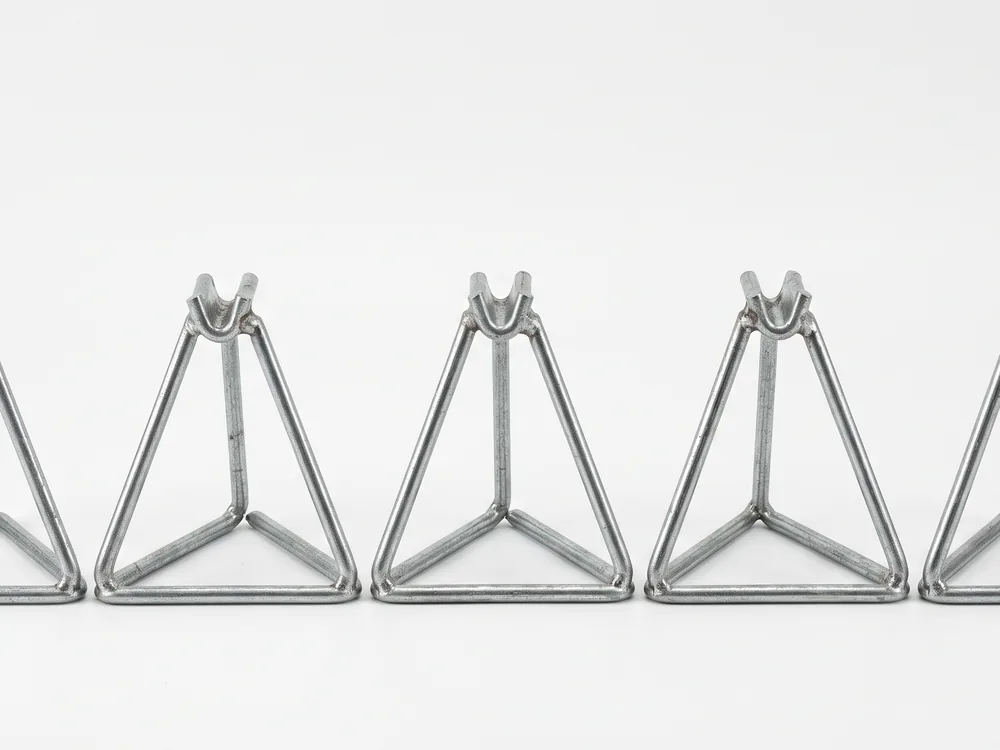
Here is the short answer. Plain (bright) wire chairs are the economical choice when the support is fully buried in dry, dense concrete far from the surface. Galvanized chairs resist corrosion and are the safer pick for exposed faces, humid or coastal sites, and jobs that use epoxy-coated or galvanized reinforcement. At Hebei Leeter Import and Export Co., Ltd ("Leeter"), a Dingzhou, Hebei manufacturer supplying North America and Europe since 2006, we help contractors match the finish to the exposure rather than guessing.
This guide walks through the finish options, where each fits, the trade-off between price and service life, and where a plastic-tipped chair earns its place.
Why the finish on a wire bar chair matters
A wire rebar chairs product is a small steel frame, but it sits inside the same concrete that protects your reinforcement. The concrete cover is what keeps steel from rusting. When cover is generous and the concrete stays dry and dense, a plain steel leg is well protected and rarely a problem.
Trouble starts when the support sits close to a surface that stays wet, gets splashed with de-icing salt, or lives in a coastal, chloride-rich environment. Water and chloride ions travel through concrete over years. If they reach a bare steel leg, that leg can corrode. Corroding steel expands, and that expansion cracks the surrounding concrete. A rust stain bleeding through a finished slab or wall usually traces back to a bar support or tie wire sitting too near the face.
So the finish question is really an exposure question. How wet will this concrete get, how much salt is around, and how close does the chair leg sit to a surface that people will see or that weather will hit?
What are the main rebar chair finish options?
There are three finishes contractors ask about most: plain bright wire, galvanized wire, and plastic-tipped or fully plastic supports. Each answers the corrosion question in a different way, and each has a clear home on the jobsite.
Plain (bright) wire chairs
Plain wire chairs are drawn steel with no protective coating. They are the lightest-cost option and ship in high volume. The bright steel is strong, holds height reliably, and ties in fast. For interior slabs, footings, and thick foundation elements where the chair is buried deep in dry concrete, plain wire performs well for the life of the pour.
The limitation is exposure. Bare steel offers no corrosion barrier of its own. It relies entirely on the surrounding concrete for protection. Put a plain leg near a wet or salted surface and you invite rust staining and localized cracking.
Galvanized wire chairs
Galvanized rebar chairs carry a zinc coating that shields the steel underneath. Zinc corrodes sacrificially, meaning it gives itself up before the steel does, and it also forms a physical barrier against moisture and chlorides. That buys real time in aggressive conditions. Galvanized chairs are the standard choice for architectural concrete, bridge decks, parking structures, marine and coastal work, and any element where a rust stain would be a visible or durability defect.
Hot-dip galvanizing gives a thicker, more rugged coating and suits harsh exposure. Electro-galvanizing gives a thinner, cleaner coating for milder conditions and tighter cost control. We match the coating type to how tough the environment really is.
Plastic-tipped and all-plastic supports
A plastic rebar chairs option removes bare steel from the surface entirely. Plastic-tipped wire chairs cap the leg feet with plastic so no steel touches the form face. All-plastic supports go further and eliminate metal at the contact point completely. Both are common where owners want zero risk of rust bleed on an exposed face and where the load is moderate.
How do plain, galvanized, and plastic supports compare?
The table below sums up the practical differences. Treat it as a starting point, then confirm against your project specification and local exposure class.
| Factor | Plain wire chair | Galvanized rebar chair | Plastic-tipped / plastic |
|---|---|---|---|
| Corrosion resistance | Low, relies on cover | High, zinc barrier | High at the surface contact point |
| Best exposure | Dry, buried, interior | Humid, coastal, chloride, exposed | Exposed faces, moderate load |
| Rust-stain risk on face | Present if near surface | Greatly reduced | Removed at the tip |
| Relative unit cost | Lowest | Moderate | Low to moderate |
| Load capacity | High | High | Varies by design |
| Pairs with coated bar | Not ideal | Yes | Yes |
| Typical use | Footings, thick slabs | Bridge decks, parking, architectural | Architectural, wet interiors |
Notice that load capacity is strong for both wire types. The finish does not weaken the chair. What changes is how the support survives moisture over decades and whether it can stain the surface it touches.
When should you choose plain wire over galvanized?
Choose a plain wire bar chair when the support is fully encased in dry, well-consolidated concrete and sits well away from any exposed surface. Interior floor slabs on grade, deep footings, pile caps, and mass foundation pours are typical homes for plain wire. In these elements the cover is thick, the concrete stays dry, and the chair simply does its structural job unseen.
Cost is the honest driver here. Plain wire is the least expensive finish, and on a large pour with thousands of supports, the savings add up. When exposure is genuinely low, paying for galvanizing adds cost without adding value. Good engineering means matching the finish to the risk, not over-specifying every support on the site.
A second reason to pick plain wire is compatibility. If the project uses ordinary black reinforcing bar with generous cover, a plain support is a consistent match. Problems appear only when someone reaches for plain wire on a job that actually needs corrosion protection.
When are galvanized rebar chairs the right call?
Reach for galvanized rebar chairs whenever the concrete will see moisture, salt, or an exposed face. Bridge decks and approach slabs endure de-icing chemicals every winter. Parking garages take chloride-laden drips from vehicles. Coastal and marine structures live in salt spray. Architectural walls, precast panels, and polished floors show every blemish, so a rust stain is unacceptable. In all of these, the zinc coating pays for itself by protecting the surface and extending service life.
There is also a systems argument. If the reinforcement itself is epoxy-coated or galvanized, the owner has already invested in corrosion protection. Pairing coated bar with bare plain chairs undermines that investment, because the untreated support becomes the weak link. Galvanized or plastic-tipped supports keep the whole assembly consistent. Many specifications for corrosion-sensitive structures require it.
If you are unsure which exposure class applies, describe the environment and cover to us and we will recommend a finish. You can request a quote with your drawings and we will spec the support to the condition.
Cost versus service life: how to think about the trade-off
The finish decision is a cost-versus-consequence calculation. Plain wire has the lowest unit price. Galvanized carries a coating premium. Plastic-tipped sits in between depending on design. The unit price gap looks large on a spreadsheet, yet the support is one of the cheapest items in the entire reinforcement package.
Weigh that small premium against the cost of failure. Repairing a chloride-induced rust stain means grinding, patching, and sometimes partial demolition of a finished surface. On a bridge deck or parking structure, corrosion repairs run into serious money and downtime over the structure's life. Spending a little more per chair to avoid that outcome is usually the sensible trade, and it is why durability-focused specifications lean toward galvanized in aggressive settings.
The reverse is also true. Over-specifying galvanized on a dry interior footing wastes money with no durability gain. The goal is to spend where corrosion risk is real and save where it is not. Match the finish to the exposure and both budget and durability come out ahead.
Practical selection tips from the field
Start with the exposure class in your project specification, because that document already reflects the local corrosion risk. Next, check how close the support sits to any exposed or wet surface. The nearer the leg is to the face, the more the finish matters. Then confirm what reinforcement the job uses, since coated bar calls for a matching support.
Also think about handling and storage. Galvanized chairs tolerate outdoor storage and damp yards better than bright wire, which can surface-rust before it is even placed. On long projects with material sitting in the elements, that resilience is a quiet advantage.
Finally, remember that a single project can mix finishes. Plain wire in the buried footings, galvanized on the exposed deck, and plastic-tipped along the architectural face is a perfectly reasonable plan. You are not locked into one finish for the whole job.
Frequently asked questions
Are galvanized rebar chairs worth the extra cost?
In dry, deeply buried concrete, usually not, because plain wire is protected by the cover and costs less. In humid, coastal, chloride-exposed, or architectural conditions, galvanized rebar chairs are worth it. The coating premium is small next to the cost of repairing rust stains or corrosion damage in a finished structure.
Can plain wire chairs cause rust stains on a concrete surface?
Yes, when a plain leg sits close to a surface that stays wet or gets salted. Moisture and chlorides can reach the bare steel, which corrodes and bleeds a rust stain through the face. Keep plain wire deep in dry concrete, and use galvanized or plastic-tipped supports near exposed surfaces.
Do galvanized chairs weaken over time?
The zinc coating corrodes sacrificially, protecting the steel first and forming a moisture barrier. In aggressive exposure the coating is consumed gradually, so a thicker hot-dip layer lasts longer than a thin electro-galvanized one. Match the coating type to how harsh the environment is, and the support outlasts the concrete's critical early years.
Should I use galvanized chairs with epoxy-coated rebar?
Yes. If the reinforcement is epoxy-coated or galvanized, the owner has paid for corrosion protection, and a bare plain support becomes the weak link. Galvanized or plastic-tipped chairs keep the whole assembly consistent. Many corrosion-sensitive specifications require the supports to match the protection level of the bar.
What is the difference between plastic-tipped and fully plastic supports?
Plastic-tipped wire chairs cap the leg feet so no steel touches the form face, while keeping a strong steel frame for load. Fully plastic supports remove metal entirely at the contact point. Both prevent rust bleed on exposed faces. Choose tipped for higher load and full plastic for the strictest no-metal surface requirements.
Get the right finish for your project
The finish on a bar chair is a small line item with a long tail. Choose plain wire where concrete stays dry and buried, choose galvanized rebar chairs where moisture, salt, or exposed faces raise the corrosion risk, and reach for plastic-tipped supports where a visible surface must stay stain-free. Match the finish to the exposure and you protect both the budget and the structure.
Leeter manufactures plain, galvanized, and plastic-tipped rebar supports for contractors across North America and Europe. Send us your drawings, exposure class, and cover requirements, and we will recommend the finish that fits. Request a quote and we will help you spec supports that hold height and resist corrosion for the life of the pour.
