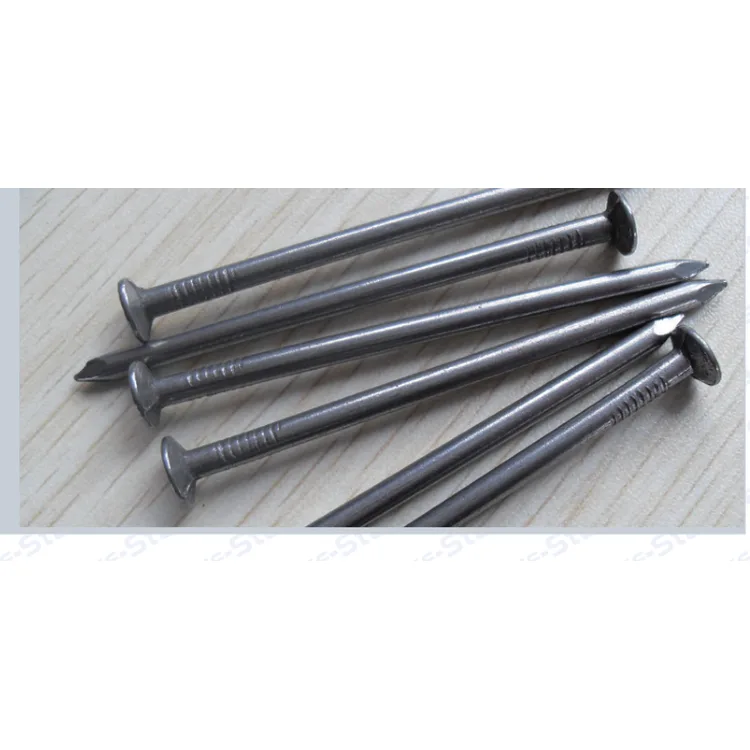
We are Hebei Leeter Import and Export Co., Ltd ("Leeter"), a construction wire and fastener manufacturer in Dingzhou, Hebei, China, exporting since 2006 to North America and Europe. Collated construction nails for pallet and crate lines are a core export item, and the tables below are the spec sheets we use when packaging plants and pallet builders size an order.
Shank type: how the hold is made
The shank is the single most important pallet-nail decision because it sets withdrawal resistance — the force needed to pull the nail back out under a loaded, flexing pallet. Smooth-shank nails rely on friction alone; deformed shanks (ring and screw) mechanically lock into the wood fibres so a joint survives forklift racking, drop impact and repeated stacking.
| Shank type | Withdrawal hold | Drive speed | Best timber | Typical use |
|---|---|---|---|---|
| Ring / annular | Highest | Slower | Softwood and mixed | Deck-to-stringer joints, export pallets, reusable/pool pallets |
| Screw / spiral | High | Fastest | Dense hardwood | Oak/eucalyptus block pallets, hardwood crates |
| Smooth | Lowest | Fast | Dry softwood | One-way/disposable pallets, crating, low-cost lines |
Ring shank is the default when a pallet must be reused or shipped internationally, because the annular rings resist the pull-out that loosens a pallet over its service life. Screw shank spins in as it drives, cutting through hard, dense timber where a ring nail would slow the machine or bend. Smooth shank belongs on single-trip pallets where cost per nail matters more than long-term hold.
Sizes, diameters and gauges
Pallet nailers run a narrow, standardised size window so machine magazines and drivers stay compatible. Length is matched to timber thickness — long enough to reach through the deckboard into the stringer or block without blowing out the far face.
| Length | Diameter | Approx. gauge (BWG) | Typical joint |
|---|---|---|---|
| 1-1/2" (38mm) | 0.099"–0.105" | 11 ga | Thin deckboards, top caps |
| 2" (50mm) | 0.099"–0.113" | 11–10 ga | Standard deck-to-stringer |
| 2-1/4"–2-3/8" (57–60mm) | 0.113"–0.120" | 10 ga | GMA/48x40 stringer pallets |
| 2-1/2" (65mm) | 0.120"–0.131" | 10–9 ga | Heavy stringer, block pallets |
| 3"–3-1/2" (75–90mm) | 0.120"–0.135" | 9 ga | Thick blocks, heavy-duty crates |
Collation matters as much as the nail: coil nails feed high-volume automatic machines (thousands per coil, fewer reloads), while stick (strip) nails suit smaller nailers and repair work. Specify the collation type and angle your machine accepts — plastic-collated, paper-tape or wire-weld coil — because the wrong collation will not load.
Points: chisel vs blunt
The point controls splitting, and splitting is the main quality complaint on pallet lines. A standard chisel (diamond) point drives fast and is fine on green or soft timber. A blunt point sacrifices a little drive speed but crushes its way through the fibres instead of wedging them apart, so it dramatically reduces splitting near board ends and in dry, brittle hardwood. For block pallets and any nailing close to the edge of a deckboard, a blunt-point ring or screw nail is the safe specification.
MIBANT, bend angle and hardness
Pallet-nail quality is measured by the MIBANT (Morgan Impact Bend Angle Nail Tester) test, the standard used by the pallet industry and referenced in NWPCA and ASTM F1667 work. A weighted pendulum strikes a nail held in a fixture, and the resulting bend angle grades the steel: a higher MIBANT bend angle means a tougher, more ductile nail that bends rather than snaps under impact. Nails are specified to a MIBANT angle band matched to the timber hardness — too soft and the nail bends over instead of driving; too hard and it shatters in dense hardwood. Leeter supplies pallet nails to a stated MIBANT range with mill test reports (MTR) and hardness data, so buyers can match the steel to their timber and machine.
Finish: bright, EG or coated
Most pallet nails are bright (plain steel) because pallets live indoors and cost rules. Where the pallet sees moisture, cold storage or export humidity, electro-galvanised (EG) adds a thin zinc layer for rust delay. Adhesive/resin-coated nails are common on smooth and screw shanks: the coating heats on drive-in, then re-sets to bond the nail to the wood and add withdrawal hold — a cheaper route to grip than a full ring shank on softwood. Choose bright for standard indoor pallets, EG for damp or export service, and coated where you want extra hold without paying for annular rings.
Stringer vs block pallets
Pallet construction drives the spec. Stringer pallets (three solid or notched runners, the classic 48x40 GMA design) take 2 to 2-3/8 inch ring-shank nails through the deckboard into softwood stringers, usually blunt-point to protect the board ends. Block pallets (nine feet/blocks, often denser hardwood, the ISO/EUR style) need more drive power and hold: 2-1/2 to 3-1/2 inch screw-shank nails handle the dense blocks, and blunt points are essential to stop the hard timber splitting. Match length to your deckboard-plus-stringer or deckboard-plus-block stack, pick ring for softwood and screw for hardwood, and confirm the diameter your machine drives cleanly. As the manufacturer we draw, collate and point to the ordered spec, hold hardness to the MIBANT band, and ship from ~1 pallet up to full 20-foot containers, mixed lines allowed.
Frequently asked questions
What size nails are used for pallets?
Pallet nails typically run 1-1/2 to 3-1/2 inches (38 to 90mm) in 0.099 to 0.135 inch diameters, roughly 11 to 9 gauge. Standard 48x40 stringer pallets use 2 to 2-3/8 inch nails through the deckboard into the stringer, while heavier block pallets use 2-1/2 to 3-1/2 inch nails. Match length to the combined deckboard and stringer or block thickness.
Are ring shank or screw shank nails better for pallets?
Ring (annular) shank nails give the highest withdrawal resistance and are best for softwood, reusable and export pallets. Screw (spiral) shank nails drive fastest and hold well in dense hardwood block pallets. Ring shank is the default for softwood pallets that must be reused; screw shank is the choice for hard, dense timber where a ring nail would slow the machine.
Why do pallet nails have blunt points?
A blunt point crushes wood fibres as it drives instead of wedging them apart like a sharp chisel point, which sharply reduces splitting near board ends and in dry or hardwood timber. Blunt-point pallet nails are standard for block pallets and for nailing close to a deckboard edge, where splitting is the main quality problem. Chisel points drive faster and suit green softwood.
What is MIBANT for pallet nails?
MIBANT (Morgan Impact Bend Angle Nail Tester) measures a pallet nail's toughness by striking it with a weighted pendulum and reading the bend angle. A higher MIBANT angle means tougher, more ductile steel that bends under impact rather than snapping. Pallet nails are specified to a MIBANT band matched to timber hardness so they drive straight without bending over or shattering.
Can I get collated pallet nails in coils and sticks?
Yes. Collated construction nails for pallets come in wire-weld coils for high-volume automatic nailers and in plastic or paper-tape stick strips for smaller machines and repair work. Specify the collation type and angle your nailer accepts, since coil and stick magazines are not interchangeable. Leeter supplies bright, electro-galvanised and coated finishes in ring, screw and smooth shank.
