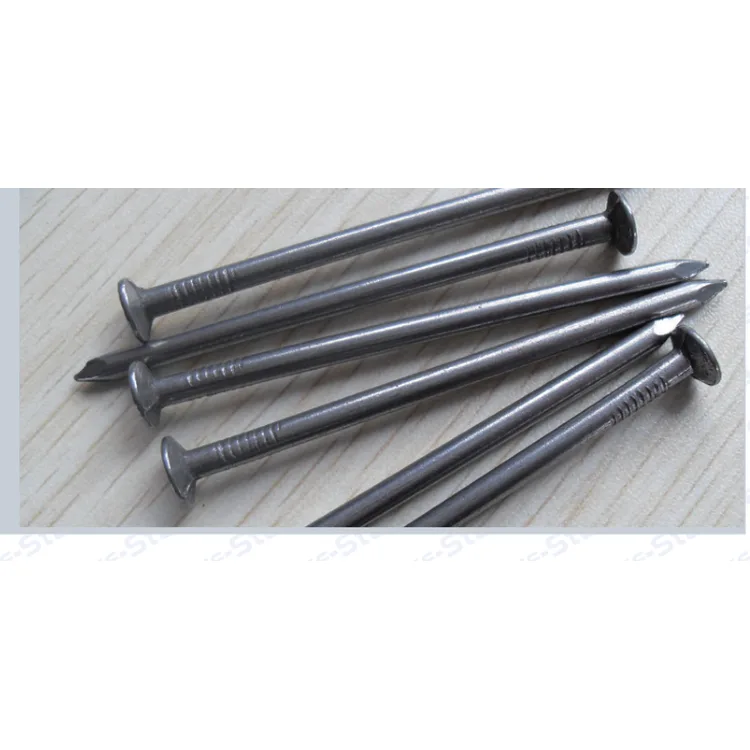
We are Hebei Leeter Import and Export Co., Ltd ("Leeter"), a construction wire, mesh and fastener manufacturer in Dingzhou, Hebei, China, exporting since 2006 to buyers across North America and Europe. Construction nails are a founding line, and the table below is the map we use when hardware importers and roofing distributors build a roofing-nail order.
Match the nail to the roof type
| Roof / deck type | Nail family | Length | Head / shank | Finish |
|---|---|---|---|---|
| Asphalt shingles on wood deck | Coil roofing nail | 3/4"–1-3/4" (19–44mm) | 10–11mm flat head, smooth or ring shank | EG or HDG |
| High-wind shingle zones | Ring-shank coil nail | 1-1/4"–2" (32–50mm) | 10–11mm flat head, ring shank | HDG |
| Corrugated steel sheet | Umbrella / dome-head nail | 2"–3" (50–75mm) | Dome head + EPDM washer, twisted shank | HDG |
| Fibre-cement sheet | Umbrella / dome-head nail | 1-3/4"–2-1/2" (44–63mm) | Dome head + washer, plain shank | HDG or SS |
| Coastal / marine (any deck) | Coil or umbrella | as above | ring or twisted shank | Stainless 304/316 |
| Underlayment / felt | Cap nail or short coil | 3/4"–1" (19–25mm) | Wide plastic/metal cap | EG |
Coil roofing nails for asphalt shingles
Coil roofing nails are the volume item wherever roofs are shingled. They are short — 3/4 to 2 inches — and defined by a large flat head, 10 to 11mm in diameter, that seats the shingle without cutting through the mat. The shank is typically 11 to 12 gauge (2.5–3.0mm). Smooth shank is standard for normal exposure; a ring (annular) shank is specified where the roof sees wind, because the rings roughly double withdrawal resistance for a small price premium.
They ship wire-collated into 120-nail coils that feed pneumatic roofing guns (Bostitch, Hitachi, Max and their clones), so a crew drives thousands of nails an hour. The two spec numbers importers most often miss are head diameter — shingle manufacturers' warranties usually call for at least 3/8 inch (9.5mm) — and coil wire angle, which must match the gun. Confirm both against the buyer's gun and shingle brand before you produce.
Umbrella-head nails for metal and fibre-cement sheet
Umbrella- or dome-head roofing nails answer a different problem: fixing profiled sheet over open purlins. The nail must reach through the sheet crown into timber or a batten, so lengths jump to 1-3/4 to 3 inches. The domed head is the key feature — it caps the fixing hole and sheds water down the profile — and a twisted (helical) shank grips the batten against the flexing and thermal movement of a metal roof.
For a weatherproof seal, most sheet-roofing nails carry an EPDM-bonded washer: a stainless or galvanized cup crimped over a rubber gasket that compresses as the nail drives, sealing the hole. Fibre-cement sheet uses the same dome head, usually on a plain shank and a slightly shorter length, because the softer board does not need the aggressive grip that steel sheet demands. Offer both washered and plain versions — some markets still bed the fixing in mastic instead.
Ring and screw shank for wind uplift
Shank geometry decides how hard the nail is to pull back out, and on a roof that is the number that matters. A smooth shank holds by friction alone; a ring shank cuts annular grooves that the wood fibres spring back into; a screw (helical/twisted) shank threads itself in and resists both pull-out and vibration loosening.
- Smooth shank — general shingle work in sheltered, low-wind areas. Cheapest, fastest to drive.
- Ring shank — the default upgrade for shingles in hurricane and high-wind zones; many US building codes now require it near coasts.
- Screw / twisted shank — sheet roofing and battens, where thermal cycling would work a smooth nail loose over years.
Where a job specifies uplift performance, ring or screw shank plus a hot-dip or stainless finish is the combination that passes.
Choosing a finish: EG, HDG or stainless
| Finish | Corrosion protection | Where to use it |
|---|---|---|
| Electro-galvanized (EG) | Thin zinc — indoor/short exposure | Underlayment, felt, temporary and dry-climate work |
| Hot-dip galvanized (HDG) | Thick zinc, ~40–70µm | The standard for exterior shingle and sheet roofing |
| Stainless 304 | High, non-rusting | Coastal and salt-spray zones, cedar and premium roofs |
| Stainless 316 | Highest, marine-grade | Direct marine exposure, chloride-heavy air |
Roofing is an outdoor job, so bright nails have no place on the deck. Hot-dip galvanized is the working default — the thick zinc layer outlasts electro-galvanizing many times over. Within about 15 miles of salt water, or under warranty for cedar and slate, step up to stainless: 304 for most coastal work and 316 where salt spray hits the roof directly. Match the washer and any galvanized tie wire or accessories in the same container to the same class so the whole assembly weathers evenly.
Building a roofing-nail order
Roofing nails ship dense — coils in cartons on pallets, or bulk boxes of umbrella nails — so a mixed line item adds little freight. A typical container for a roofing distributor pairs coil nails in the fast 1-1/4 and 1-1/2 inch shingle lengths (EG and HDG, smooth and ring shank) with umbrella-head sheet nails in 2-1/2 and 3 inch, HDG, EPDM-washered. Specify each line as family, length, head diameter, shank, washer and finish, plus collation angle for coil nails and packing. As the manufacturer we draw, cut, head and collate to the ordered spec, hold the head diameter that shingle warranties demand, and supply mill test reports, AQL sampling and pre-shipment inspection on request.
Frequently asked questions
What size roofing nails do I need for asphalt shingles?
Asphalt shingles use coil roofing nails 3/4 to 2 inches long (19–50mm), sized so the nail penetrates at least 3/4 inch into the wood deck or fully through thin sheathing. Most three-tab and architectural shingles fix with 1-1/4 or 1-1/2 inch nails. The head should be at least 3/8 inch (9.5mm) across, and 11 to 12 gauge shank, to meet shingle-warranty requirements.
When should I use ring-shank instead of smooth-shank roofing nails?
Use ring-shank roofing nails in high-wind and hurricane zones, where their annular grooves roughly double withdrawal resistance and many building codes now require them. Smooth-shank nails are fine for sheltered, low-wind roofs and cost less. For metal and fibre-cement sheet, choose a twisted (screw) shank instead, which also resists the loosening caused by thermal movement.
What are umbrella-head roofing nails for?
Umbrella- or dome-head roofing nails fix corrugated metal and fibre-cement sheet to timber purlins or battens. Running 1-3/4 to 3 inches long, their domed head caps the fixing hole and sheds water, and an EPDM-bonded washer seals against leaks. A twisted shank grips the batten against the thermal movement of a metal roof. They are hand-driven or fired with a special nailer.
Do roofing nails need an EPDM washer?
Sheet-roofing nails for metal and fibre-cement usually carry an EPDM-bonded washer, which compresses as the nail drives and seals the hole against rain. Coil nails for asphalt shingles do not need a washer, because the overlapping shingle above covers each fixing. Leeter supplies umbrella-head nails both washered and plain, since some installers still bed the fixing in mastic instead.
Which roofing nail finish is best for coastal projects?
For coastal and marine roofs, stainless steel is the correct choice: grade 304 within roughly 15 miles of salt water, and grade 316 where salt spray hits the roof directly. Hot-dip galvanized nails are the standard everywhere else outdoors, but their zinc coating corrodes faster in chloride-heavy air. Match washers and any accessories in the same order to the same corrosion class.
