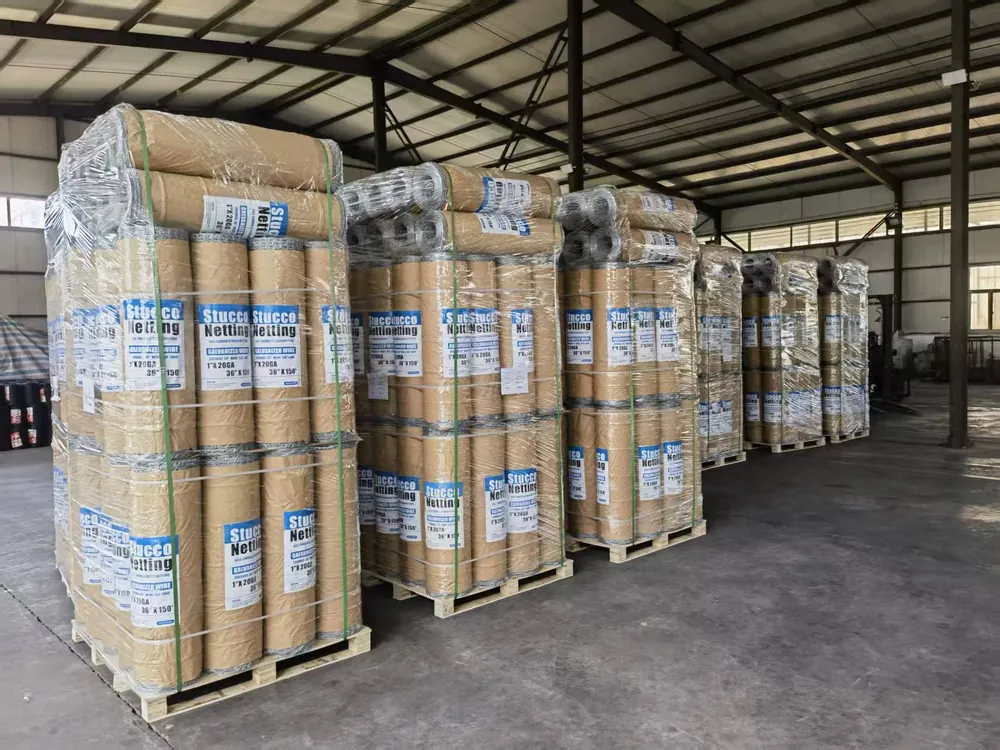
We are Hebei Leeter Import and Export Co., Ltd ("Leeter"), a construction wire and mesh manufacturer in Dingzhou, Hebei, China, exporting since 2006 to buyers across North America and Europe. This guide explains what self-furring means, why the furring depth matters, and how to specify self-furring lath for stucco and plaster work.
What is self-furring stucco lath?
Self-furring stucco lath is woven netting or metal lath that has integral dimples pressed into it at regular intervals. Those dimples act as tiny built-in spacers. When the lath is fastened to the wall, the dimples touch the substrate and hold the flat plane of the mesh a set distance away from it. The result is a continuous air gap behind the mesh that plaster fills.
The alternative is flat (non-furred) lath, which must be held off the substrate by separate furring devices such as furring nails, spacers, or self-furring fasteners. Self-furring lath builds the standoff into the product, which speeds installation and gives a consistent gap across the whole wall.
| Feature | Self-furring lath | Flat (non-furred) lath |
|---|---|---|
| Standoff | Built-in dimples | Requires separate furring devices |
| Furring depth | Consistent across sheet | Depends on installer and fasteners |
| Install speed | Faster, fewer parts | Slower, extra hardware |
| Best use | Over solid sheathing / WRB | Open framing where key forms between studs |
Why is self-furring lath used?
Self-furring lath is used because plaster only performs when it fully embeds the reinforcement and forms a key. ASTM C1063 requires that lath be embedded in the plaster, and on solid backing that only happens if the mesh is held off the surface. Push the lath flat against a sheathed, papered wall and the plaster stops at the front face of the wire. The back of the mesh stays dry and unbonded, the key never forms, and the plaster is prone to cracking and delamination.
The furring gap solves this. By lifting the mesh roughly 1/4 inch (6mm), plaster flows behind the wire, surrounds it, and hardens into an interlocking key that holds the coat to the wall. This is essential over continuous solid substrates:
- Over exterior sheathing (plywood, OSB, gypsum sheathing) with a water-resistive barrier (WRB).
- Over rigid foam insulation.
- Over concrete, masonry, or any surface where plaster cannot key between framing members.
On open framing, plaster can partially key between studs, but self-furring lath still improves embedment and consistency. Over solid backing, furring is not optional.
How far does self-furring lath stand off the wall?
The typical self-furring depth is about 1/4 inch (6mm), created by the height of the stamped dimples. That distance is a deliberate target: deep enough for plaster to pass fully behind the wire, but not so deep that the mesh ends up too close to the finished face of the scratch coat.
| Furring parameter | Typical value |
|---|---|
| Furring (standoff) depth | ~1/4 in (6mm) |
| Created by | Stamped dimples / crimps |
| Governing install standard | ASTM C1063 |
| Purpose | Full plaster embedment and mechanical key |
The point of embedment is that the wire ends up surrounded by plaster, not buried at the very back nor floating at the front. Correct furring depth positions the reinforcement inside the coat where it resists cracking. If the dimples are shallow or crushed during rough handling, the gap closes and the benefit is lost, which is why consistent, well-formed dimples are a real quality marker.
Gauges, finishes, and specifying self-furring lath
Self-furring is a feature you add to a base product, so you specify it alongside the mesh type, gauge, and finish. For self-furring woven stucco netting, common configurations use galvanized hex mesh with 1 inch (25mm) or 1.5 inch (38mm) openings in 17 to 20 gauge wire. Galvanizing per the relevant zinc-coating specification protects the wire inside the wall assembly, where moisture behind the plaster would otherwise cause rust.
Points to confirm on any self-furring lath order:
- Mesh type and standard: woven netting (ASTM C1032), expanded metal lath (ASTM C847), or welded wire lath (ASTM C933).
- Wire gauge and opening size, which set stiffness and embedment.
- Galvanized finish and coating weight, for corrosion resistance in the wall.
- Furring depth, targeting about 1/4 inch (6mm), with well-formed dimples.
The honest sourcing note: two rolls of self-furring lath can look identical yet differ in dimple height, zinc coating, and wire gauge, and all three affect whether plaster keys and whether the base rusts years later. Ask your supplier to confirm gauge, coating, and furring depth in writing. Tell us your substrate and coat system and we will recommend a self-furring configuration, name the standard, and confirm the specification. You can request a quote to match the order to your project.
Frequently asked questions
What is self-furring stucco lath?
Self-furring stucco lath is woven netting or metal lath with integral dimples that hold the mesh about 1/4 inch (6mm) off the substrate. The built-in standoff creates a gap so wet plaster flows behind the wire and forms a mechanical key. It removes the need for separate furring devices and gives a consistent gap across the wall.
Why is self-furring lath used?
It is used so plaster can fully embed the reinforcement and key to the wall, as ASTM C1063 requires. On solid backing such as sheathing with a WRB, foam, or masonry, flat lath lets plaster stop at the front of the mesh and never key. The furring gap lifts the mesh so plaster surrounds it, resisting cracking and delamination.
How far does self-furring lath stand off the wall?
Typically about 1/4 inch (6mm), set by the height of the stamped dimples. That depth lets plaster pass fully behind the wire while keeping the reinforcement inside the coat rather than at its back or front face. If the dimples are crushed during handling, the gap closes and embedment suffers, so consistent dimples matter.
Do I need self-furring lath over sheathing and a WRB?
Yes. Over continuous solid substrates like exterior sheathing with a water-resistive barrier, plaster cannot key between framing members, so the mesh must be held off the surface. Self-furring lath provides that standoff automatically. Flat lath in the same spot would sit against the WRB and fail to embed, which is why self-furring is standard over solid backing.
