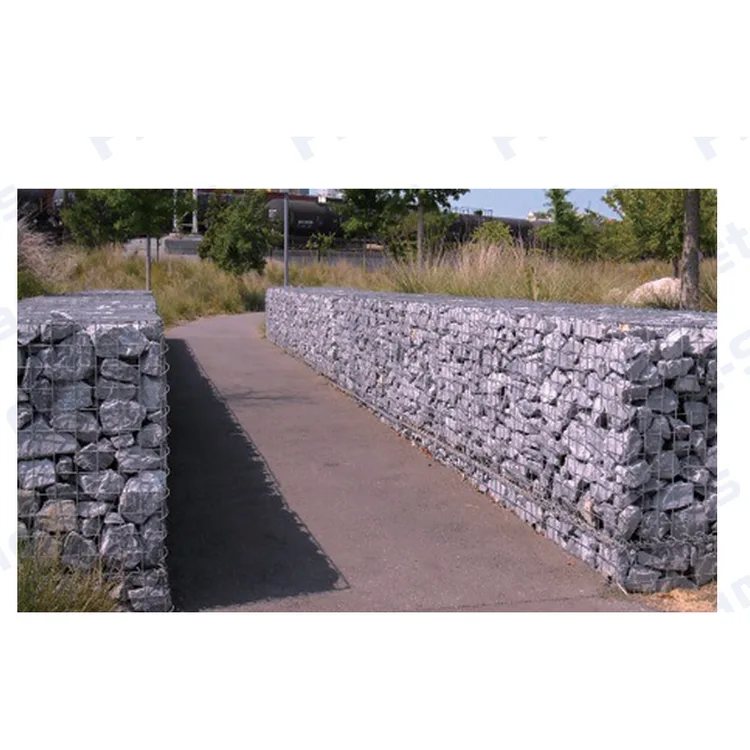
We are Hebei Leeter Import and Export Co., Ltd ("Leeter"), a gabion manufacturer in Hebei, China. Bulged faces are the most common complaint on first gabion projects — and almost all of it is technique plus wire spec, both fixable before the first stone goes in.
Why gabions bulge
A filled basket pushes outward with the weight of loose rock. The cage resists through its mesh stiffness, its internal ties, and the support of its neighbours. Bulge appears when any of those is missing:
- No bracing wires. The face is a flat panel of mesh holding back a metre of rock. Without cross-ties to the opposite face, it must bow — the physics allows nothing else.
- One deep fill lift. Dumping the full height at once loads the face before any bracing can be fitted, and the stones bridge and wedge outward.
- Machine-tipped face stone. Rounded, randomly tipped stone against the face transmits point loads and settles unevenly; the face follows.
- Light wire / oversized panels. A tall welded panel of 3 mm wire spans too far between stiff edges. Wire diameter is the cage's beam depth.
- Un-connected units. A lone basket has no neighbours to share load; walls act as walls only when the baskets are laced or clipped together along every touching edge.
The prevention sequence
1. Brace as you fill — the non-negotiable
Fill in ~300 mm lifts. At one-third and two-thirds of the basket height (i.e. at the top of each lift on a 1 m basket), fit bracing wires — loops of lacing wire connecting the front face to the back face, twisted tight windlass-style (a bar through the loop, wound until snug). Rate: about 4–5 braces per square metre of exposed face; corner cells get extra. Preformed stiffeners/hooks do the same job faster on welded baskets.
2. Pack the face by hand
- Select flat-bedded, angular stone for the visible faces and lay it like dry-stone walling — tight, staggered joints, flat side out.
- Machine-fill only the core, and keep the tipping height low so face stone isn't displaced.
- Use properly sized stone: 1.5–2× the mesh opening, typically 100–200 mm angular rock — undersized rounds migrate and load the face; see the fill quantity guide.
3. Connect everything
- Lace or clip every touching edge of adjacent baskets — continuous spiral or lacing wire along verticals and horizontals — before filling. A wall of connected cells shares load; a row of loose boxes bulges box by box.
- Fill neighbouring cells in balanced stages (no cell more than one lift ahead of its neighbour) so pressure never lands on an empty-sided panel.
- Overfill each basket 25–50 mm proud before closing the lid so settlement doesn't leave a slack, rattling top that lets stone shift.
4. Specify the cage for the job
| Lever | Anti-bulge spec |
|---|---|
| Welded gabion wire | 4–5 mm for structural/facing walls (3 mm only for small decorative units) |
| Woven (double-twist) | Heavy-gauge 80×100 mesh; accept that woven faces show gentle rounding by design — welded stays flattest |
| Panel size | Smaller cells (1 m modules with diaphragms) bulge less than long undivided faces |
| Diaphragms | Internal partitions every 1 m — insist on them in 2 m+ baskets |
| Bracing supply | Order lacing + bracing wire (or preformed stiffeners) with the baskets — the missing consumable on most first orders |
Welded gabions hold the crispest faces for architectural work; double-twist woven suits ground movement and hydraulic works — the trade-off is covered in our box vs mattress guide. As the manufacturer we supply welded and woven gabions with matched lacing wire, bracing wire, spiral binders and stiffeners, in Galfan, heavy galvanized or PVC-over-zinc — say the wall height and stone, and we'll spec wire diameter, diaphragms and the bracing kit together.
Frequently asked questions
Why are my gabion baskets bulging?
Some combination of four causes: no internal bracing wires tying front to back, filling in one deep lift instead of ~300 mm layers, loose machine-tipped stone against the faces instead of hand-packed flat stone, and wire too light for the panel size. All four are preventable at fill time — bulge is technique and spec, rarely the rock's fault.
Where do the bracing wires go in a gabion?
At one-third and two-thirds of the basket height — practically, at the top of each ~300 mm fill lift on a 1 m basket — connecting the front face to the back face, twisted windlass-tight. Plan about 4–5 braces per square metre of exposed face, more at corners. Preformed stiffeners or hooks do the same job on welded baskets.
What wire diameter stops gabions from bulging?
For welded gabions used structurally or as facing walls, 4–5 mm wire; 3 mm suits only small decorative units. For woven double-twist gabions, use the heavy-gauge 80×100 mesh and expect a gentle designed-in rounding rather than a flat face. Diaphragms every 1 m matter as much as diameter — long undivided panels bulge regardless of wire.
Can I fill gabions by machine?
The core, yes — the faces, no. Hand-place flat-bedded angular stone against every visible face like dry-stone walling, then machine-fill the middle in low tips so the face stone stays seated. Stone should be 1.5–2× the mesh opening (typically 100–200 mm); undersized rounded stone migrates and pushes the face out.
Do connected baskets really bulge less?
Yes — lace or clip every touching edge before filling, and keep neighbouring cells within one lift of each other as you fill. Connected cells share pressure like a masonry wall; isolated boxes carry it alone on each panel. Overfill 25–50 mm proud before closing lids so settlement doesn't leave slack for stone to shift into.
Sources
- Wire Fence UK — how to stop gabion baskets bulging
- Gabion Walls Australia — avoiding gabion basket bulging
- Geofabrics — gabion installation guide (bracing rate, lifts)
- UFGS 31 36 00 — gabion specification (lifts, overfill)
- Permies — improvised welded fence wire gabions failing (welds rust, cages part)
