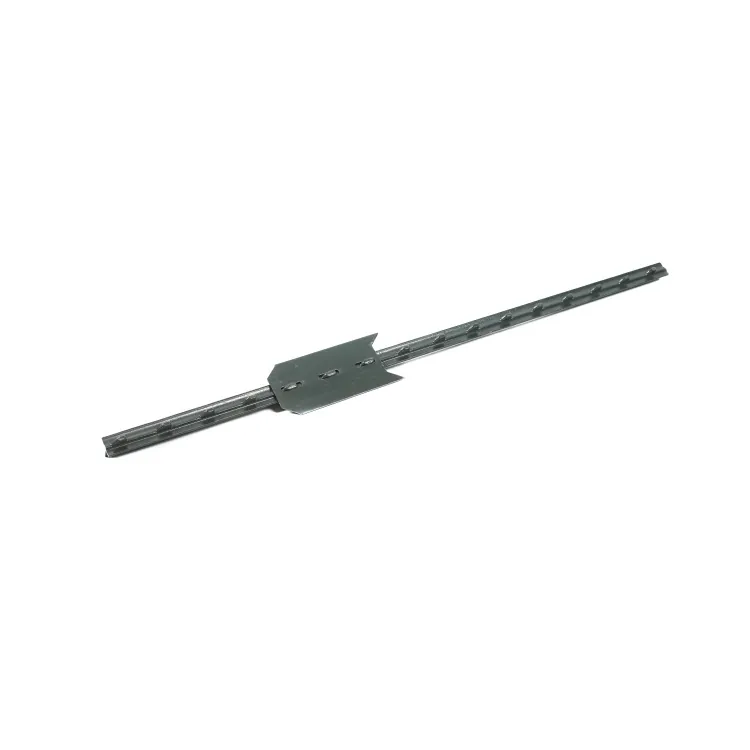
We are Hebei Leeter Import and Export Co., Ltd ("Leeter"), a construction hardware manufacturer in Dingzhou, Hebei, China, exporting since 2006 to buyers across North America and Europe. We produce studded T-posts and U-posts in painted and galvanized finishes for distributors, farm-supply chains, and contractors buying by the container.
T-post vs U-post at a glance
The core difference is the cross-section and the anchor. A T-post's T-section and welded spade plate resist bending and pull-out far better than a lighter U-post.
| Feature | Studded T-post | U-post |
|---|---|---|
| Section shape | T-shaped rolled steel | U / channel section |
| Weight per foot | 0.95 / 1.25 / 1.33 lb (0.43 / 0.57 / 0.60 kg) | Lighter, usually below T-post |
| Wire attachment | Studded face + clips | Punched holes |
| Anchor | Welded/riveted spade plate | Small or no plate |
| Strength | Higher bending & pull-out resistance | Lower, light-duty |
| Cost | Moderate | Lower |
| Typical use | Livestock, high-tension, permanent | Temporary, light, short runs |
T-post weight classes and lengths
Studded T-posts are sold by weight per foot, which is the real indicator of strength. Heavier posts resist bending under animal pressure and hold tension wire without leaning.
| Weight class | Per foot | Typical use |
|---|---|---|
| Light | 0.95 lb (0.43 kg) | Light fencing, garden, temporary lines |
| Standard | 1.25 lb (0.57 kg) | General field and livestock fencing |
| Heavy | 1.33 lb (0.60 kg) | High-tension, cattle, demanding lines |
Common lengths are 4, 5, 6, 7, and 8 ft (1.2, 1.5, 1.8, 2.1, and 2.4 m), chosen so roughly a quarter to a third of the post drives below grade. Match length to fence height plus bury depth and soil: softer ground and taller fences call for a longer, heavier post.
Studs vs holes: wire attachment
The studded face on a T-post is its defining feature. Raised studs space the wire and stop it from sliding, and a T-post clip snaps over the wire and around the post for a fast, secure hold. This makes stringing multi-strand or woven wire quick and keeps lines evenly spaced over years of tension.
A U-post instead has punched holes; wire is threaded or wired through, which is fine for light temporary runs but slower and less secure under real tension. For high-tension or livestock fencing, the studded T-post system holds better.
Finishes and durability
Finish drives service life, especially for posts standing in weather for decades:
- Baked-enamel paint (green or silver) over a galvanized spade plate is the common, economical finish for farm fencing.
- Fully galvanized posts resist corrosion best and suit coastal, wet, or long-life installations.
For buyers, matching finish to climate and expected fence life is the key trade-off between upfront cost and replacement cost.
Bulk and container sourcing
Fence posts are dense, freight-heavy items, so importers and distributors buy by the container. As a China manufacturer, Leeter supplies both post types to one spec, mixed loads of weight classes, lengths, and finishes to fill a container efficiently, and banded bundles by length and class for clean counts. Consolidating your fence-post line with one wholesale manufacturer simplifies freight, keeps dimensions consistent, and lowers landed cost per post.
Frequently asked questions
What is the difference between a studded T-post and a U-post?
A studded T-post is a T-shaped rolled-steel post with raised studs on the face and a welded anchor (spade) plate, giving strong bending and pull-out resistance for livestock and high-tension fencing. A U-post is a lighter U or channel section with punched holes, suited to temporary or light-duty fencing at lower cost. The T-post is stronger and more durable; the U-post is lighter and cheaper.
How much does a T-post weigh per foot?
Studded T-posts are commonly made in three weight classes: 0.95, 1.25, and 1.33 pounds per foot (0.43, 0.57, and 0.60 kg per foot). A 6 ft (1.8 m) standard 1.25 lb/ft post therefore weighs about 7.5 lb (3.4 kg). Heavier per-foot posts resist bending better under tension and animal pressure.
Which fence post is stronger, T-post or U-post?
The studded T-post is stronger. Its T-shaped section and welded spade plate resist bending and pull-out far better than a lighter U-post, which is why T-posts are the standard for cattle, high-tension, and permanent fencing. U-posts are best kept to temporary or light-duty runs.
Which post should I buy for livestock or high-tension fencing?
Choose a heavier studded T-post, typically the 1.25 or 1.33 lb/ft (0.57 or 0.60 kg/ft) class, in a length that buries about a quarter to a third of the post. Pair it with a galvanized or galvanized-spade painted finish matched to your climate for long service life.
