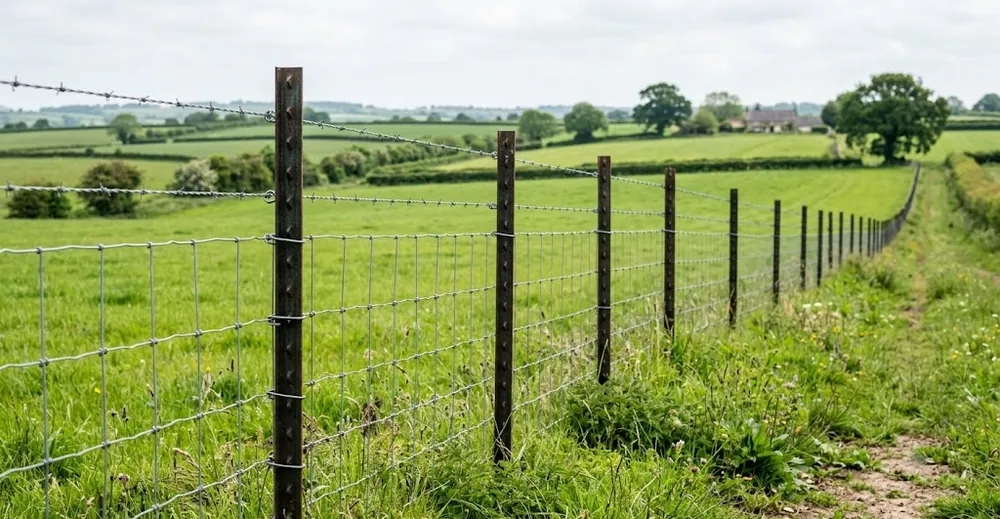
We are Hebei Leeter Import and Export Co., Ltd ("Leeter"), a manufacturer and exporter based in Dingzhou, Hebei, China. Since 2006 we have supplied wire, mesh, anchors, and fencing supports to customers across North America and Europe. This guide draws on what we hear back from contractors and ranch buyers who install our T-posts by the pallet, and it lays out the practical spacing and driving rules that keep a fence line true.
Why spacing decides the fence, not the post
Spacing controls how much load each post carries and how much the wire sags between them. Set posts too far apart and the fabric bellies out, animals push through, and tension is lost. Set them too close and you waste steel and labor for no real gain. The sweet spot depends on what the fence has to hold back and what the ground will allow.
Think of the post spacing and the wire tension as one system. A high-tension line pulls hard, so posts can sit farther apart if they are braced properly. A loose garden mesh carries almost no pull, but it also flops over unless posts are close enough to support the top edge. Neither number is universal, and that is the point.
What is the right t-post spacing by fence type?
The right t-post spacing runs from as tight as 6 feet for garden and small-animal fencing up to 20 feet or more for high-tension wire on flat ground. The controlling factors are wire tension, animal pressure, and terrain. Below is a quick reference we share with buyers before they place an order.
| Fence type | Typical t-post spacing | Notes |
|---|---|---|
| Field / woven wire (cattle, horses) | 12-16 ft | Add posts on rises and dips |
| High-tension smooth or barbed wire | 15-25 ft | Wider spans need line stays between posts |
| Garden / small animal mesh | 6-8 ft | Close spacing supports light fabric |
| Electric wire (portable or permanent) | 20-30 ft | Insulators carry no vertical load |
| Rugged or hilly terrain (any type) | Reduce by 25-40% | Follow ground contour, not the map |
These are starting points, not hard limits. On flat pasture with well-braced ends, cattle fence can stretch toward the upper figure. On rolling ground, tighten it up. When in doubt, we tell customers to add one more post rather than trust a long span.
Field and livestock fencing
For most cattle and horse operations, 12 to 16 feet is the working range. Livestock lean, rub, and push, so the wire needs frequent support to hold its line. Horses in particular deserve tighter spacing near gates and corners where they crowd. Woven-wire fence holds its shape better than single strands, but the posts still do the heavy work of keeping the fabric vertical.
High-tension wire
High-tension systems change the math. Because the wire itself carries much of the structural load, line posts can sit 15 to 25 feet apart. The trade-off is that your end and corner assemblies must be genuinely strong, since all that tension terminates there. Between posts, many installers drop in a fiberglass or steel line stay, a short spacer that keeps wires separated without being driven into the ground.
Garden and small-animal fencing
Garden mesh and poultry netting are light, but they need close support to stay upright and keep small animals out. Six to eight feet works well. The fabric has little tension of its own, so the posts, not the wire, define the fence line. Closer spacing also gives you more places to clip or tie the mesh, which stops sagging along the top rail.
How deep should you drive a T-post?
Drive a T-post so that about one-third of its total length is in the ground, which puts a standard 6-foot post roughly 22 to 24 inches deep. The buried anchor plate, that welded stud near the base, must sit fully below the soil surface. That depth gives the post its resistance to leaning when wire is tensioned or an animal pushes against it.
Depth is not negotiable in soft or sandy soil. If the ground is loose, go deeper or step up to a longer post. A post that only reaches frost-loose topsoil will heave and lean within a season. We size our T-posts in common lengths precisely so installers can bury the right fraction and still have usable height above grade.
Here is a simple rule we pass along: measure the finished fence height you need, add one-third for the buried portion, then buy the next standard length up. A 4-foot fence wants roughly a 6-foot post. Skimping on length to save a few cents per post is the most common mistake we see, and it always costs more in repairs.
Which way should the anchor plate face?
Point the anchor plate toward the fence, on the side where the wire pulls, so the plate resists the tension load. The plate acts like a keel buried in the soil. When wire tension tries to drag the post toward the next line post, the buried plate levers against undisturbed ground and holds firm.
This orientation matters most on curves and where the fence changes grade. On a straight run the pull is even, but at any point where the line bends, the post wants to lean toward the inside of the curve. Facing the plate into that pull is the difference between a post that stays plumb and one that slowly tips. It costs nothing to get right at install time and is a real chore to fix later.
How do you build corners and braces?
Corners and end assemblies carry the entire tension of the fence, so they should never rely on a single driven T-post. A proper corner uses a heavier post or a braced H-assembly, with the T-posts serving only the line between those anchors. This is where most fence failures begin, and it is where we tell buyers to over-build.
A common and reliable approach is the diagonal brace: a strong corner post, a second post several feet down the line, a horizontal rail between them, and a diagonal wire tensioned from the top of the corner to the base of the brace post. That triangle absorbs the pull of the whole fence run. T-posts alone flex too much for this job, which is why we recommend pairing them with proper wood or heavy steel corners.
Gates deserve the same respect. A gate post takes both the fence tension and the swinging weight of the gate itself. Set it deep, brace it well, and do not hang a heavy gate off a light line post. We have watched perfectly good fence lines undone by one under-built gate corner.
How does terrain change your spacing?
Terrain overrides the table every time. On flat, firm ground you can run posts to the wide end of the range. On hills, in gullies, and across soft or rocky soil, tighten spacing by 25 to 40 percent and add posts wherever the ground rises or falls. The fence must hug the land, not span across dips like a bridge.
Every high point and low point needs a post. On a rise, the wire lifts and wants to pull the post out of the ground, so a dip post or an anchored post keeps it down. In a low spot, the wire pushes down, and a post there stops it sagging into the gap. Ignore the contour and you leave openings that animals find within days.
Soil type matters as much as slope. Sandy and saturated ground holds posts poorly, so drive deeper and space closer. Rocky ground resists driving but grips well once the post is set. In frost-prone regions, depth below the frost line protects against heaving, which is another reason we favor longer posts in cold climates.
Quick installation checklist
Before you start driving, walk the line and mark it. A tight string line from corner to corner keeps posts straight and spacing even, which matters for both looks and performance. Then work from the corners in, setting braced ends first so you have solid anchors to tension against.
- Set and brace all corner and end assemblies first.
- Run a string line between anchors as your guide.
- Space line posts per the table, tightening on slopes.
- Drive each post one-third deep with the anchor plate below grade.
- Face the plate toward the wire pull.
- Add posts at every rise and dip.
- Tension wire only after every post and brace is set.
Follow that order and the job goes faster with fewer corrections. Rushing the corners to get to the easy line work is a false economy, since a weak anchor makes every downstream post work harder than it should.
Frequently asked questions
How far apart should T-posts be for a cattle fence?
For cattle, we recommend 12 to 16 feet between T-posts on flat ground, tightening toward 12 feet on slopes or where animals crowd. Woven wire tolerates the wider end of the range, while single-strand barbed wire benefits from closer support. Always add posts at gates, corners, and any change in grade.
How deep do you drive a 6-foot T-post?
Drive a 6-foot T-post about 22 to 24 inches into the ground, roughly one-third of its length, with the welded anchor plate fully below the soil surface. In soft or sandy ground, go deeper or use a longer post. Correct depth is what keeps the post from leaning under wire tension.
Which direction should the T-post anchor plate face?
Face the anchor plate toward the fence line, on the side where the wire pulls. The buried plate then levers against undisturbed soil and resists the tension trying to drag the post sideways. This matters most on curves and grade changes, where an incorrectly oriented post will slowly lean.
Can T-posts be used for corners?
We do not recommend relying on a single T-post for a corner, because corners carry the full tension of the fence. Use a heavier braced assembly, either wood or heavy steel, with a diagonal brace to absorb the load. Let T-posts handle only the line between properly braced corners.
Do I need closer T-post spacing on hilly ground?
Yes. On hills, gullies, and soft soil, reduce spacing by 25 to 40 percent and add a post at every rise and dip. The fence must follow the contour of the land, or the wire will span across low spots and lift over high ones, leaving gaps that livestock exploit quickly.
Get the right posts for your line
Matching post length, gauge, and spacing to your fence type is the difference between a fence that lasts and one you patch every spring. If you are planning a run and want help sizing your order, browse our T-posts or request a quote and tell us your fence type, height, and terrain. We will point you to the right specification.
