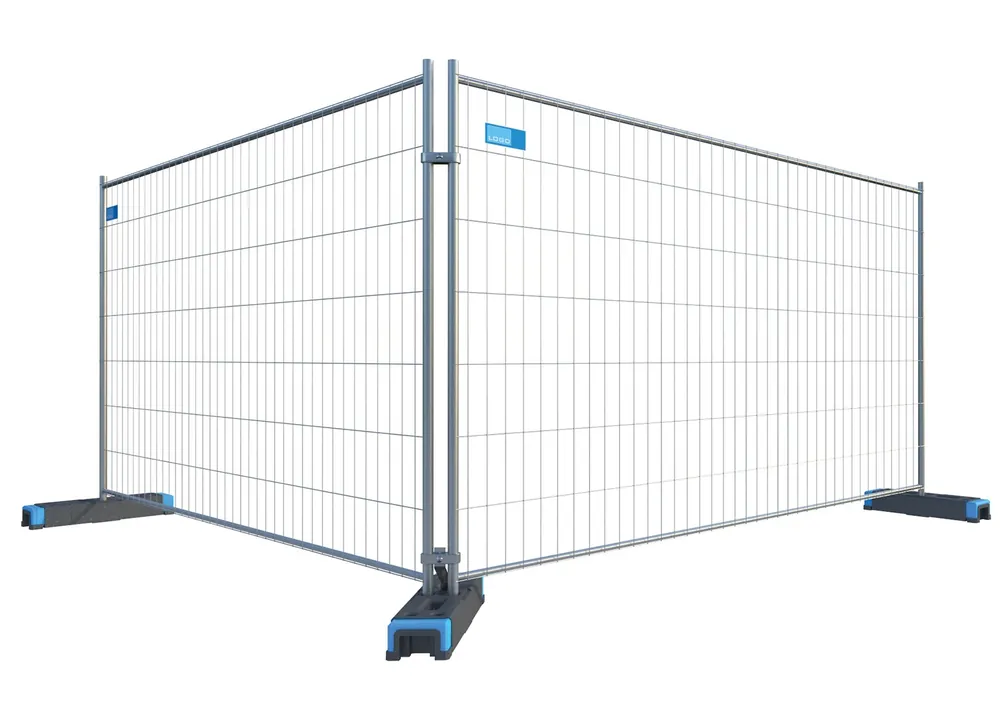
We are Hebei Leeter Import and Export Co., Ltd ("Leeter"), a construction wire, mesh and fencing manufacturer in Dingzhou, Hebei, China, exporting since 2006 to buyers across North America and Europe. Feet, clamps and couplers ship alongside our welded mesh and chain-link panels so a full temporary fence system arrives in one container.
The three main base types
Each base type trades off weight, cost, shipping volume and stability. The table compares them from an importer's point of view.
| Base type | Typical mass | Ships as | Best ground | Wind resistance |
|---|---|---|---|---|
| Plastic block (water/sand fill) | ~1–4 kg empty; 20–40 kg filled | Empty, nests to save space | Hard, flat, paved | Good when filled |
| Recycled concrete / rubber | ~15–30 kg (0.6–1.2 kg per L) | Pre-weighted, dense | Hard or semi-hard | High |
| Steel cross-foot | ~5–12 kg | Flat-pack panels | Uneven, soft, windy | Very high (wide stance) |
Because feet drive both freight weight and stability, the right choice depends on where the fence will stand and how it ships. Empty plastic feet cube-efficiently and are filled on arrival; concrete feet arrive heavy but ready to use.
Plastic block feet: the shipping-friendly default
Hollow plastic (usually recycled HDPE) block feet ship empty and stack, so they take little container space and add almost no freight weight — a major cost advantage when importing in bulk. On site, crews fill them with water or sand to reach 20–40 kg (44–88 lb) of holding mass each. Water is fastest but can freeze or leak; sand is more permanent. These feet suit hard, level surfaces such as roads, car parks and paved sites, and are the standard base under Heras-style welded mesh panels. Pair them with our welded mesh and chain-link panels for a complete lightweight system.
Concrete and rubber feet: mass where it counts
Recycled concrete and rubber feet arrive pre-weighted, typically 15–30 kg (33–66 lb) each, so there is nothing to fill on site — you drop the panel foot into the slot and go. That built-in mass gives strong resistance to wind and accidental knocks, which is why they are favored for exposed perimeters and longer-duration sites. The trade-off is freight: they are dense and heavy, so they consume your container weight budget quickly. Many buyers ship a smaller quantity of concrete feet for the exposed windward runs and use plastic feet elsewhere.
Steel cross-feet: rigidity on rough ground
Steel cross-feet (an A-frame or cross-shaped welded base) clamp to the panel and provide a wide, rigid stance. They excel on uneven, soft or sloping ground where a flat block foot would rock, and their wide footprint resists tipping in high wind. They flat-pack for shipping and are galvanized for outdoor life. The trade-off is more parts and a slower setup than a drop-in block foot.
Clamps, couplers and staying stable in wind
Feet alone do not make a fence stable — the panels must be tied together so the whole run acts as one structure. Anti-tamper clamps or couplers join every adjacent panel at the top and bottom rails, turning individual panels into a continuous, self-bracing line. To keep a temporary fence standing in wind:
- Couple every joint so wind load spreads across the run instead of loading one panel.
- Add mass or width at exposed ends and corners — concrete feet or steel cross-feet where gusts hit hardest.
- Remove or open shade cloth and banners in storms; solid coverings turn a fence into a sail and multiply wind load.
Standardizing on one foot type and one clamp type keeps every panel interchangeable and simplifies re-ordering. For freight math on a full system, see our guide on panels per container.
Frequently asked questions
What base is best for temporary fencing?
For most temporary fencing on hard, flat ground, hollow plastic block feet filled on site with water or sand are the best all-round choice — they are cheap, ship empty to save freight, and give 20–40 kg of holding mass once filled. On uneven or windy sites, steel cross-feet or pre-weighted concrete feet are better because they add rigidity and a wider, tip-resistant stance.
How do you stabilize temporary fence panels in wind?
Couple every panel to its neighbours at the top and bottom rails so the run braces itself, add mass or width at exposed corners and ends using concrete or steel cross-feet, and brace long straight runs with angled stays. Critically, remove or open any shade cloth or banners in high wind, since solid coverings act as a sail and dramatically increase the load that can topple a run.
Should I fill plastic fence feet with water or sand?
Both work. Water is faster to fill and empty, making it convenient for short-term or frequently moved fences, but it can leak or freeze. Sand gives more permanent, freeze-proof ballast and is preferred for longer installs. Either way, fill the foot fully to reach its rated holding mass of roughly 20–40 kg.
Do bases and clamps ship with the fence panels?
Yes. As a manufacturer and supplier we ship feet, anti-tamper clamps and couplers in the same container as the welded mesh or chain-link panels, so a complete temporary fence system arrives together. Standardizing on one foot and clamp type keeps every panel interchangeable and simplifies bulk re-ordering.
