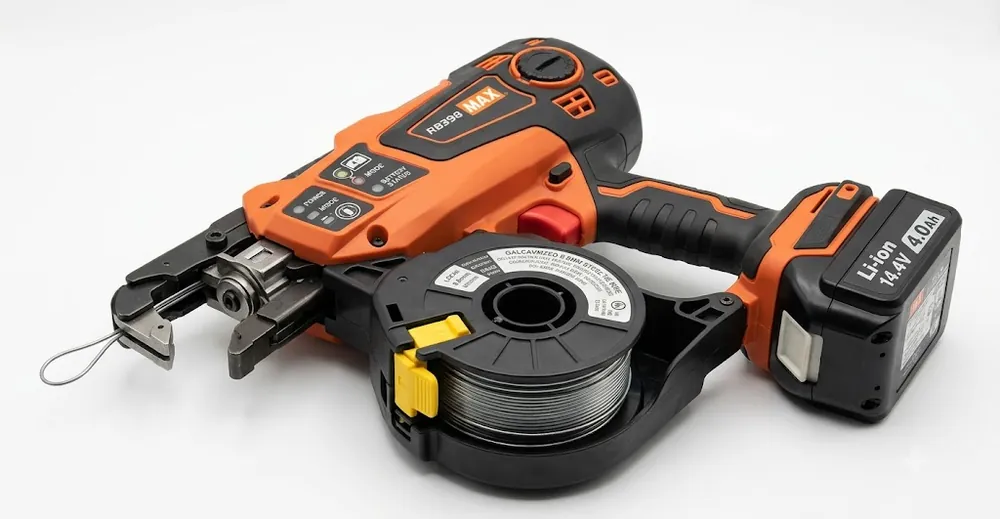
Why automatic tiers need reels, not coils
Battery-powered rebar tiers do not pull wire from an open coil. They feed a continuous strand from a compact, level-wound reel seated inside the tool housing. The mechanism grips, bends, twists, and cuts in a fraction of a second, so the wire has to arrive at the feed rollers in a predictable, tangle-free path. A hand-tie coil, wound loosely for a worker to grab and twist with pliers, does none of that. Force one into a tool and you get overruns, birdnesting, and half-formed ties.
The core idea is simple. Hand tying tolerates a rough wire; machine tying does not. Every reel we produce for tier tools is spooled under controlled tension so each wrap sits beside the last. That is what "level winding" means, and it is the single biggest predictor of jam-free feeding. If you remember one thing from this page, make it that.
We are a manufacturer, so we will be honest about the trade-off. Purpose-wound tie wire reels cost more per kilogram than bulk coil stock. You are paying for the winding process, the spool, and tighter diameter control. On a real job the math still favors reels, because labor is far more expensive than wire, and a stalled crew burns both.
What wire gauge works in rebar tying tools?
Most battery rebar tiers run wire in the 0.8 to 1.0 mm range, roughly 19 to 21 gauge, with 0.8 mm being the common default for standard-duty tools. Lighter 0.8 mm wire feeds fast and suits smaller bar and lighter mats. Heavier 1.0 mm and above holds bigger intersections and works with the high-capacity tiers built for structural bar. Going outside a tool's rated diameter is the fastest way to void feed reliability.
Gauge is not a preference; it is a tool specification. Each tier is engineered around a diameter window, and the feed rollers, bending anvil, and twist hook are all tuned to it. Undersized wire slips and produces weak ties. Oversized wire strains the motor and jams at the cutter. Always match the reel to the tool's stated range before you buy.
Here is a practical starting point. Confirm the exact figures against your specific tool, but these bands reflect what we ship most often.
| Wire diameter | Approx. gauge | Typical use | Tool class |
|---|---|---|---|
| 0.8 mm | ~21 GA | Light mesh, small bar, high speed | Standard-duty tiers |
| 0.9 mm | ~20 GA | General slab and wall rebar | Standard to mid-duty |
| 1.0 mm | ~19 GA | Heavier intersections, structural mats | Mid to high-duty tiers |
Notice that gauge and metric diameter do not map perfectly. Gauge systems vary by region and by whether the wire is measured before or after coating. When you order, give us the millimeter figure. It removes ambiguity that a gauge number alone can introduce.
Reel format and level winding
A tier reel is defined by three things beyond the wire itself: spool diameter, spool width, and hub design. These have to match the tool's magazine, or the reel will not seat and the tool will not run. That sounds obvious, yet it is the most frequent ordering error we correct. A buyer nails the gauge, then supplies a spool that physically does not fit the tool housing.
Level winding deserves its own note because it is invisible until it fails. On a well-wound reel, the wire lies in flat, parallel layers, and each layer unwinds cleanly under the tool's pull. On a poorly wound reel, wraps cross and dig into lower layers. Under machine tension those crossed wraps snag, the feed stalls, and the operator has to open the tool mid-pour. We control winding tension electronically and inspect spools before packing, because there is no field fix for a badly wound reel.
Our experience is that consistency matters more than any single spec. A reel wound to a tight, repeatable diameter and a clean layer pattern will outperform a nominally "better" wire that was wound carelessly. Buy the process, not just the alloy.
Which coating should you specify?
The four coatings we supply for tier reels are annealed (black), electro-galvanized, PE-coated, and epoxy, and each trades cost against corrosion life and feed behavior. Annealed black wire is the workhorse for temporary and covered work. Galvanized resists rust for exposed or coastal conditions. PE and epoxy add a bonded barrier for aggressive or decorative concrete where staining and long service life matter.
Coating changes how the wire feeds, not just how it lasts. A soft annealed wire bends and twists with less motor effort, which is why it dominates general tying. Galvanized adds a thin zinc layer that slightly stiffens the strand, so confirm the tool handles it at your chosen diameter. Thicker PE and epoxy coatings raise the effective diameter, and that can push you toward a lighter core gauge to stay inside the tool's window.
| Coating | Corrosion resistance | Feed behavior | Typical application |
|---|---|---|---|
| Annealed (black) | Low | Softest, easiest twist | Interior, covered, temporary work |
| Electro-galvanized | Medium | Slightly stiffer | Exposed and humid environments |
| PE-coated | High | Bulkier, check diameter | Marine, chemical, long-life concrete |
| Epoxy | High | Bulkier, check diameter | Bridge decks, decorative structural |
One honest caution from the shop floor: any added coating thickness eats into the tool's diameter tolerance. If your tier is rated to 1.0 mm and you want epoxy, we may recommend a 0.8 mm core so the finished, coated strand still feeds. Tell us the environment and the tool, and we will spec the core and coating together.
How do you match tie wire to your specific tool?
The reliable method is to specify four values together: wire diameter in millimeters, coating type, spool dimensions, and hub or arbor design. Get those four right and the reel drops in and runs. Miss one and you risk a reel that either does not fit or does not feed. We ask every tier-wire buyer for all four before we quote, because guessing helps no one.
Start with the tool. Read the manual or the plate on the housing for the rated wire diameter and the reel format it accepts. If you cannot find it, send us a photo of the tool and an old reel, and measure the spool with calipers. Different tool families use different spool footprints, and there is no universal reel, so this step cannot be skipped.
Then match the wire to the work. Bar size, exposure, and concrete class drive gauge and coating. A parking deck in a freeze-thaw climate and an interior slab call for different reels even on the same tool. We pair the rebar twisters and reels we ship so the whole system stays inside spec, rather than selling wire in isolation.
Finally, order a trial quantity, run it, then commit. We would rather send a sample and confirm clean feeding than ship a pallet that fights your tool. When you request a quote, give us the tool model and the job conditions, and we will propose a reel and back it with a test batch.
Storage, handling, and shelf life
Store tier reels sealed, dry, and off the ground, because moisture is the enemy of both the wire and the feed. Even galvanized reels degrade if condensation collects inside shrink wrap over months. We pack reels individually and case them for stacking, but once a case is open, keep partial reels in a closed bin away from concrete dust and rain runoff.
Handling matters at the tool too. Seat each reel fully, confirm the wire threads through the guide before the first tie, and never splice a broken strand back through the mechanism. A reel that has been dropped can develop a flattened wrap that jams later, so treat them as the precision consumables they are. Small habits here protect the speed you paid for.
Frequently asked questions
Can I use hand-tie coil wire in an automatic rebar tier?
No. Hand-tie coils are wound loosely for manual twisting and lack the level winding, tension control, and spool format a tool needs. Forcing coil wire into a tier causes birdnesting, feed stalls, and malformed ties. Always use a purpose-wound reel matched to your tool's rated diameter and spool dimensions.
What gauge tie wire do most rebar tying tools use?
Most battery tiers run 0.8 to 1.0 mm wire, roughly 19 to 21 gauge, with 0.8 mm as the common standard-duty default. Heavier 1.0 mm and above suits structural bar and high-capacity tools. Always confirm the millimeter range printed on your specific tool before ordering, since gauge systems vary by region.
Will galvanized or epoxy coating jam my tier?
Not if you account for thickness. Coatings add to the finished diameter, so an epoxy or PE strand on a 1.0 mm core may exceed a tool's window. We often pair a lighter core with a heavier coating to stay in spec. Tell us the tool model and environment, and we spec core and coating together.
How do I know which reel fits my tool?
Match four values: wire diameter in millimeters, coating, spool dimensions, and hub design. Read the tool plate or manual for the rated diameter and reel format, then measure an existing spool with calipers. Send us those details or photos, and we confirm the correct reel before shipping a trial batch.
Do you supply the tying tools as well as the reels?
Yes. We supply both battery rebar tiers and matched reels so the full system stays within specification. Buying wire and tool from one source avoids diameter mismatches and format errors. Send your job conditions and preferred tool class, and we will propose a compatible reel plus a sample run to prove clean feeding.
Ready to spec tool-compatible reels that feed without jams? Send us your tool model, wire diameter, and job conditions, and we will match a reel and back it with a trial batch. Request a quote and we will get you running.
