At Hebei Leeter Import and Export Co., Ltd, a wire, mesh, and masonry exporter working since 2006 out of Dingzhou, Hebei, we ship brick wall ties into North American and European jobs every week. This guide walks through how to select the right tie for each backup wall, how to fasten it, and how to keep it coursed correctly with the brick.
Why backing type drives the whole decision
The backup wall is the structural partner in every veneer assembly. The brick you see from the street carries no vertical building load in a modern cavity wall; it is a rainscreen anchored back to the real structure. That structure might be timber studs in a house, cold-formed steel studs in a mid-rise, a CMU block wall, or a poured concrete frame. Each of those materials accepts fasteners differently, moves differently with temperature and moisture, and sits at a different distance from the brick.
Because of that, a tie that performs perfectly on a stud wall can be useless on concrete. A screw needs wood or steel to bite into. A dovetail anchor needs a slot cast into the concrete. Joint reinforcement needs a bed joint in block. So before you look at any catalog, answer one question: what am I fastening into? That answer narrows the field to a handful of correct options and rules out the rest.
What wall tie suits a stud backup?
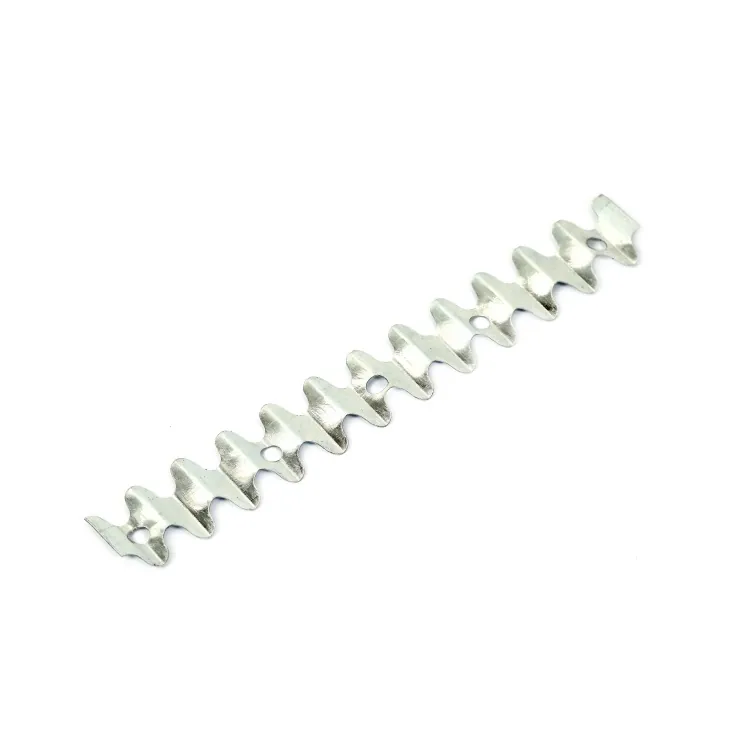
Stud walls, whether wood or cold-formed steel, take screw-fixed ties that thread through the exterior sheathing into the framing member. The two common families are corrugated strip ties and two-piece adjustable ties. Corrugated ties are the economical choice for residential wood-frame work; a bent galvanized strip is screwed to the stud and the free end is embedded in the mortar bed joint.
Corrugated ties have a limit worth respecting. Because the strip bends at the sheathing line, it resists tension and compression well only when it stays roughly straight and the cavity is narrow. On wider cavities or where you want the veneer to move vertically relative to the backup, a two-piece adjustable tie is the stronger answer. That design uses a barrel or plate screwed to the stud, plus a wire pintle or triangle that sits in the bed joint, so the two halves can shift as the wall settles.
For steel studs, the fastener changes but the logic holds. Self-drilling, self-tapping screws rated for the stud gauge replace the wood screws, and you should confirm the screw pulls tight against the sheathing without stripping the thin steel. Always land the fastener in the stud, never in the sheathing alone; sheathing has almost no pull-out strength on its own.
Fastening and spacing on studs
Drive each screw into the framing, not just the board. Seal the penetration where the tie passes through the water-resistive barrier so you do not create a leak path. Keep ties aligned with the studs, which means your horizontal tie spacing follows the stud layout, commonly 16 or 24 inches on center, and your vertical spacing follows the brick coursing. Consult your project's structural drawings and local code, because tie density increases near openings, at corners, and in high-wind zones.
Which tie works with a CMU backup?
Concrete masonry unit backup walls call for either adjustable two-piece ties anchored into the block or continuous horizontal joint reinforcement that ties both wythes together. The choice depends on whether the backup block and the brick veneer course at the same height. When bed joints line up, ladder or truss joint reinforcement with an integral tab or box-and-pintle tie is efficient because you reinforce the block and connect the veneer in one product.
Joint reinforcement is welded wire laid into the mortar bed of the block wall. A ladder pattern uses two parallel side rods with perpendicular cross rods; a truss pattern adds diagonals for more rigidity. When the assembly needs a veneer connection, you specify a version with an adjustable tab or an eye-and-pintle so the brick can be tied without forcing its coursing to match the block. Our welded wire mesh lines feed the same fabrication, so the geometry stays consistent from block reinforcement to veneer tie.
When coursing does not align, or when you prefer to reinforce and tie separately, use a standalone adjustable anchor set into the block bed joint. A plate or dovetail-style anchor embeds in the mortar and a pintle receives the brick tie. This keeps each wythe on its own coursing while still holding them together across the cavity.
Getting embedment right in block
Lay joint reinforcement fully in the mortar bed with cover on both sides so the wire is protected from moisture. Do not let cross rods bridge the cavity and short-circuit your drainage plane. For adjustable anchors, set the embedded leg deep enough in the bed joint that it cannot pull free, and keep the exposed pintle level so the veneer tie seats without bending. Corrosion protection matters here as much as strength, which is why hot-dip galvanized or stainless is standard for anything buried in mortar.
How do you tie brick to a concrete backup?
Cast concrete backup walls use dovetail anchor systems where slots are formed into the pour, or post-installed anchors drilled and fastened after the concrete cures. The cleaner method is the dovetail slot: a galvanized or stainless channel is nailed to the formwork before the pour, the concrete sets around it, and after stripping the forms you drop dovetail anchors into the continuous slot at any height you need. That flexibility is the big advantage, because you place each tie exactly on the brick bed joint rather than where a stud happened to fall.
When the concrete is already cast and no slots were provided, switch to post-installed anchors. These use a screw anchor or expansion fastener drilled into the concrete face, carrying a plate or barrel that receives the veneer tie. Post-installed work demands attention to embedment depth, edge distance, and drilling technique, since a fastener set too shallow or too near an edge loses much of its rated capacity. Follow the anchor manufacturer's published values and the structural engineer's spacing.
A quick reference for matching backing to tie and fastening:
| Backing type | Suitable tie | Fastening method |
|---|---|---|
| Wood stud | Corrugated strip tie or two-piece adjustable | Wood screw into the stud through sheathing |
| Steel stud | Two-piece adjustable, plate anchor | Self-drilling/self-tapping screw into stud |
| CMU (coursed with brick) | Ladder/truss joint reinforcement with tab or pintle | Embedded in the block bed joint mortar |
| CMU (offset coursing) | Standalone adjustable anchor + pintle | Embedded in the block bed joint mortar |
| Cast concrete (formed) | Dovetail anchor in cast-in slot | Anchor slides into continuous dovetail channel |
| Cast concrete (existing) | Post-installed plate/barrel anchor | Screw or expansion fastener drilled into concrete |
How does coursing affect tie choice?
Coursing decides how freely you can place a tie, and it separates fixed ties from adjustable ones. On a stud wall, the tie must land on a framing member horizontally, but vertically it sits in whatever brick bed joint is nearest, so a small vertical offset between fastener and mortar joint is normal and acceptable within limits. Adjustable ties exist precisely to absorb that offset without bending the tie into a stressed shape.
With CMU, block courses are taller than brick courses, so their bed joints rarely line up one-to-one with the veneer. If you insist on a fixed connection, you fight the geometry. Adjustable two-piece ties solve this by letting the veneer leg sit at the brick joint while the anchored leg sits at the block joint, each independent of the other. Cast concrete with a continuous dovetail slot gives the most freedom of all, since the slot accepts an anchor at any point along its length.
A practical rule holds across all three backings: keep the tie as close to horizontal as the assembly allows. A tie that slopes steeply up or down between the two wythes loses efficiency and can push or pull on the mortar joint. Where large vertical offsets are unavoidable, choose an adjustable design rated for that movement rather than forcing a rigid tie.
Corrosion, movement, and detailing that outlast the brick
The best tie selection still fails if the metal rusts or the wall cannot move. Every tie buried in mortar or exposed in a damp cavity should carry appropriate corrosion protection, typically hot-dip galvanizing for standard exposure and stainless steel for coastal, high-humidity, or long-service applications. Because ties are effectively impossible to replace once the veneer is up, spending on corrosion resistance at the start is cheaper than any repair.
Movement is the other quiet requirement. Brick expands over its life while concrete and block tend to shrink, and temperature swings move every material daily. Two-piece adjustable ties accommodate that differential movement in the plane of the wall. Keep the cavity clear of mortar droppings so ties are not bridged, maintain your drainage and flashing details, and do not let a tie become a bridge for water across the air gap.
Ready to match ties to your backup?
Getting wall ties right by backing type protects the veneer for the life of the building, so start from the backup and work outward to the brick. Leeter fabricates corrugated ties, adjustable anchors, dovetail systems, and joint reinforcement for stud, CMU, and concrete backups, all with galvanized or stainless options for the exposure you face. Send us your wall section, backing material, and cavity width and we will help you specify. To move a project forward, request a quote and our team will follow up with sizing and lead times.
Frequently asked questions
Can I use the same wall tie for stud, CMU, and concrete backup?
No single tie suits every backup. Screw-fixed corrugated and plate ties need studs, joint reinforcement and adjustable anchors suit CMU bed joints, and dovetail or post-installed anchors are made for concrete. Using the wrong tie usually means a fastener with nothing solid to grip, which fails under load.
What is the difference between fixed and adjustable ties?
Fixed ties, such as corrugated strips, hold the two wythes in one relative position and work best when the fastener and mortar joint nearly align. Adjustable two-piece ties use a separate anchored leg and veneer leg, letting each wythe follow its own coursing and move with temperature and moisture without stressing the mortar.
When should I choose dovetail anchors over post-installed anchors?
Choose cast-in dovetail slots whenever you control the concrete pour, because they let you place a tie at any height along the slot with no drilling. Reserve post-installed anchors for existing concrete where no slots were formed, and follow the anchor maker's embedment and edge-distance limits closely.
Does joint reinforcement replace individual veneer ties?
Not by itself. Standard ladder or truss joint reinforcement reinforces the CMU backup. To also connect the brick veneer, specify a version with an adjustable tab, eye, or pintle, or add separate veneer anchors. Confirm the product you order is rated to both reinforce the block and tie the veneer.
How do corrosion and coating choices affect tie selection?
Ties sit in damp cavities and mortar and cannot be replaced once the wall is built, so coating drives long-term performance. Hot-dip galvanizing suits typical exposures, while stainless steel is the safer pick for coastal, high-humidity, or long-service walls. Match the tie coating to the environment before you finalize the order.
