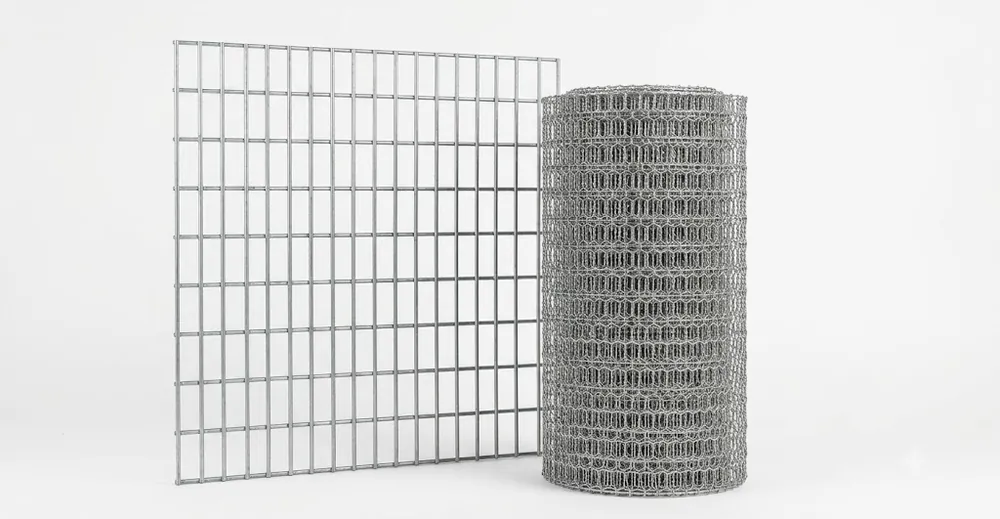
We are Hebei Leeter Import and Export Co., Ltd ("Leeter"), a construction wire and mesh manufacturer in Dingzhou, Hebei, China, exporting since 2006 to buyers across North America and Europe. We run both welded lines and weaving looms, so we have no reason to push one product over the other. The right answer depends entirely on your job. Below we walk through the joint, the rigidity, the aperture range, the cut edge, the cost and the applications, with real numbers you can specify against.
The core difference: a fused joint versus a crossed strand
Welded wire mesh starts as straight wires laid at 90 degrees, then resistance-welded at each intersection. Every crossing point becomes a small nugget of fused metal. That single fact drives almost everything else about the product. The sheet behaves as one bonded grid, not a bundle of loose strands.
Woven wire mesh is made on a loom, exactly like fabric. Warp wires run lengthwise and weft (shute) wires run across, passing over and under each other in a plain weave, twill weave or Dutch weave. Nothing is bonded. The wires hold position through crimp and friction, and the interlocking pattern gives the cloth its shape.
The practical result: pull a welded joint apart and you break steel. Pull a woven mesh apart and the wires simply slide and unravel. That is why welded panels keep their geometry under load and woven cloth stays pliable enough to wrap, roll or form.
Which mesh is more rigid and dimensionally stable?
Welded mesh wins on rigidity every time. Because each joint is fixed, the aperture cannot shift, the panel resists shear, and a large sheet stays flat without a frame. This is what makes welded mesh the default for concrete reinforcement, security fencing, animal enclosures, and any panel that must carry or resist a load.
Woven mesh is intentionally not rigid. The crossing wires can pivot slightly, so the cloth drapes, rolls and conforms to curved surfaces. That flexibility is a feature for filter elements, insect screens and vibrating sieve decks, where the mesh must flex without cracking a weld.
There is a middle ground worth knowing. Locking-crimp and intercrimp woven meshes add deep crimps that seat the wires firmly, giving a woven product more stability without welding. For heavy quarry screens this matters, because a fully welded panel of coarse wire would crack at the joints under constant impact. So "rigid" is not always the same as "durable." Match the property to the duty.
How do the aperture ranges compare?
This is where the two technologies split most clearly.
| Property | Welded wire mesh | Woven wire mesh |
|---|---|---|
| Joint | Fused at each crossing | Interlaced, not bonded |
| Typical aperture | ~6 mm up to 150 mm+ (0.24 in to 6 in) | ~20 micron up to ~25 mm (0.0008 in to 1 in) |
| Wire diameter | ~0.5 mm to 12 mm | ~0.02 mm to ~5 mm |
| Rigidity | High, holds a flat plane | Flexible, drapes and rolls |
| Cut edge | Stable, joints hold | Frays unless edges are sealed |
| Best for | Reinforcement, fencing, panels, cages | Filtration, sieving, screening, guards |
| Relative cost | Lower per square metre at coarse sizes | Higher, rises sharply at fine mesh |
Welded mesh lives in the coarse-to-medium range. Common openings run from around 6 mm up to 150 mm and beyond, with wire from roughly 0.5 mm to 12 mm. You will not resistance-weld a 40 micron opening; the wires are too fine to form a joint.
Woven mesh covers the fine and ultra-fine end. Weaving can hold openings from around 25 mm all the way down to roughly 20 micron in Dutch weave constructions used for hydraulic and polymer filtration. If your specification calls for a mesh count like 100, 200 or 325 wires per inch, you are in woven territory. Welding simply cannot reach it.
Where the ranges overlap, roughly 6 mm to 25 mm, either product can work, and cost, edge behaviour and rigidity break the tie.
What happens at the cut edge?
Welded mesh cuts clean. Snip through a panel and the joints on either side of the cut still hold their neighbours, so the sheet keeps its shape. You do lose the outermost joints along the cut line, which leaves short wire tails, but the body of the mesh stays intact. That predictability is why fabricators like welded stock for cages, guards and made-to-size panels.
Woven mesh frays. Cut across a plain weave and the loose end wires want to unravel, because nothing bonds them. Filter and screen makers deal with this by sealing edges: soldering, welding a frame, folding a hem, or bonding the perimeter. For fine filtration cloth this is a normal fabrication step, not a defect, but it adds labour you should budget for.
We flag this early with buyers because it changes the delivered cost. A woven filter disc with a sealed edge costs more to produce than a raw welded offcut of the same size.
Which is cheaper to buy?
At coarse apertures, welded mesh is usually the cheaper choice per square metre. The process is fast and automated, wire consumption is efficient, and there is no edge sealing. For fencing, reinforcement and general fabrication, welded delivers the most steel per dollar.
Woven mesh costs more, and the price climbs steeply as the mesh gets finer. Fine wire is expensive to draw, weaving is slower than welding, and tight tolerances at 200 or 325 mesh demand careful loom control. A square metre of 325-mesh stainless cloth can cost many times a square metre of coarse welded panel. That premium buys you precision the welded process cannot deliver, so it is money well spent when filtration is the goal.
Material choice shifts both prices. Galvanised low-carbon steel is the economical baseline for welded panels. Stainless 304 and 316 raise cost on either product, and are standard for woven filter cloth exposed to moisture, chemicals or food contact.
Which should you buy for your application?
Match the mesh to the duty. Choose welded when the mesh must hold a shape, carry a load or define a boundary. Choose woven when the mesh must separate particles, filter a fluid or flex without failing.
Buy welded wire mesh when you need
Structural reinforcement in concrete slabs, walls and precast is the classic case, and it sits alongside our welded wire mesh range for construction. Welded also suits security and boundary fencing, animal cages and aviaries, machine and window guards, gabion baskets, and any custom panel a fabricator will cut to size. If someone will lean on it, climb it or pour concrete around it, weld it.
Buy woven wire mesh when you need
Liquid, gas or air filtration is the leading reason to weave, from coarse strainers down to fine hydraulic filters. Woven also fits particle sizing and lab test sieves, vibrating screen decks in mining and aggregate, insect and pollen screening, architectural infill panels, and shielding where a precise open area matters. If the job is to pass one thing and stop another by exact size, weave it.
The overlap zone deserves a note. Around 6 mm to 12 mm openings, we see buyers pick welded for a rigid guard or infill and woven for a flexible screen or decorative panel. There is no single correct answer; the surrounding requirements decide.
A quick decision checklist
Ask four questions in order. First, what is the smallest opening you need? Below about 6 mm, you are almost certainly buying woven. Second, does the mesh carry load or hold a plane? If yes, weld it. Third, will you cut the mesh and leave raw edges exposed? Welded tolerates this better; woven needs sealing. Fourth, what is the corrosion and hygiene environment? That sets your material grade before you ever choose a weave or weld.
Answer those four and the specification usually writes itself. When it does not, that overlap zone is exactly where a manufacturer earns its keep, and we are glad to run samples both ways so you can test before committing to a production order.
Frequently asked questions
Is welded or woven wire mesh stronger?
Neither is universally stronger; they fail differently. Welded mesh is stiffer and holds a load-bearing plane, which is why it reinforces concrete and builds cages. Woven mesh resists impact and flexing better because its joints move instead of cracking, which is why quarry screens are woven. Match the property to the duty rather than chasing a single strength number.
Can welded mesh reach the fine apertures of woven mesh?
No. Resistance welding needs wires thick enough to form a joint, so welded openings bottom out around 6 mm in practice. Fine screening below that, down to roughly 20 micron for filtration, is only achievable by weaving. If your drawing calls out a mesh count like 100 or 200 per inch, you need woven cloth, not welded panel.
Why does woven wire mesh fray when I cut it, and welded does not?
Woven wires are only interlaced, held by crimp and friction, so a cut lets the ends unravel. Welded wires are fused at each crossing, so a cut sheet keeps its geometry apart from the outermost joints. For woven cloth we recommend sealing cut edges by soldering, framing or hemming, which is a normal fabrication step.
Which mesh is cheaper for a large fencing or reinforcement project?
Welded mesh, in nearly every case. Its automated process, efficient wire use and lack of edge sealing make it the lowest cost per square metre at the coarse apertures fencing and reinforcement use. Woven mesh costs more and the premium grows as the opening gets finer, so reserve woven for jobs that genuinely need precise filtration.
What material grade should I specify?
Start from the environment. Galvanised low-carbon steel is the economical default for welded fencing and reinforcement. Stainless 304 suits general corrosion resistance, while 316 handles marine, chemical and food-contact duty and is common for woven filter cloth. Set the grade first, because it drives cost and lead time more than the choice between welded and woven.
Talk to a manufacturer before you order
Specifying mesh is easier with samples in hand and a supplier who runs both processes. Tell us the opening, wire diameter, panel or roll size, material grade and application, and we will point you to welded or woven honestly, then quote it. Request a quote and we will help you buy the right mesh the first time.
