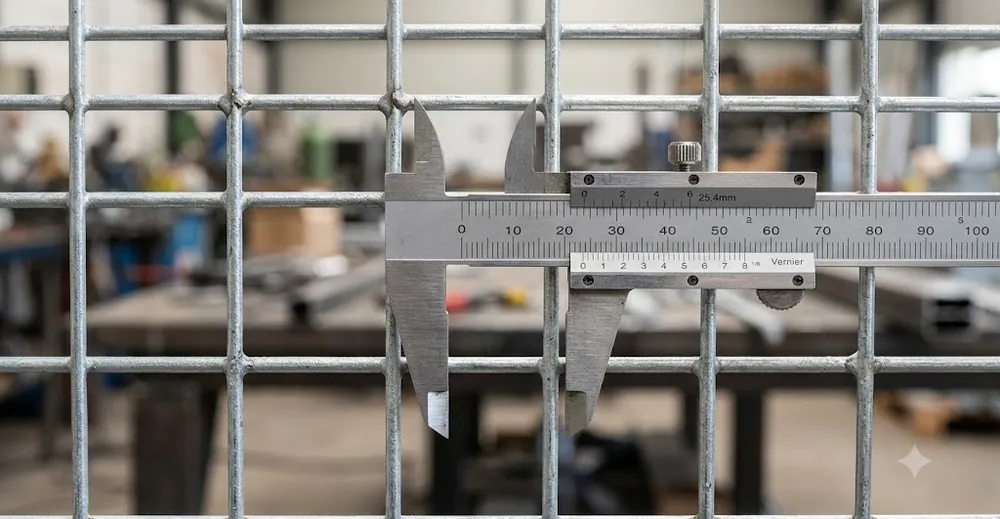
At Leeter, we have been drawing wire and building mesh in Dingzhou, Hebei since 2006, and we ship to fabricators, farmers and contractors across North America and Europe. The single most common ordering mistake we see is a buyer who fixes the aperture but never checks the wire gauge behind it. This guide walks you through both, in plain trade terms, so you can specify with confidence.
The short answer
Aperture (the opening size) and wire diameter (the thickness of the wire) work as a pair. Aperture controls what passes through and how the panel looks. Wire diameter controls strength, rigidity and weight. Choose them together, matched to the load and the job.
As a fast starting point, use these bands:
- Light garden and pet mesh: wire 0.7 to 1.5 mm, aperture 12.7 to 25 mm.
- General fencing and animal enclosures: wire 2 to 4 mm, aperture 50 to 100 mm.
- Concrete reinforcing mesh: wire 4 to 6 mm, aperture 100 to 200 mm.
Those ranges cover most of what leaves our factory. The rest of this guide explains how to read the numbers and fine tune them.
What aperture actually means
Aperture is the size of a single opening in the mesh, and it is where most confusion starts. Two mills can quote "50 mm mesh" and mean slightly different things, so always confirm which measurement basis a supplier uses before you sign off.
There are two common ways to state it:
- Clear opening: the gap between the inside edges of two neighbouring wires. This is the space an object can actually pass through.
- Centre to centre (pitch): the distance from the middle of one wire to the middle of the next.
The difference between the two is exactly one wire diameter. For a mesh built from 3 mm wire on a 50 mm pitch, the clear opening is only 47 mm. On thin garden wire the gap is trivial. On heavy reinforcing bar it matters a great deal, because a 6 mm wire eats 6 mm out of every stated pitch.
When we quote, we state the pitch and the wire diameter separately so nothing is hidden. If a drawing calls for a guaranteed clear opening, tell us, and we work backwards to the right pitch.
Reading mm against inches
Most of our European buyers work in millimetres and most North American buyers in inches, so both appear on our drawings. A few conversions worth memorising: 12.7 mm is 1/2 inch, 25.4 mm is 1 inch, 50.8 mm is 2 inches, and 100 mm is close to 4 inches. Woven mesh is often described by "mesh count", meaning the number of openings per linear inch, which is a different system again. A 4 mesh screen has four openings per inch, so the opening plus one wire equals a quarter inch. Welded panels, by contrast, are almost always sold by pitch in mm or inches, which is cleaner for construction work.
Why wire diameter carries the load
Wire diameter is where strength lives, and it climbs faster than the number suggests. The cross sectional area of a wire, and roughly its strength, rises with the square of the diameter. Move from 2 mm to 3 mm wire and you have not added fifty percent of steel; you have added more than double.
That squared relationship is the single most useful idea in this whole guide. It explains why a small bump in wire gauge stiffens a panel dramatically, and why it also raises weight and price in the same jump. When a customer tells us their fence "just needs to be a bit stronger", the answer is usually a half millimetre more wire, not a smaller aperture.
Thicker wire also resists corrosion for longer, because a zinc or PVC coating has more base metal to protect and rust has more material to chew through before failure. For coastal, agricultural or outdoor jobs, that extra life often justifies the heavier gauge on its own.
The aperture to wire ratio rule of thumb
The ratio between aperture and wire diameter is the quiet number that separates a rigid panel from a floppy one. As a working rule, keep the aperture no more than roughly 25 to 40 times the wire diameter for a panel that needs to hold its shape.
Here is how that plays out:
- A 50 mm aperture with 2 mm wire gives a ratio of 25. That is stiff and dependable for fencing.
- A 50 mm aperture with 1 mm wire gives a ratio of 50. That panel will flex, bow and dent under any real pressure.
- A 100 mm aperture with 5 mm wire gives a ratio of 20. That is proper structural mesh.
When the ratio drifts above 40, you are usually buying a mesh that looks strong on paper but behaves like a net. There are legitimate exceptions, such as lightweight aviary or protective screens where nothing pushes on the panel, but for anything load bearing, keep the ratio tight. If you send us the opening you want and the load you expect, we will suggest a wire gauge that lands in a sensible band.
How aperture and wire diameter drive weight and cost
Weight follows wire diameter and pitch in a direct, predictable way, and weight is what you pay to ship. A tighter aperture packs more wire into every square metre, and thicker wire adds mass on top of that. Both push the panel heavier and dearer.
Think of it as two dials. Shrinking the aperture adds more wires per metre. Fattening the wire adds mass to each one. Pull both dials toward "heavy duty" and the panel weight can multiply several times over compared with a light garden grade of the same outer dimensions. For freight from China to a North American or European yard, that weight is a real line on the invoice, so there is a genuine reward for not over specifying.
Our honest advice, and we say this even though we sell the steel: buy the strength the job needs and no more. A reinforcing gauge used for a chicken run is money left in the field.
Selection by application
Application should drive every specification, so here is how we steer buyers by job. The table below sets out the ranges we ship most often. Treat it as a starting map, then adjust for load, span and environment.
| Application | Typical wire diameter | Typical aperture (pitch) | Notes |
|---|---|---|---|
| Garden and rabbit netting | 0.7 to 1.2 mm | 12.7 to 25 mm | Light, easy to cut and shape |
| Aviary and small pet cages | 1.0 to 1.5 mm | 12.7 to 25 mm | Small opening keeps predators out |
| General farm and animal fencing | 2.0 to 3.0 mm | 50 to 75 mm | Balance of strength and cost |
| Security and boundary fencing | 3.0 to 4.0 mm | 50 to 75 mm | Tighter opening resists cutting and climbing |
| Gabion and retaining baskets | 2.7 to 3.4 mm | 60 to 100 mm | Holds stone, drains freely |
| Light concrete reinforcing | 4.0 to 5.0 mm | 100 to 150 mm | Slabs, paths, light floors |
| Structural reinforcing mesh | 5.0 to 6.0 mm | 150 to 200 mm | Follows the engineer's drawing |
Garden, pet and light screens
For garden and small animal work, lead with the aperture and keep the wire light. A 12.7 mm to 25 mm opening stops rabbits, mice and birds, while 0.7 to 1.5 mm wire keeps the roll easy to cut and bend by hand. There is no load to carry, so a higher aperture to wire ratio is perfectly acceptable here.
Fencing and enclosures
Fencing is the middle ground and the biggest part of our order book. Here the wire diameter earns its keep, because animals push, lean and rub. Move to 2 to 4 mm wire, and pick the aperture by what you are containing. Poultry wants 25 to 50 mm; livestock and boundary fencing sits happily at 50 to 100 mm. For security lines, tighten the opening so a hand or a bolt cutter has nothing to grab.
Concrete reinforcing
Reinforcing mesh is the one place where you should not improvise. The wire diameter and aperture come from a structural drawing or a national standard, and they exist to control cracking and carry tension in the slab. Common welded reinforcing runs 4 to 6 mm wire on a 100 to 200 mm grid, but follow the engineer, not a rule of thumb. Our job is to match the drawing exactly and certify the wire.
Weld versus weave affects your choice
The construction method changes how aperture and wire behave, so it belongs in your decision. Welded mesh fuses every crossing, so the panel is rigid and the opening stays square under load, which suits fencing and reinforcing. Woven mesh interlocks the wires, giving flexibility and a finer achievable aperture, which suits filtration and fine screens. Our welded wire mesh range covers the fencing and reinforcing bands in this guide, and if you are weighing the two methods, our comparison of welded versus woven mesh goes deeper.
A simple way to specify
Pulling it together, specify in this order and you rarely go wrong. First, fix the aperture from the job: what must pass through, or be kept out, or reinforced. Second, choose the wire diameter to hit a sensible aperture to wire ratio, tighter for load, looser for light screens. Third, check the weight and freight, and back off the gauge if the job does not need it. Fourth, confirm coating and standard for the environment. Send us those four points and a quantity, and we can quote fast.
Frequently asked questions
What is the difference between aperture and mesh size? Aperture is the physical size of one opening, usually stated in millimetres or inches. "Mesh size" or "mesh count" is a woven wire term meaning the number of openings per linear inch. For welded panels we always quote aperture as a pitch in mm or inches, which is clearer for construction and fencing work.
Is aperture measured as the clear gap or centre to centre? It can be either, which is why you must confirm the basis. Clear opening is the gap between neighbouring wires; centre to centre (pitch) measures from wire middle to wire middle. The two differ by exactly one wire diameter. We quote pitch and wire diameter separately so the clear opening is never in doubt.
Does a smaller aperture make the mesh stronger? Not directly. Strength comes mainly from wire diameter, which raises panel stiffness with the square of its size. A smaller aperture packs in more wires and adds some rigidity, but if you need a genuinely stronger panel, increase the wire gauge. Doing so also adds weight and cost, so match it to the real load.
What wire diameter should I use for concrete reinforcing mesh? Follow the structural drawing or the relevant national standard rather than a rule of thumb. Typical welded reinforcing mesh uses 4 to 6 mm wire on a 100 to 200 mm grid, but the correct figures depend on the slab, the span and the load. We supply mesh to your specified diameter and pitch and can certify the wire.
How does aperture and wire diameter affect shipping cost? Both drive weight, and weight drives freight. A tighter aperture means more wires per square metre, and thicker wire adds mass to each one. Overspecifying either can multiply panel weight and inflate your landed cost. We often help buyers step back one gauge when the application allows it, which saves real money on ocean freight.
Talk to us before you order
Specifying aperture and wire diameter is straightforward once you match them to the job, but a five minute conversation can still save a wasted container. Send us your application, the opening you need, and roughly what the mesh must resist, and we will suggest a wire gauge, coating and standard that fit. Request a quote and we will turn your requirement into a clear, honest specification.
