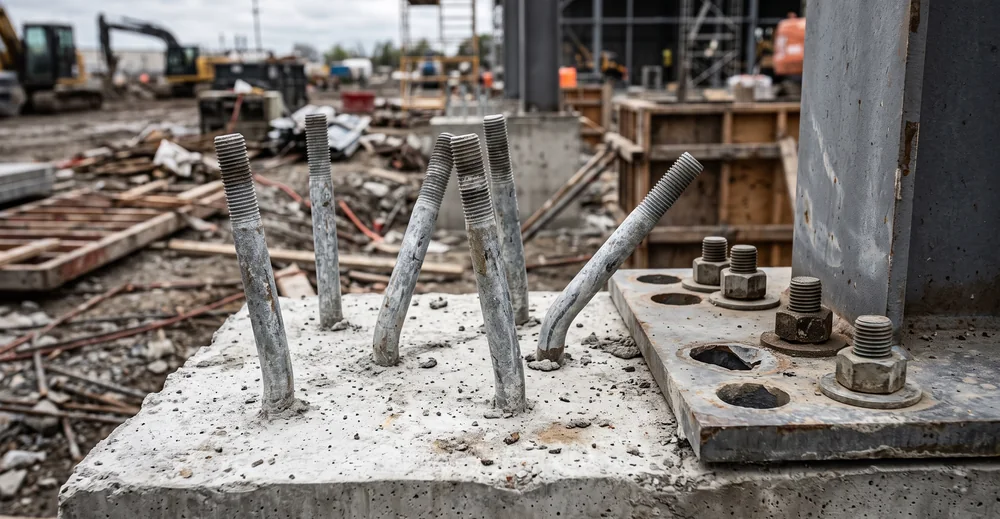
We are Hebei Leeter Import and Export Co., Ltd ("Leeter"), a manufacturer of ASTM F1554 anchor bolts in Dingzhou, Hebei. These are the questions that fill contractor forums in a panic the day after a pour — here is the same triage we give buyers, fix by fix.
Problem 1: the bolts are too short
The classic: the pier or grout came up high, and now there isn't enough thread above the sill plate or base plate to seat a nut. Ranked fixes:
- Coupling nut + threaded rod extension — the cleanest repair. A full-length coupling nut joins the short bolt to a rod extension of the same grade; full thread engagement on both sides. Match the grade and finish (an HDG bolt takes an HDG coupling and rod).
- Counterbore/route the sill (wood sill plates only) — recessing the washer and nut a quarter inch into the plate is a common, inspector-accepted fix for marginal cases; it must not over-weaken the plate, so get the sign-off first.
- Partial engagement with analysis — AISC allows reduced thread engagement where the engineer verifies it; this is an engineering call, not a field call.
- Abandon and retrofit — where the bolt is hopeless, cut it flush and install a drilled anchor beside it (Problem 2).
Prevention is cheap: order bolts with an inch or two of extra thread, and check formwork/grout elevations before the pour — extra projection costs cents, a repair costs a morning.
Problem 2: the crew missed (or misplaced) the anchor bolts
Missing sill-plate anchors are fixed after the fact with post-installed anchors:
- Wedge anchors for cured concrete — drill through the plate into the slab/stem wall and install at the same spacing the code wanted for cast-in bolts (IRC: within 12 in of each plate end, max 6 ft on centre, minimum two per plate section).
- Epoxy/adhesive anchors with threaded rod where higher capacity or closer edge distances are involved — follow the adhesive's embedment and cure table exactly.
- In some jurisdictions, approved plate straps/angle brackets spanning sill joints are accepted for isolated missed bolts — ask the inspector before choosing.
A misplaced bolt that lands under a stud or in a doorway is treated the same way: cut it flush, seal it, and set a retrofit anchor in the right spot.
Problem 3: the bolts came out bent
Bolts get knocked during the pour and cure at an angle. The field rules:
- Small lean (up to roughly 1:40, a few degrees): gentle cold-bending back to vertical is generally tolerated — bend low on the shank with a pipe over the bolt, steadily, never with heat on Grade 105 (heat-treated) bolts.
- Larger bends or a visible kink: the cold work has already damaged the steel; don't straighten and hope. Options are replacement (cut and retrofit) or an engineered fix.
- Grade matters: Grade 36 tolerates minor straightening best; Grade 55 with care; Grade 105 should not be heated or re-bent at all.
Problem 4: the bolts don't line up with the base plate
Steel-erection day, and the anchor pattern is off by half an inch. Accepted repairs, in order:
- Enlarge the base-plate holes and cover with thick plate washers welded to the base plate — the standard AISC-style field fix for small offsets.
- Slotted holes + engineered washers where the misalignment is directional.
- Cut and epoxy new rods in the correct pattern when the offset is beyond washer fixes.
All of these are engineer-approved repairs — the fabricator or EOR specifies the washer thickness and weld.
The wet-setting question
"Can we just push the J-bolts into the concrete right after the pour?" The consensus among engineers is no — wet-setting (wet-sticking) is rejected because you can't verify embedment, alignment or consolidation around the hook, and the logic is brutal: if the concrete is still soft enough to reform around the bolt, it's too soft to hold it. Codes assume anchors are positioned before placement — the reliable method is a plywood template screwed to the forms that holds every bolt plumb, at the right projection, through the pour. Our setting templates guide covers the layout.
Ordering your way out of repairs
Most of these emergencies trace to ordering, not workmanship: bolts bought too short, no template, unmatched nuts. When you order, specify projection with margin (grout + plate + washer + nut + 2–3 spare threads), matched A563 nuts (tapped oversize after galvanizing — a plain nut will not thread onto an HDG bolt), and a setting template per pattern. As the manufacturer we supply F1554 Grades 36/55/105 with matched hardware, extra-thread options and templates — see the selection and measurement guide for specifying.
Frequently asked questions
My anchor bolts are too short to get a nut on — what are my options?
Ranked: a coupling nut with a threaded-rod extension of the same grade and finish (cleanest); counterboring the wood sill so the nut seats lower, with the inspector's approval; partial thread engagement backed by the engineer's analysis; or abandoning the bolt and installing a drilled retrofit anchor beside it. Never leave a nut half-engaged and call it done.
The concrete crew missed some sill plate anchors — what do I do?
Retrofit with post-installed anchors: wedge anchors drilled through the plate into cured concrete at the code spacing (within 12 in of plate ends, max 6 ft on centre), or epoxy anchors with threaded rod where more capacity is needed. Some inspectors accept approved strap/angle hardware for isolated misses — ask before you buy.
Can I bend a crooked anchor bolt straight?
Only slightly. A lean of a few degrees can be cold-straightened gently, low on the shank, with a pipe — no heat. Anything with a visible kink or a large bend has already work-hardened; replace it or get an engineered repair. Never heat or re-bend Grade 105 bolts, which are heat-treated alloy.
Is wet-setting anchor bolts bad practice?
Yes — pushing bolts into fresh concrete after the pour is rejected by engineers because embedment, plumbness and consolidation around the hook can't be verified: concrete soft enough to reform around the bolt is too soft to grip it. Set bolts through a plywood template fixed to the formwork before placement.
The anchor bolts don't line up with my column base plate — what now?
For small offsets, enlarge the base-plate holes and weld thick plate washers over them — the standard field repair. Directional offsets can use slotted holes with engineered washers. Beyond that, cut the rods and epoxy new ones in the correct pattern. All of these need the engineer's sign-off on washer thickness and welds.
Sources
- Fine Homebuilding forum — anchor bolts too short (field fixes thread)
- Eng-Tips — "I thought wet setting anchor bolts was bad practice?"
- Eng-Tips — bent anchor bolts and base-plate misalignment repairs
- InterNACHI — IRC foundation anchor bolt spacing (R403.1.6)
- Portland Bolt — galvanized nuts tapped oversize
