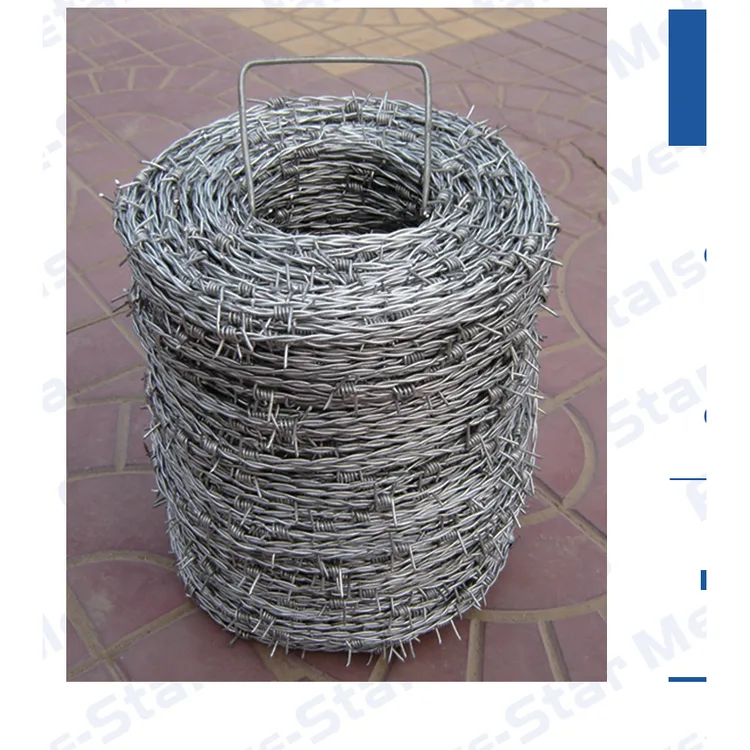
We are Hebei Leeter Import and Export Co., Ltd ("Leeter"), a wire and fencing manufacturer in Dingzhou, Hebei, exporting since 2006. Barbed wire is one of our core permanent-fencing lines, so this is the same quantity math we walk buyers through when they size an order — plus the coil and gauge notes importers actually need.
The standard roll: 1,320 ft, and what it weighs
The ranch-standard roll is 1,320 ft = ¼ mile = 80 rods (one rod = 16.5 ft). This is the unit almost every US manufacturer and farm store sells, and it is the number your whole estimate hangs on. Weight depends on the wire:
| Wire type | Weight per 1,320 ft roll |
|---|---|
| 12.5 ga standard (2-point) | ~77–78 lb |
| 12.5 ga Class 3 / 4-point | up to ~88–90 lb |
| 15.5 ga high-tensile (4-point) | ~40–45 lb |
High-tensile 15.5 ga weighs roughly half as much as 12.5 ga for the same 1,320 ft, because the wire is thinner high-carbon steel — a real saving on ocean freight for importers.
A note for buyers importing by the container: export barbed wire is packed by weight, in 25 kg and 50 kg coils, not by a fixed length. Do not trust the "metres per 25 kg coil" figures floating around online — those are for plain single-strand line wire. Twisted double-strand wire with barbs weighs far more per metre, so the length in a 25 kg coil is much lower and varies with wire diameter (1.4–2.5 mm) and barb spacing. Always take the metres-per-coil from the manufacturer's data sheet for the exact product.
How many strands? By livestock
Strand count is the multiplier on your fence length, and it is set by what you are containing:
| Animal | Barbed strands | Note |
|---|---|---|
| Cattle | 4–5 | NRCS minimum 4; 5 common with bulls or heavy pressure |
| Horses | — | Barbed wire is not recommended for horses (injury risk) — use smooth wire, rail or tape |
| Sheep & goats | 5–7 | NRCS spec is 7 barbed strands; woven "net" wire is usually preferred |
| Deer | — | Barbed wire does not contain deer — needs 8 ft woven/high-tensile deer fence |
| Boundary / "lawful fence" | 3–4 | Legally defined by your state fence statute — check the code |
For most cattle fences, plan 5 strands. That is the figure used in the tables below.
How much barbed wire to fence an acre
Here is where estimates go wrong. A square parcel's perimeter is 834.8 × √(acres) feet, so it does not double when the acreage doubles. One roll covers 1,320 ft of a single strand; multiply by strands to get total rolls.
| Acres | Side (ft) | Perimeter (ft) | Rolls per strand | Rolls for 5-strand |
|---|---|---|---|---|
| 1 | 209 | 835 | 1 | 4 |
| 5 | 467 | 1,867 | 2 | 8 |
| 10 | 660 | 2,640 | 2 | 10 |
| 40 | 1,320 | 5,280 (1 mile) | 4 | 20 |
| 160 | 2,640 | 10,560 (2 miles) | 8 | 40 |
| 640 | 5,280 | 21,120 (4 miles) | 16 | 80 |
(Rolls per strand are rounded up to whole rolls.) The pattern is the useful part: a 40-acre block is a sweet spot — its perimeter is exactly one mile. Going from 1 acre to 160 acres multiplies the area by 160 but the wire only by about 12.6, so rolls per acre collapse from ~3–4 down to 0.25. Big contiguous parcels are dramatically cheaper to fence per acre than small ones.
Barbed wire per mile
One mile is 5,280 ft, and 5,280 ÷ 1,320 = exactly 4 rolls per mile, per strand:
| Strands | Rolls per mile |
|---|---|
| 3 | 12 |
| 4 | 16 |
| 5 | 20 |
| 7 (sheep/goat) | 28 |
Posts and staples
Wire is only part of the order — size the posts and fasteners with it:
- Line-post spacing is typically 12–16.5 ft (T-posts often at 12 ft; one rod, 16.5 ft, is the traditional maximum). NRCS lists a 20 ft minimum spec, but that is a floor, not tight-livestock spacing.
- Posts per mile: about 440 at 12 ft, 320 at 16.5 ft — plus corner and brace assemblies, and a wood/H-brace at least every 1,320 ft.
- T-post to wood ratio is commonly about 5:1 — steel T-posts on the line, wood or pipe braces at corners, ends, gates and dips.
- Fasteners: one staple per wire per wood post, so a 5-strand fence uses 5 staples per wood post (1½–2 in., 8–9 ga galvanized). T-posts use clips, not staples — 5 clips per post for 5 strands. A mile of 5-strand on 12 ft wood posts is roughly 2,200 staples.
For choosing between T-posts, wood and pipe, see our fence post options comparison.
Add a waste allowance
Add 5–10% to the linear wire for splices, corner wraps, tie-offs and take-up, and 10–15% for hilly ground, many corners or lots of short runs. Remember that terrain also adds real length — a fence that rides over hills is longer than the flat map distance.
The classic wrong answers
Three mistakes show up on cost-content pages again and again — avoid them:
- "One roll covers about two acres." That is a single-strand figure for a lone ~1-acre square. A real 5-strand acre needs 3–4 rolls — six to eight times more. Always multiply by strands.
- Assuming wire scales with acreage. Double the acres does not double the wire; perimeter scales with √area.
- Wrong roll length. The barbed-wire standard is 1,320 ft (80 rods). Do not confuse it with woven-wire "20-rod" rolls (330 ft) or quote a "50-lb roll" as if pounds were a length.
Specifying and buying barbed wire
Once you know the quantity, pin down the wire itself — gauge, coating and barb pattern all change price and life. Our barbed wire specifications guide covers gauge and twist in detail; in short:
- State gauge and finish: 12.5 ga for standard hot-dip galvanized, 15.5 ga high-tensile for lighter, longer runs; Class 1 vs Class 3 zinc for service life; PVC-coated for coastal or decorative lines.
- State barb pattern: 2-point vs 4-point, and barb spacing (typically 3", 4" or 5").
- Confirm coil packing (25 kg / 50 kg), coils per pallet and container quantity, with a galvanizing certificate and a third-party check before shipment.
As the manufacturer we supply barbed wire in 12.5 and 15.5 ga, 2- and 4-point, hot-dip galvanized, Class 1/3 or PVC-coated, in 25 kg and 50 kg export coils — send your total length, strands and gauge and we will work the coil count for the container.
Frequently asked questions
How much barbed wire do I need to fence an acre?
A square 1-acre lot has a perimeter of about 835 ft. Since one standard roll is 1,320 ft per strand, a 5-strand fence around a single acre needs roughly 4 rolls. But larger parcels are far more efficient: 10 acres needs about 10 rolls (5-strand) and 40 acres about 20 — because perimeter grows with the square root of area, not in proportion to it.
How long is a roll of barbed wire?
The US standard roll is 1,320 ft, which equals a quarter mile or 80 rods. It weighs about 77–90 lb in 12.5 gauge and roughly 40–45 lb in 15.5 gauge high-tensile. Short DIY rolls (100 ft, 330 ft) exist at retail, but 1,320 ft is the ranch and wholesale unit. Export coils are instead packed by weight, in 25 kg and 50 kg.
How many rolls of barbed wire are in a mile?
Exactly 4 rolls per strand, because a mile is 5,280 ft and a roll is 1,320 ft. So a 3-strand fence is 12 rolls per mile, a 4-strand is 16, a 5-strand is 20, and a 7-strand sheep-and-goat fence is 28 rolls per mile.
How many strands of barbed wire do I need?
For cattle, plan 4–5 strands (5 is common with bulls or heavy pressure). Sheep and goats need 5–7 (the NRCS spec is 7). Barbed wire is not recommended for horses and will not contain deer. Boundary "lawful fence" strand counts are set by your state's fence statute, so check the local code.
How many posts per mile of barbed wire fence?
At 12 ft spacing you need about 440 line posts per mile; at the traditional 16.5 ft (one rod) maximum, about 320 — plus corner and brace assemblies. Fasteners run one per wire per wood post (5 staples per post on a 5-strand fence) or a clip per wire on T-posts. Add a 5–10% wire allowance for splices and corners, more on hilly ground.
Sources
- USDA-NRCS — Fence (Practice 382) Fact Sheet: strands, spacing and brace intervals
- Michigan State University Extension — Fencing Systems for Livestock
- Rangemaster Fence — Acreage Chart (80-rod roll coverage)
- Red Brand — How Much Fence Do I Need?
- Bekaert — high-tensile and standard barbed wire specifications
