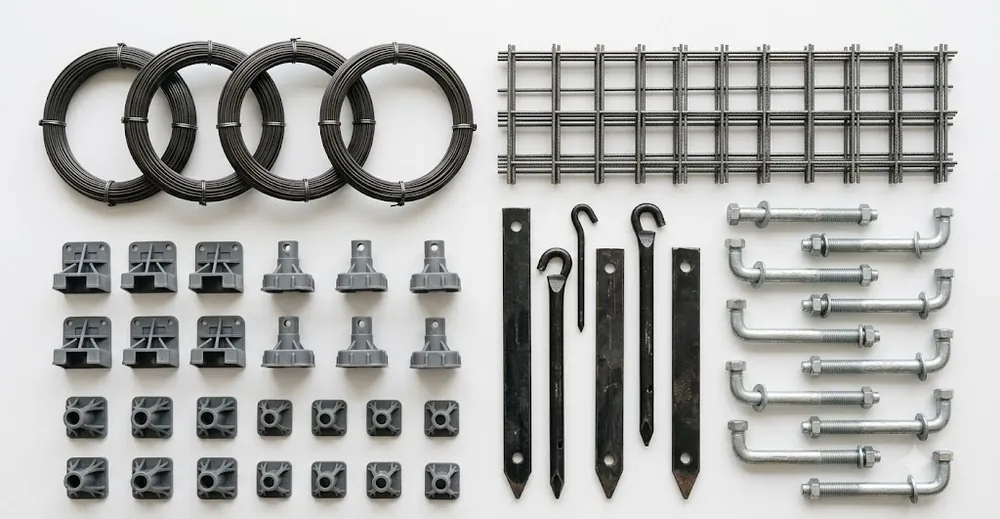
The order below is grouped the way a distributor or a foreman would buy it. Each section explains what to purchase, why it matters on site, and roughly how much to carry for a typical mid-size pour. Quantities are starting points, not gospel. Your drawings, local code, and inspector always win.
Start with the reinforcement tie wire
Tie wire is the smallest item on the list and the one crews burn through fastest. It holds rebar intersections in position while concrete is placed, so nothing shifts under the weight of the pour. Buy more than you think you need. Running out mid-slab stops the whole crew.
The workhorse is 16 gauge annealed black rebar tie wire, soft enough to twist by hand or with a tie tool and strong enough to hold a joint. For heavier bar or windy conditions, some crews step up to 15 gauge. Coils and spools both work. If your team uses automatic tie guns, buy the pre-cut wire reels the gun is spec'd for, since loose coil will not feed.
How much? A rough field rule is one 3.5 lb coil per ton of rebar for typical slab spacing, more when intersections are tight. We usually suggest carrying a full case so a half-day of tying never gets interrupted. Order annealed wire in bulk cartons; it stores well and does not spoil.
| Item | Use | Typical order |
|---|---|---|
| 16 ga black annealed tie wire | Hand-tying rebar intersections | 20-50 lb per pallet job |
| 15 ga annealed tie wire | Heavier bar, windy sites | 10-20 lb as backup |
| Pre-cut tie gun reels | Automatic tie tools | 1 case per crew per week |
What loop ties and bag ties belong on the list?
Loop ties and bar ties speed up the same job that hand wire does, only faster and more consistently. A double-loop tie, sometimes called a bag tie or snap tie for rebar, is a pre-cut, pre-looped wire the worker wraps once and twists. Crews tying hundreds of intersections a day save real hours this way, and the ties come out uniform.
Standard loop ties are 16 gauge black annealed, cut to lengths like 4, 5, or 6 inches depending on how many bars stack at the joint. Longer loops for bundled bar, shorter for single-bar mesh. Buy them boxed by the thousand. They travel well and never go to waste, since any concrete job with rebar eats them.
In our experience the crews that mix hand wire with a stock of loop ties finish reinforcement fastest. Hand wire covers the odd corner; loop ties handle the repetitive grid. Carry a couple of boxes of each length so the foreman is not rationing them near the end of a mat.
Welded wire mesh for slabs and flatwork
Welded wire mesh reinforces slabs on grade, driveways, sidewalks, and light flatwork where full rebar mats are more than the job needs. The mesh distributes shrinkage cracking across the pour instead of letting it concentrate in one line. It is a staple of the concrete hardware list because so many residential and commercial slabs specify it.
Mesh comes in sheets and rolls. Sheets lie flatter and are easier to place accurately, which is why most commercial crews prefer them; rolls cost less and suit long continuous pours. The common spec is 6x6 W1.4/W1.4, often written 6x6 10/10 in the old gauge system. Heavier slabs move to 4x4 or thicker wire.
Order by the square footage of slab plus a lap allowance. Sheets should overlap one full grid square, roughly 6 inches, and get tied at the laps, so buy about 10 percent more area than the raw slab measurement. Keep mesh off the ground on chairs so it sits in the middle third of the slab, not on the dirt where it does nothing.
Which rebar chairs and bolsters do you need?
Rebar supports keep steel at the correct height inside the concrete, and skipping them is the most common reason reinforcement ends up in the wrong place. If bar sits on the subgrade, it cannot resist tension where the slab needs it. Chairs, bolsters, and spacers all solve the same problem at different scales.
For slabs, plastic or wire rebar chairs hold single bars or mesh at a set cover height, commonly 2 or 3 inches. Plastic chairs with wide feet resist punching into soft subgrade and vapor barriers. Wire bar chairs and slab bolsters run in continuous rows under long bar. For walls and columns, wheel spacers clip onto the bar and set side cover against the form.
Sizing chairs to your cover requirement
Buy chairs by the concrete cover your drawings call for. A slab needing 3 inches of bottom cover takes a 3-inch chair, no substitutions. Order a range of heights on any job with both slabs and footings. Quantity depends on bar spacing: figure one support roughly every 3 to 4 feet along each bar, then round up.
Continuous supports versus individual chairs
Slab bolsters and beam bolsters carry many bars at once and stay aligned better than scattered individual chairs on wide mats. On a big flat pour, continuous supports save labor. On small footings or patch work, loose chairs are simpler. Most contractors stock both, since a mixed jobsite uses each somewhere.
Anchor bolts and embeds for connections
Anchor bolts tie the structure that comes later to the concrete you are pouring now. Sill plates, column base plates, equipment, and steel connections all land on embedded anchors, so the shopping list is not complete without them. Set them wrong and the trade that follows loses days.
The everyday item is the cast-in-place anchor bolt, typically an L-shaped or J-shaped hooked bolt in 1/2 or 5/8 inch diameter for wood sill plates, larger for structural steel. Galvanized is the honest choice anywhere near moisture or exterior exposure, since a rusting anchor is a callback waiting to happen. For heavier connections, headed anchor bolts and anchor rods with plate washers and nuts do the work.
Buy anchors as a kit where you can: bolt, nut, and washer together so nothing is missing at set time. Count them off the plans, one per hold-down and per plate location, then add spares, because a dropped bolt in wet concrete is gone. We ship anchors matched to nuts and washers for exactly this reason.
What form and safety hardware rounds out the order?
Form hardware and safety gear are the quiet part of the construction hardware list that keeps a pour contained and a crew injury-free. Forms have to hold their line against fresh concrete pressure, and exposed rebar ends have to be covered. Neither is optional, and inspectors check both.
Form stakes, usually round or flat steel pins with nail holes, drive into the ground to brace edge forms for slabs, curbs, and footings. Buy them in 18, 24, and 30 inch lengths so the crew can match stake to soil. Add double-headed form nails and snap ties or she-bolts for wall forms. On the safety side, plastic rebar caps, and OSHA-rated impalement-protection caps for anything a worker could fall onto, slide over every upstanding bar end.
| Item | Use | Typical order |
|---|---|---|
| Steel form stakes 18-30 in | Bracing edge forms and curbs | 1 per 2-3 ft of form edge |
| Double-head form nails | Fastening and stripping forms | 5-10 lb per slab |
| Plastic rebar safety caps | Covering exposed bar ends | 1 per vertical bar, plus spares |
| Impalement-rated caps | Fall-protection zones | Per OSHA on the exposed grid |
Round the order out with a few consumables that never make the plans but always get used: form-release oil, marking chalk, spare tie tool reels, and a box of assorted plastic spacers. Carrying them means the foreman is not sending someone to the supply house mid-morning.
How much of each should a distributor stock?
A distributor serving concrete contractors should weight inventory toward the fast-movers: tie wire, loop ties, and rebar chairs turn over far faster than anchor bolts or mesh, which are ordered per job. Stocking depth follows how the products get consumed, not how much they cost.
Tie wire and loop ties are pure consumables; keep deep shelves. Chairs and spacers sell in mixed heights, so breadth matters more than depth. Mesh and anchors are typically bought to a specific slab or connection, which means quoting and lead time matter more than shelf stock. That split is the honest way to plan a construction hardware list you resell rather than install.
If you are sourcing these lines for resale or a large project, we manufacture the full range in Dingzhou and consolidate mixed loads so one container covers wire, mesh, supports, and anchors together. That saves you juggling several suppliers. Request a quote and we will help size the order to your job list.
Frequently asked questions
How much tie wire do I need for a rebar job?
A practical starting figure is one 3.5 lb coil of 16 gauge annealed wire per ton of rebar at typical slab spacing. Tighter grids and heavier bar use more. We suggest carrying extra, because running out mid-pour stops the entire crew and costs far more than a spare coil.
What is the difference between rebar chairs and bolsters?
Chairs support individual bars or mesh at a set height and get placed in a grid across the pour. Bolsters are continuous supports that carry many parallel bars in one long row. Wide slab mats favor bolsters for alignment and speed; small footings and patch work use individual chairs.
Do I need galvanized anchor bolts?
Use galvanized anchor bolts anywhere exposed to moisture, weather, or exterior conditions, and follow your engineer's spec. A plain steel anchor in a damp or outdoor location can corrode and weaken the connection over time. Galvanizing costs a little more up front and prevents callbacks later, which makes it the honest default outdoors.
What welded wire mesh spec is standard for slabs?
The common residential and light commercial spec is 6x6 W1.4/W1.4, older labeled 6x6 10/10. Heavier slabs step up to 4x4 spacing or thicker wire. Always order about 10 percent extra area for laps, since sheets overlap one grid square and get tied together at the seams.
Can I order all this hardware from one supplier?
Yes. We manufacture tie wire, loop ties, welded mesh, rebar chairs and bolsters, anchor bolts, form stakes, and safety caps, then consolidate them into a single mixed container. Buying the full construction hardware list from one factory cuts your paperwork, freight coordination, and lead-time headaches versus splitting the order across vendors.
Ready to build your order? Send us your job list or drawings and we will help size quantities and quote a consolidated load. Contact us to get started.
