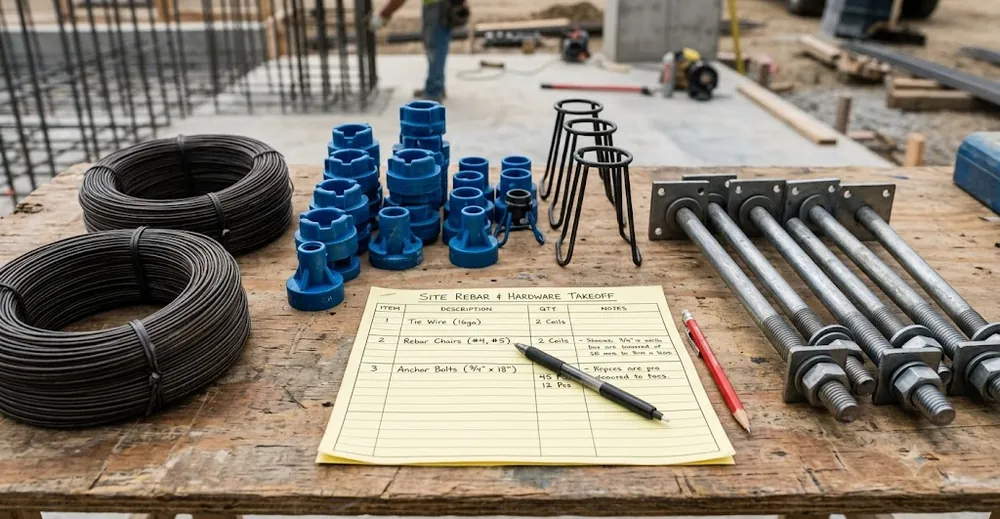
We keep it grounded in field ratios we see in real practice, not lab ideals. Your ties will vary with crew habit and bar size. Your chair count depends on spacing and slab geometry. Treat the rules of thumb here as starting points, then adjust for your own history.
Start with the rebar takeoff
Everything downstream depends on two numbers: total rebar tonnage and total intersections to be tied. Pull the tonnage straight from the bar schedule, either as a supplied weight or by summing bar length times unit mass. A #4 (12 mm) bar runs about 0.668 kg/m, and a #5 (16 mm) runs about 1.552 kg/m, so a schedule converts to weight quickly.
Once you have tonnage, decide how you will tie. Not every intersection gets a tie. A common field practice on flat slab mats is to tie every intersection at edges and every second or third one in the field, which cuts tie count substantially versus tying everything. Write down your assumed tie ratio, because it drives both the tie wire estimate and the labour estimate. If you are unsure, tying roughly every other intersection is a reasonable planning midpoint for standard slabs on grade.
You also need the support geometry: bar spacing in each direction and the number of layers. A single top mat and a single bottom mat need separate chair or bolster runs. Note the cover requirement too, since it sets chair height, not quantity, but it stops you ordering the wrong part.
How much tie wire do you need?
Tie wire is the cheapest accessory to buy and the easiest to underestimate, so start here. As a planning ratio, budget roughly 8 to 14 kg of 16-gauge (1.6 mm) annealed tie wire per tonne of rebar for typical slab and footing work. Lighter mats with wide spacing land near the low end. Dense mats, smaller bars and heavy tying push toward the high end.
Two ways exist to reach a number, and we recommend running both as a cross-check.
Ratio method. Multiply your rebar tonnage by a chosen kg-per-tonne figure. For 40 tonnes at 11 kg/tonne, that is 440 kg of tie wire. Fast, and good enough for early budgeting.
Count method. Estimate total ties, then multiply by wire per tie. A single snap tie on #4 to #5 bars consumes roughly 0.30 to 0.40 m of wire once you include the twist and waste. So 60,000 ties at 0.35 m each is 21,000 m of wire. With 16-gauge weighing about 15.6 kg per 1,000 m, that is roughly 328 kg. If your two methods disagree by a wide margin, revisit your tie ratio, that is usually the culprit.
Add a waste allowance on top. We suggest 10 to 15 percent for dropped ties, cut-offs and the reel ends nobody wants to fight. If your crew uses battery tie guns, switch to the manufacturer's collated wire spool count instead of loose reels; a tie gun uses a fixed wire length per tie, which makes counting easier but changes your per-tie consumption. For loose hand-tying, keep a spare box of rebar tie wire on the truck regardless of the math, because reorders for a 10 kg shortfall are never worth the delay.
How many chairs and bolsters do you need?
Support count comes straight from the spacing grid, and it is the accessory contractors most often shortchange. Chairs and bolsters hold the mat at correct cover; too few and the steel sags or floats during the pour, failing inspection. For continuous bolster strip, divide the mat area by the strip spacing. For individual chairs, use a support grid, commonly one chair every 1.0 to 1.2 m in each direction for light slab mesh, and tighter for heavy bar.
Here is the individual-chair method step by step. Pick a support spacing, say 1.0 m each way. Divide slab length and width by that spacing, add one to each for the end rows, then multiply. A 20 m by 30 m slab at 1.0 m spacing needs about 21 x 31, or 651 chairs per mat. A top mat and bottom mat double it, though top mats often use a wider grid or upper continuous bolsters instead.
Continuous bolster is counted by length, not by piece. Run bolster rows perpendicular to the main bars at your chosen row spacing, sum the row lengths, then divide by the stock bolster length to get pieces. Add roughly 5 to 10 percent for overlap at row ends and breakage.
| Accessory | Estimating basis | Planning rule of thumb | Waste to add |
|---|---|---|---|
| Tie wire (16 ga) | Per tonne of rebar | 8-14 kg per tonne | 10-15% |
| Individual chairs | Support grid area | 1 per 1.0-1.2 m each way, per mat | 5-10% |
| Continuous bolster | Row length | Rows at 1.0-1.5 m, sum length / stock length | 5-10% |
| Safety caps | 1 per exposed vertical bar end | Count dowels + verticals, add spares | 10% |
Match chair height to your cover requirement and chair type to your surface. Plastic-tipped or all-plastic supports suit exposed slabs on grade. Wire bar chairs and slab bolsters suit heavier decks. Browse rebar chairs by height so you order the cover you specified, not the one closest at the counter.
How many rebar safety caps do you need?
Safety caps are a headcount item, and on many jobs they are also a code requirement. OSHA impalement protection rules mean every exposed vertical bar end that a worker could fall onto needs a cap or equivalent guard. So the estimate is simple in principle: count the exposed vertical and projecting bar ends, then add spares for loss and reuse rotation.
Walk the drawings for dowels, column verticals, wall starter bars and any projecting stubs that will be exposed during construction. Sum them. Add about 10 percent because caps crack, walk off site and get buried. If verticals are placed in stages, you can rotate a smaller pool of caps as lower ends get encased, so the peak simultaneous count, not the total bar end count, drives your buy quantity. That distinction alone can cut a cap order meaningfully on multi-lift wall work.
Pick the cap rated for the fall protection you need. Simple mushroom caps stop scrapes but are not all rated for impalement; guard-rated caps carry a load rating. Order to the rating your safety plan specifies.
A worked example: slab on grade
Numbers make the method concrete, so here is a single 20 m by 30 m slab on grade, 600 m2, with a top and bottom mat of #5 (16 mm) bar at 200 mm spacing each way. This is a mid-size pour, the kind where a tidy estimate saves a scramble.
First, tonnage. At 200 mm spacing, each mat has about 101 bars one way and 151 the other, roughly 3,050 lineal metres per mat, 6,100 m for both mats. At 1.552 kg/m that is about 9.47 tonnes of steel. Call it 9.5 tonnes.
Tie wire, ratio method: 9.5 tonnes at 11 kg/tonne gives about 105 kg. Add 12 percent waste, order roughly 118 kg. Cross-check by count: two mats at 200 mm spacing produce many intersections; tying every second one and applying 0.35 m per tie lands in a similar range, which gives us confidence.
Chairs, bottom mat: at 1.0 m support grid, 21 x 31 is 651 chairs. The top mat on continuous upper bolster instead of individual chairs, so we price bolster by length there. Safety caps: this slab has few verticals, so caps track any dowels at construction joints or wall tie-ins, counted from the plan. Order those plus 10 percent.
That single pass produces a clean order: about 118 kg tie wire, roughly 700 bottom chairs including waste, bolster by the metre for the top mat, and caps by dowel count. One order, not three.
Common estimating mistakes to avoid
The biggest estimating error we see is guessing tonnage instead of pulling it from the schedule, which throws off every accessory downstream. The second is assuming you tie every intersection; that inflates both wire and labour and quietly wrecks the budget. The third is matching chair height to habit rather than the specified cover, which passes the count but fails the inspection.
A fourth trap is forgetting the waste factor entirely. Accessories are consumables. Wire snaps, chairs crack, caps disappear, and a zero-waste estimate guarantees a reorder. Build in the 5 to 15 percent buffer up front so the field never stalls on a small part.
Keep your assumptions written beside the numbers: tie ratio, support grid, cover, waste percent. When a job comes in different from your estimate, you can see which assumption moved and tighten it next time. That habit turns estimating from a guess into a record.
Frequently asked questions
How much tie wire per tonne of rebar should I estimate?
Budget roughly 8 to 14 kg of 16-gauge annealed tie wire per tonne of rebar for typical slab and footing work, then add 10 to 15 percent waste. Wide-spaced light mats sit near the low end; dense mats with small bars and heavy tying push toward the high end. Cross-check with a per-tie count when the job is unusual.
What tie wire gauge is standard for hand tying?
Sixteen-gauge, about 1.6 mm, black annealed wire is the common choice for hand tying #4 through #6 bar. It is soft enough to twist cleanly and strong enough to hold the mat. Heavier bar or bundled bars may use double ties or a slightly heavier gauge. Battery tie guns use manufacturer-specified collated wire, so follow the tool spec there.
How do I calculate the number of rebar chairs?
Divide slab length and width by your support spacing, add one to each direction for end rows, then multiply. At 1.0 m spacing a 20 by 30 m mat needs about 21 x 31, or 651 chairs. Double for a second mat unless the top mat uses continuous bolster. Add 5 to 10 percent for breakage, and match chair height to your cover.
Do I need a safety cap on every rebar end?
Every exposed vertical or projecting bar end a worker could fall onto needs impalement protection under OSHA rules, which usually means a rated cap or guard. If verticals are placed in stages, rotate a smaller pool of caps as lower ends get encased, so the peak simultaneous count drives your buy. Add about 10 percent for loss and breakage.
How much waste should I add to accessory estimates?
Add 10 to 15 percent to tie wire and safety caps, and 5 to 10 percent to chairs and bolster. Accessories are consumables that snap, crack and disappear on an active site. A zero-waste estimate almost guarantees a mid-pour reorder, and the delay costs far more than the buffer. Adjust the percentage from your own job history over time.
Need a hand turning your bar list into an accessory order that lands right the first time? Request a quote and we will help you size tie wire, chairs and caps to your job.
