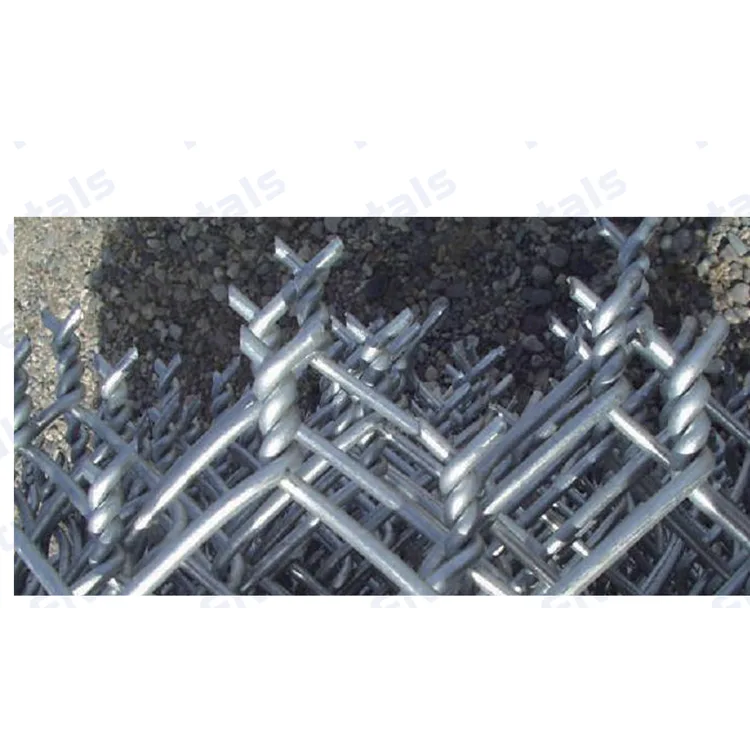
We are Hebei Leeter Import and Export Co., Ltd ("Leeter"), a chain link fence manufacturer in Dingzhou, Hebei, exporting since 2006. This guide is the quantity and bill-of-materials side; for the fabric itself — mesh size, gauge and selvage — see our chain link fabric guide.
Fabric: rolls and heights
Chain link fabric ships in 50 ft rolls in the US, in standard heights of 3, 3.5, 4, 5 and 6 ft (commercial and industrial fabric runs up to 8, 10 and 12 ft). Fabric needed is simply fence length ÷ 50, rounded up.
For export and metric markets the unit changes: fabric ships in 25 m rolls (about 82 ft) in heights of 0.9, 1.2, 1.5, 1.8 and 2.4 m. Container quantities are quoted in rolls, not linear feet, so convert before you order — a 100 ft US run is 2 rolls, but the same run in 25 m metric fabric is a little over 1 roll.
Line post spacing: 10 ft on center
The industry and code maximum for chain link line posts is 10 ft on center (per ASTM F567 and municipal fence specs). Closer spacing is optional stiffening, not a requirement. The count on a straight run is:
Line posts = (length ÷ 10) + 1
The "+1" is the post that closes the far end — forget it and every run is one post short.
| Run length | Gaps at 10 ft | Posts (straight run) |
|---|---|---|
| 100 ft | 10 | 11 |
| 200 ft | 20 | 21 |
| 500 ft | 50 | 51 |
| 1 mile (5,280 ft) | 528 | 529 |
Then add a terminal post at every end, corner, gate side and pull point on top of that grid — those are separate from the line-post count.
Post types and sizes
There are two families: line (intermediate) posts and terminal posts (ends, corners, gates and pulls). Count the terminals first, then fill line posts at ≤10 ft between them.
| Post role | Residential OD | Commercial OD |
|---|---|---|
| Line post | 1-5/8" – 2" | 2" – 2-3/8" |
| Terminal (end / corner / gate) | 1-7/8" – 2-3/8" | 2-3/8" – 2-7/8" |
The rule that catches people: a terminal post is one OD size larger than the line post on the same job, because it anchors all the fabric tension. Setting depth follows the "one-third rule" — bury at least a third of the post length (about 30–36" for a 4–6 ft fence, deeper for 8 ft) — but local frost line overrides the rule of thumb in freeze-thaw regions.
Top rail: 21 ft lengths
Top rail comes in 21 ft lengths with a swaged (crimped) end so sections nest without a separate sleeve. Rail runs the full length of the fence, so:
Top rail lengths = fence length ÷ 21, rounded up
A 100 ft run needs 5 lengths (100 ÷ 21 = 4.76). Line posts carry the rail through a loop/eye-top cap (one per line post); terminal posts get a dome post cap, and the rail terminates into a rail end held by a brace band.
Hardware per terminal post
This is where bills of materials go wrong. Each fabric face at a terminal post needs a fixed hardware set:
| Hardware | Count rule | 4 ft fence |
|---|---|---|
| Tension bar | 1 per face, full height | 1 |
| Tension bands | (height in ft − 1) per face | 3 |
| Brace band | 1 per rail connection | 1 |
| Rail end | 1 per rail direction | 1 |
| Post cap (dome) | 1 per terminal post | 1 |
The key subtlety: an end post has 1 face, but a corner or pull post has 2 faces — so a corner needs double the tension bars and bands. And tension bands are height minus one (a 4 ft fence gets 3 bands per face, a 6 ft fence gets 5), not one per foot.
Continuous, per-length items:
- Bottom tension wire (coil wire) runs the full fence length along the base, with the fabric tied to it about every 24".
- Tie wires attach the fabric to line posts every 12" and to the top rail every 24" — roughly 4–5 ties per line post on a 4 ft fence, plus about one tie per 2 ft of rail.
Worked example: 100 ft, 4 ft high, two ends and one corner
An L-shaped 100 ft run with two ends and one corner → 11 posts total: 3 terminal (2 ends + 1 corner) + 8 line.
| Component | Qty | Basis |
|---|---|---|
| Fabric, 4 ft × 50 ft roll | 2 | 100 ÷ 50 |
| Line posts (1-5/8") | 8 | 11 − 3 terminal |
| Terminal posts (2-3/8") | 3 | 2 ends + 1 corner |
| Top rail, 1-3/8" × 21 ft | 5 | 100 ÷ 21, round up |
| Loop caps (line) | 8 | 1 per line post |
| Dome caps (terminal) | 3 | 1 per terminal |
| Tension bars | 4 | ends 1 + 1, corner 2 faces |
| Tension bands | 12 | (4 − 1) × 4 faces |
| Brace bands | 4 | matches faces |
| Rail ends | 4 | matches brace bands |
| Bottom tension wire | 100 ft (1 coil) | fence length |
| Tie wires | ~80 | ~35 line + ~50 rail |
Add a walk gate and you add a gate frame, two gate posts (terminal-sized), hinges and a latch — and each gate post becomes another fabric face. For concrete, budget roughly 1.5–2 bags (60 lb) per line post and 2–3 bags per terminal, adjusting for hole size and frost depth.
Buying chain link for import
- State the unit clearly — 50 ft rolls for the US market or 25 m rolls for metric, plus height and gauge — and quote container loads in rolls.
- Order terminal posts one size up from line posts, and a matched hardware kit per terminal face (tension bar, bands, brace band, rail end, cap) so nothing is short on site.
- Confirm the finish (galvanized or PVC-coated core-and-clad) — see PVC-coated vs galvanized chain link — and whether posts and rail are pre-cut or mill lengths.
As the manufacturer we supply chain link fabric, posts, top rail, gates and the full tension-and-tie hardware set, galvanized or PVC-coated, in US 50 ft or metric 25 m rolls — send your fence length, height and corner/gate count and we will build the bill of materials for the container.
Frequently asked questions
How much chain link fabric do I need?
Divide the fence length by the roll length and round up. US fabric comes in 50 ft rolls, so 100 ft of fence is 2 rolls and 300 ft is 6. Metric export fabric comes in 25 m rolls (about 82 ft), so the same 100 ft run is a little over 1 roll. Always match the height (3–6 ft residential, up to 12 ft commercial) and buy full rolls.
What is the maximum post spacing for chain link fence?
Ten feet on center is the maximum for chain link line posts under ASTM F567 and typical municipal specs. You can space posts closer for extra rigidity, but not wider. Count line posts as (length ÷ 10) + 1 on a straight run, and add a separate terminal post at every end, corner and gate.
How many posts do I need for a 100 ft chain link fence?
For a straight 100 ft run, 11 posts — ten 10 ft gaps plus one to close the end. If the run turns a corner, one of those becomes a heavier terminal post and you may add posts; an L-shaped 100 ft run with two ends and one corner is typically 3 terminal posts plus 8 line posts. Terminal posts are one size larger in diameter than line posts.
How long is chain link top rail?
Top rail comes in 21 ft lengths with a swaged end that lets sections join without a sleeve. Because rail runs the full fence length, divide the length by 21 and round up — a 100 ft fence needs 5 lengths. Line posts carry the rail with loop caps; terminal posts get a dome cap and the rail ends in a rail end held by a brace band.
How many tension bands per post?
One less than the fence height in feet, per fabric face. A 4 ft fence uses 3 tension bands per face and a 6 ft fence uses 5. An end post has one face, but a corner or pull post has two faces, so it needs double the tension bars and bands — the most commonly miscounted item on a chain link bill of materials.
Sources
- ASTM F567 — Standard Practice for Installation of Chain-Link Fence
- Chain Link Fence Manufacturers Institute (CLFMI) — commercial fence product manual
- FHWA Standard Drawing E619-07 — chain link fence detail (tie spacing)
- Hoover Fence — comparing grades of chain link (post diameters)
- Total Fence Supply — how many tension bands to order
