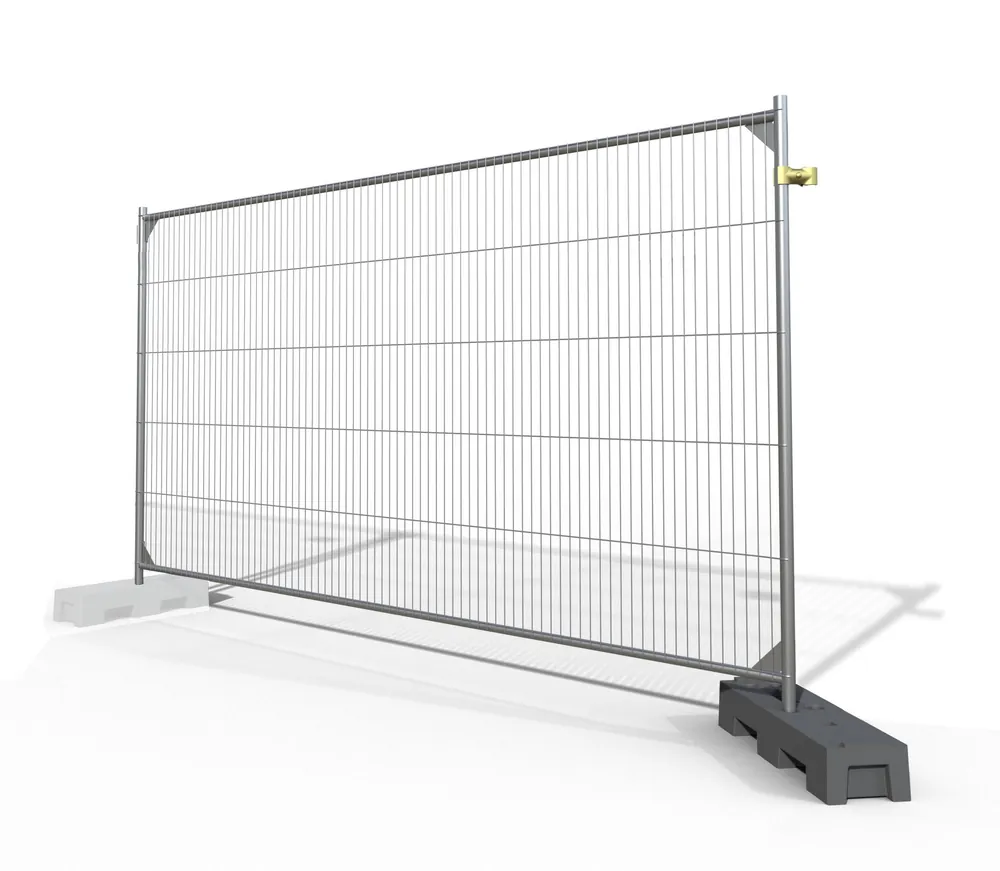
We are Hebei Leeter Import and Export Co., Ltd ("Leeter"). We manufacture welded-mesh, chain-link and steel-tube temporary fencing with the feet, clamps, couplers and braces that rental fleets run — so this is the failure mode we design against, explained the way we'd brief a fleet manager.
Why panels go over
An open mesh panel lets most wind pass through; a 2.0–2.1 m panel on plastic feet stands happily in normal weather. Three things change that:
- Privacy/windscreen fabric. Screen converts the panel's open area into solid sail. Wind load rises by multiples, and the tall, narrow footprint of a temporary panel has almost no lever arm to resist it. Most blow-over stories start with screen and not enough weight or braces.
- Under-ballasted feet. A single sandbag per foot degrades fast on site — UV rots the bags, crews kick them aside, vehicles clip them. What was "ballasted" in week one is loose in week six.
- Long unbraced straight runs. A hundred metres of coupled panels acts like one continuous wall; one gust finds the weakest foot and unzips the line.
The fixes, in order of cost
1. Ballast properly (and maintain it)
- Use purpose-made feet — concrete-filled HDPE or solid concrete blocks — not improvised weights. Flat "stand" style feet on hard surfaces (concrete/asphalt, where you can't drive posts) need weight added deliberately.
- With screen fitted, plan multiple sandbags or a concrete block per foot, and treat ballast as a consumable: bags UV-degrade and split; inspect and replace on a schedule.
- On paving, sandbags over the foot plates beat blocks beside them — weight must load the foot, not sit near it.
2. Brace the line
- Angle braces (outriggers) every few panels turn a wall into a series of triangles — the single most effective upgrade for a screened run.
- Brace every panel adjacent to gates and corners, which concentrate load.
- Stagger or dog-leg long runs every 20–30 m; a small plan offset breaks the continuous-wall effect and adds geometric stability without hardware.
3. Manage the screen itself
- Specify open-weave windscreen rather than solid film — a mesh screen with 20–30% open area sheds a large share of the load while still blocking sightlines.
- In forecast high winds, the honest procedure rental companies use: roll up or drop the screen before the storm, not after.
4. Upgrade the system for windy sites
- Driven-post temporary fence — chain-link fabric on posts driven into the ground — resists wind far better than any free-standing panel and is the standard choice for long-duration perimeter on soil.
- Where panels must stay, choose heavier frames and infill (larger tube OD/wall, 4 mm+ infill wire): panel mass itself is ballast. See the panel specifications guide for the weight levers.
Spec checklist for a wind-resistant fleet
| Item | What to specify |
|---|---|
| Feet | Concrete-filled HDPE or solid concrete; flat stands + added ballast for hard surfaces |
| Ballast plan | Bags/blocks per foot with screen vs without; replacement schedule |
| Braces | Angle braces + clamps, ratio per screened run (e.g. one per 2–3 panels) |
| Couplers/clamps | Top clamps at every joint — a line is only as stiff as its loosest coupler |
| Panel weight | Tube OD × wall and infill wire diameter — heavier panels for exposed sites |
| Screen | Open-weave windscreen; roll-down procedure for storm forecasts |
As the manufacturer we supply the full system — panels in AU/NZ, Canadian and US formats, concrete-filled and steel feet, top clamps, couplers, stays and braces — from Hebei and from our Vietnam factory (UNION TOP METAL (VIET NAM) LTD). Send your wind zone and whether the fleet runs screened, and we'll spec the feet-and-brace package with the panels.
Frequently asked questions
Why does my temporary fence keep blowing over?
Almost always a combination of privacy screen (which turns open mesh into a sail), too little ballast on the feet, and long unbraced straight runs. Fix in that order: manage or remove the screen, put real maintained weight on every foot, and add angle bracing with a stagger or dog-leg every 20–30 m.
How much weight do I need on temporary fence feet?
An unscreened panel in normal weather stands on standard concrete-filled feet. Once screen is fitted, plan multiple sandbags or a concrete block per foot and treat ballast as a consumable — bags UV-degrade, split and get moved. On hard surfaces, load the weight directly onto the foot plates rather than beside them.
Can I put privacy screen on temporary fencing?
Yes, but treat the screened fence as a different product: double the ballast, add angle braces (roughly one per two to three panels), prefer open-weave screen with 20–30% open area over solid film, and have a roll-down procedure for storm forecasts. Solid screen on single-bagged panels is how most blow-overs happen.
What's better in wind — panel fencing or driven-post temporary fence?
Driven-post systems (chain-link fabric on posts driven into soil) resist wind far better than any ballasted free-standing panel and suit long-duration perimeters. Panels win on hard surfaces, speed and re-usability — on windy sites, compensate with heavier panels, proper feet, ballast and bracing.
Does heavier panel construction actually help?
Yes — panel mass is ballast you don't have to maintain. Larger frame-tube diameter and wall thickness plus 4 mm+ infill wire raise both the weight and the stiffness of the line. For exposed or coastal sites, specify the heavy panel variant rather than adding ever more sandbags to a light one.
