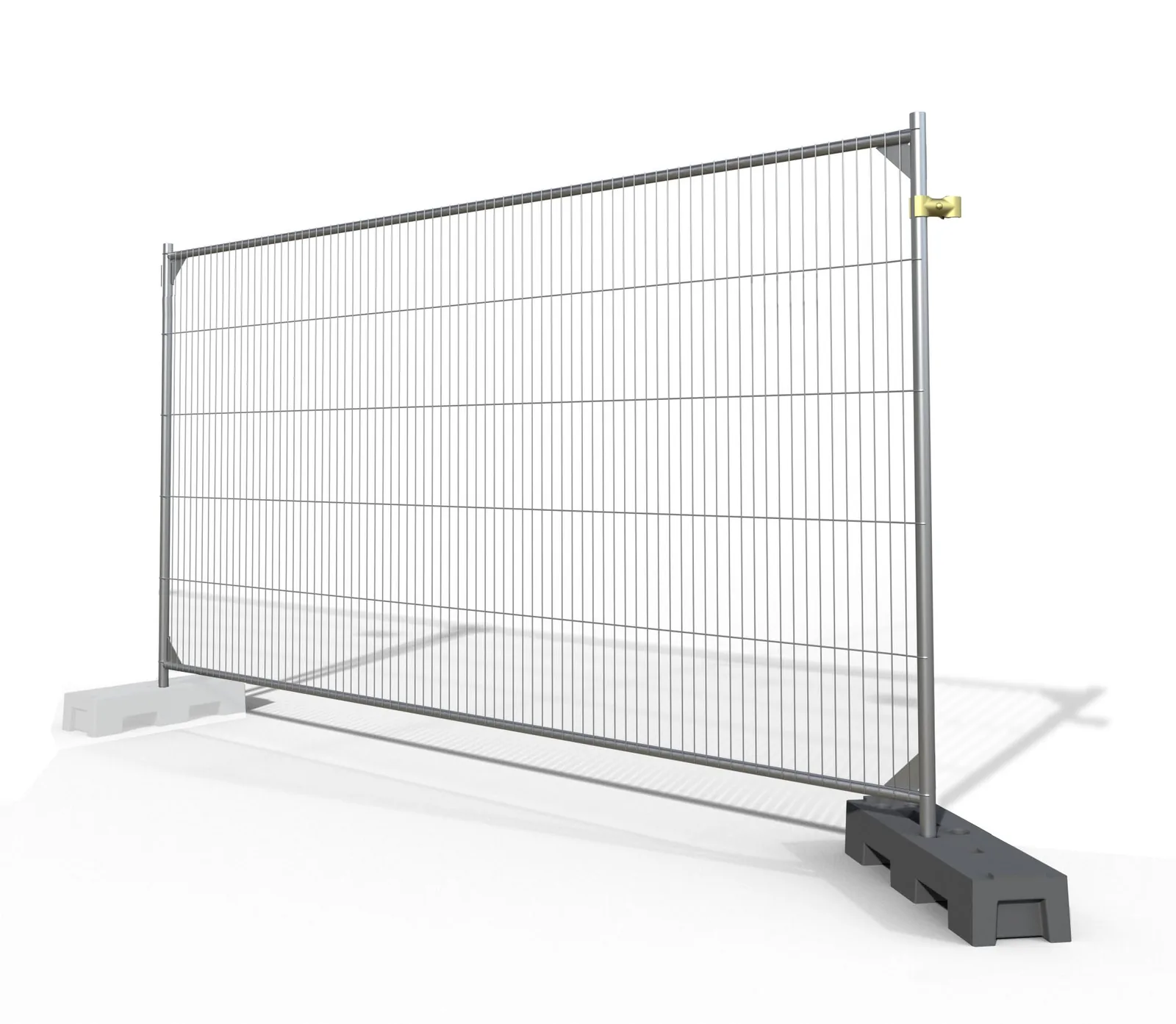
We are Hebei Leeter Import and Export Co., Ltd ("Leeter"), a construction wire, mesh and fence manufacturer in Dingzhou, Hebei, exporting since 2006. We make temporary fencing in welded-mesh, chain-link and steel-tube barrier form, so this guide is written from the factory and loading dock — the sizes, the coatings that survive shipping, and the checks to run before you buy a container.
Standard panel sizes, by region
Almost every page online covers one market and calls it "the" standard. Here is the honest cross-region picture:
| Region | Panel type | Size (W × H) | Frame tube | Typical weight |
|---|---|---|---|---|
| UK / EU | Welded-mesh "Heras" (round-top) | 3.5 m × 2.0 m (official Heras: 3500 × 1960 mm) | Ø38 mm | ~13–16 kg |
| UK / EU | "Heras" alternate width | 3.45 m × 2.0 m | Ø38.1 mm | ~16 kg |
| Australia / NZ | Welded-mesh panel | 2.4 m × 2.1 m | 32 mm OD | ~25 kg |
| US / Canada | Chain-link temp panel | 6 ft × 12 ft (also 6×10, 8×12) | 1⅜ in (34.9 mm) | — |
| Global | Steel crowd-control barrier | 2.2–2.5 m long × 1.1 m high | 32–42 mm OD | 14–22 kg |
Two things buyers should know. "Heras" is a brand name used generically for any 3.5 × 2 m mesh panel — and the official Heras height is 1960 mm, which retailers round up to "2 m." And panel weight is kept deliberately low (~14–16 kg in the UK) so two workers can lift it; a heavier "maxi" or anti-climb panel runs 24–28 kg. Confirm the weight, because a panel that is 20% lighter than spec is usually a thinner tube or thinner mesh wire. For a size-by-size table with metric and imperial heights and lengths, see our dedicated temporary fence size guide.
Mesh, frame and coating
- Mesh aperture: a standard welded-mesh panel has a large opening — roughly 100 × 350 mm on a Heras round-top (some models 50 × 200 mm). Chain-link temp panels use a 2⅜ in (60 mm) diamond in 11.5-gauge fabric.
- Frame tube: Ø38 mm (UK), 32 mm (AU), 1⅜ in (US), typically 1.5–2.0 mm wall. If you run a rental fleet, the tube diameter must match your existing couplers — a fleet standardised on 42 mm will not clamp cleanly onto 48 mm stock, forcing you to carry two inventories.
- Galvanizing is where imported panels most often disappoint. The authority to quote is ISO 1461 (batch hot-dip galvanizing), whose minimum mean coating thickness is set by steel thickness:
| Steel thickness | ISO 1461 minimum coating |
|---|---|
| < 1.5 mm | 45 µm |
| 1.5 – 3 mm | 55 µm |
| 3 – 6 mm | 70 µm |
| > 6 mm | 85 µm |
The critical distinction: pre-galvanized tube and wire (~10–30 µm, zinc applied before fabrication) leaves the welds and cut ends bare, so those become the first rust points — often within a year on an outdoor fleet. Hot-dip galvanizing after fabrication (~50–100 µm) coats the welds and cuts. A cheaper pre-galv panel is fine for short indoor hire; specify hot-dip for anything that lives outside. (Note that per the American Galvanizers Association, ASTM galvanizing on wire does not meet the ISO thickness table — relevant if your infill is welded wire mesh.)
Which standard actually applies
This is where most supplier pages are wrong or silent, so it is worth getting right:
- Australia / New Zealand — AS 4687. The commonly-cited "AS 4687-2007" is superseded; the current standard is the multi-part AS 4687:2022 (Part 2 covers temporary fencing), which added stricter wind-load engineering. The familiar numeric test criteria — a 75 mm maximum infill aperture, a 150 J impact test, and configuration-based wind speeds — come from the 2007 test methodology; treat them as indicative unless you hold the current 2022 standard. Australian WHS regulators separately require site fencing to be at least 1.8 m high, stable against wind, with no footholds or gaps.
- United States — ASTM F3342. There is no federal dimensional standard, but the real US reference that almost no one cites is ASTM F3342-19, "Standard Guide for Temporary Fence Applications for Construction Sites." Chain-link materials are covered by ASTM A392 (zinc-coated fabric) and F1043/F1083 (framework). Beyond that, US site fencing is driven by OSHA hazard rules and local code.
- United Kingdom — no dedicated British Standard. UK site fencing is governed by HSE guidance (HSG151), which calls for a 2 m mesh fence or hoarding in populated areas under the CDM 2015 duty to prevent unauthorised access, with wind loading assessed to BS EN 1991-1-4 (Eurocode 1). Any "tested to 100 mph" claim is a manufacturer statement, not a standard.
The honest one-liner: temporary fencing is governed by site-safety duty plus material standards, not one universal panel spec — so buy to the height and stability your site's regulator requires, and to a galvanizing standard you can verify.
Will it blow over? Wind, ballast and stability
Wind — not climbing — is the dominant real-world failure mode, and it is what site-safety bodies actually warn about. Australian WorkSafe guidance is explicit that fencing carrying signage, shade cloth or banner mesh "may require additional support to resist wind loadings": the covering turns the fence into a sail. And failures cascade — once one panel lifts or slides, the load transfers along the line and topples its neighbours, which is why open, coastal and long straight runs are highest-risk.
Two rules buyers should hold:
- Ballast properly — never with loose bricks, blocks or rubble. Use the engineered feet and blocks. A workable ballast ladder, from real product data: bare concrete/HDPE feet ≈ 20–22 kg, add-on ballast blocks of 23 kg and 50 kg, stackable up to roughly 200 kg per pair of panels in exposed conditions.
- Wind load is site-specific. In Australia it is engineered to AS/NZS 1170.2 for the wind region and terrain — the required ballast on a sheltered urban site and an exposed coastal one are not the same number. Add full-height stability braces as exposure rises.
Anti-climb and anti-lift are two different things
Buyers frequently conflate these, and suppliers exploit the confusion:
- Anti-climb is about aperture. A standard 100 × 350 mm mesh gives a boot a foothold; a genuine "358" security mesh — named from its 3 in × 0.5 in × 8-gauge opening (76.2 × 12.7 mm, ~4 mm wire) — is finger-proof and resists tools. If a site spec says "anti-climb," it means the tight aperture, not just a taller panel.
- Anti-lift / anti-tamper is about theft and trespass — stopping a panel being lifted off its feet. This is solved with anti-tamper couplers (a security nut needing a special spanner), fitted at the bottom of the join so no one can reach over to undo it. It is a genuine, common buyer requirement on rental contracts and is unrelated to mesh aperture.
Panels, feet and couplers: how many you need
A quick estimating rule for a run: one foot per panel, plus one extra at the end, and two couplers per join (top and bottom). Anti-tamper couplers double as anti-lift. For storage and handling, panels flat-stack and ship in steel stillages holding roughly 30–35 panels each — worth specifying if you run a fleet, because loose panels get damaged in transit.
Importing in bulk: galvanizing, welds and container loading
For a fleet or distributor buying by the container, three things decide whether the order is good value:
- Galvanizing you can verify. Ask for a third-party coating-thickness test report, not just a "hot-dip galvanized" claim — the most common import failure is electro- or pre-galv passed off as hot-dip, rusting within a year. Tie the spec to ISO 1461 (or ASTM A123) with a coating figure in µm or g/m².
- Weld integrity. Welded mesh should be welded at every intersection, and the rail-to-footplate joints are the ones that fail under wind overturning — a fair thing to ask for weld detail and a sample on.
- Loading is weight-limited, not volume-limited. A 40 ft container maxes at ~26.6 t payload, and dense concrete feet (~20–30 kg each) hit that ceiling long before the box is full — which is why panels and feet are often split across loads and why plastic feet raise the panel count. Be wary of any supplier quoting a single fixed "panels per container" number; the honest answer depends on foot type, gauge and nesting. We give buyers our real per-20 ft and per-40 ft counts from actual loading records rather than a marketing figure.
On vetting the factory, the checklist is the same as for any Chinese hardware supplier: ISO 9001, genuine mill test reports, and a pre-shipment inspection (SGS/BV) you are allowed to book — a supplier who refuses inspection or a coating-thickness report is telling you something. As the manufacturer, our own indicative terms are a container-level MOQ (with smaller trial quantities available), a 15–30 day production lead time, and FOB or CIF shipping — but always confirm these in writing on your order.
Frequently asked questions
What size is a standard temporary fence panel?
It depends on the market. The UK/EU "Heras" welded-mesh standard is 3.5 m wide × 2.0 m high (officially 3500 × 1960 mm); Australia and New Zealand use 2.4 m wide × 2.1 m high; and the US and Canada default to a 6 ft × 12 ft chain-link panel. Steel crowd-control barriers are separate, around 2.2–2.5 m long × 1.1 m high.
How much does a temporary fence panel weigh?
A standard UK welded-mesh panel is deliberately light — about 14–16 kg — so two people can lift it; Australian 2.4 × 2.1 m panels run around 25 kg, and heavy-duty or anti-climb panels 24–28 kg. A panel much lighter than these figures usually means a thinner frame tube or thinner mesh wire, so weight is a quick quality check.
What standard does temporary fencing meet?
Australia and New Zealand use AS 4687:2022 (the older AS 4687-2007 is superseded). The US has no dimensional standard but ASTM F3342-19 is the guide for construction-site temporary fence, with ASTM A392 for chain-link fabric. The UK has no dedicated British Standard; it is governed by HSE guidance (HSG151, a 2 m fence in populated areas) with wind loading assessed to BS EN 1991-1-4.
Does temporary fencing need concrete feet?
It needs enough ballast to resist the wind at that site, not necessarily concrete. Plastic/HDPE block feet (~20–22 kg) are the wind-permeable default; add-on ballast blocks (23–50 kg, stackable to ~200 kg per pair) are used in exposed conditions. Never ballast with loose bricks or rubble, and add more weight when panels carry banners or shade cloth, which act as a sail.
How do I stop temporary fence panels being climbed or stolen?
These are two different problems. To stop climbing, use a tight-aperture "358" security mesh (76 × 13 mm opening) instead of standard 100 × 350 mm mesh. To stop panels being lifted off their feet, fit anti-tamper (anti-lift) couplers with a security nut at the bottom of each join so they cannot be undone by hand.
How do I make sure imported panels won't rust?
Specify hot-dip galvanizing applied after fabrication (so the welds and cut ends are coated, not left bare like pre-galvanized stock), tie it to ISO 1461 or ASTM A123 with a coating figure in microns, and require a third-party coating-thickness test report on your order. The most common import failure is a thin pre-galv or electro-galv coating sold as hot-dip, which rusts at the welds within a year.
Sources
- Standards Australia — AS 4687.1:2022 (Temporary fencing and hoardings)
- ASTM F3342-19 — Standard Guide for Temporary Fence Applications for Construction Sites
- HSE — Protecting the public (construction site security)
- WorkSafe Victoria — Construction site security fencing
- American Galvanizers Association — ISO 1461 coating thickness
- ASTM A392 — Zinc-Coated Steel Chain-Link Fence Fabric
