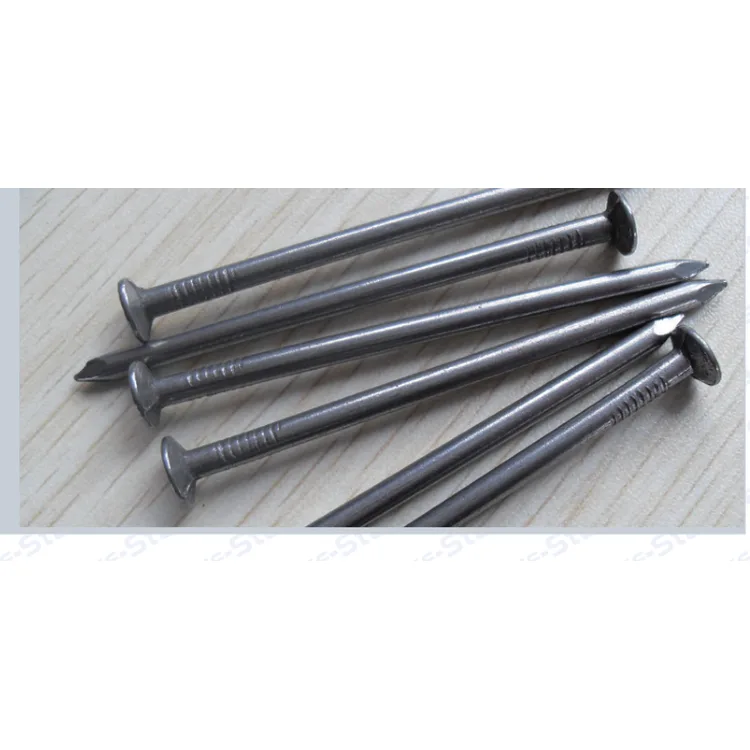
We are Hebei Leeter Import and Export Co., Ltd ("Leeter"), a construction nail, wire and fencing manufacturer in Dingzhou, Hebei, China, exporting since 2006, and construction nails are one of our founding lines drawn, cut and headed to the penny size and gauge you order.
Penny, length and gauge chart
The table below maps each penny size to length in inches and mm, with the typical common-nail wire gauge in BWG (Birmingham Wire Gauge) and its diameter. Read the penny number as length; read gauge as thickness.
| Penny (d) | Length (in) | Length (mm) | Common gauge (BWG) | Wire dia (mm) |
|---|---|---|---|---|
| 2d | 1 | 25 | 15 | 1.83 |
| 3d | 1-1/4 | 32 | 14 | 2.03 |
| 4d | 1-1/2 | 38 | 12-1/2 | 2.51 |
| 5d | 1-3/4 | 44 | 12-1/2 | 2.51 |
| 6d | 2 | 51 | 11-1/2 | 2.87 |
| 7d | 2-1/4 | 57 | 11-1/2 | 2.87 |
| 8d | 2-1/2 | 63 | 10-1/4 | 3.33 |
| 10d | 3 | 76 | 9 | 3.76 |
| 12d | 3-1/4 | 83 | 9 | 3.76 |
| 16d | 3-1/2 | 89 | 8 | 4.19 |
| 20d | 4 | 102 | 6 | 5.16 |
| 30d | 4-1/2 | 114 | 5 | 5.72 |
| 40d | 5 | 127 | 4 | 6.20 |
What the penny number actually fixes
The penny size fixes length and nothing else. A 16d nail is always 3-1/2 inches long, but its diameter depends on which pattern you buy. The gauges in the chart above are the standard values for common nails; box nails at the same penny size use thinner wire, and sinkers sit in between. So "16d" alone is an incomplete spec — you must also state the pattern (common, box or sinker) or the gauge in BWG or mm. This is why Leeter quotes nails as length plus gauge rather than penny alone: the penny number tells the mill how long to cut, the gauge tells it which wire to draw.
Gauge (BWG) vs length: how they track
As length climbs through the penny scale, the standard wire gets thicker so the nail stays stiff enough to drive without buckling. A 2d at 1 inch runs 15 BWG (1.83mm); a 16d at 3-1/2 inches runs 8 BWG (4.19mm); a 40d spike at 5 inches runs 4 BWG (6.20mm). The relationship is not linear — it is set by tradition and by what drives cleanly — but the direction is fixed: longer nails, heavier gauge. BWG counts down as wire gets thicker, so a lower gauge number means a fatter nail. Note BWG differs from SWG and from US Steel Wire Gauge, so always confirm which system a spec sheet uses, or specify the diameter in mm to remove all doubt.
Common vs box vs sinker at the same penny
Three common patterns share the penny length scale but differ in gauge, head and coating. Picking the wrong one at the right length is a frequent sourcing error:
| Pattern | 16d gauge (BWG) | Head | Coating / feature | Use |
|---|---|---|---|---|
| Common | 8 (4.19mm) | Large flat | Bright or galvanized | Structural framing, full holding power |
| Box | 10 (3.43mm) | Flat, thinner | Bright or galvanized | Thin stock, less splitting |
| Sinker | 9 (3.76mm) | Countersunk, coated | Vinyl or cement coated, textured | Framing where fast countersinking helps |
At 16d the common nail is the fattest and strongest; the box nail uses thinner wire to reduce splitting in narrow or dry lumber; the sinker adds a coating and a countersunk head so it seats fast and holds through friction. Same length, three different nails — which is exactly why penny alone never finishes a spec.
How buyers should specify nails
For an export order, give the mill four things per line and there is no ambiguity: length (in mm, with the penny size as a cross-check), gauge (BWG or mm), head (flat common, countersunk, checkered, cupped) and shank (smooth, ring or spiral), plus the finish (bright, electro-galvanized or hot-dip galvanized). For example: "3-1/2in / 89mm (16d), 8 BWG, common flat head, smooth shank, HDG." That single line drives, holds and weathers as intended. If you are also building a mixed container, pair the framing nails with matched concrete nails in the right carbon grade and decide between coil and stick collation for any nail-gun lines. Leeter supplies mill test reports, AQL pre-shipment inspection and OEM/private-label packing, with MOQ from one pallet to a mixed 1x20' container and 15-35 day lead times.
Frequently asked questions
What does the "d" in nail sizes mean?
The "d" stands for penny, from the Latin denarius, and it is a traditional length scale for nails. The letter is a suffix, so 8d is read "eight penny." Each penny number maps to one fixed length — 8d is always 2-1/2 inches (63mm) — regardless of manufacturer. The penny number sets length only; nail diameter is stated separately as a wire gauge.
How long is a 16d nail?
A 16d nail is 3-1/2 inches long, which is 89mm. In common-nail pattern it uses 8 BWG wire (4.19mm diameter) with a large flat head, making it the standard framing nail in the US. Box and sinker nails at 16d share the same 3-1/2 inch length but use thinner wire, so always confirm the pattern or gauge, not just the 16d penny size.
Does the penny size tell me the nail's thickness?
No. The penny size fixes length only; thickness comes from the wire gauge, which is a separate spec. A 16d common, 16d box and 16d sinker are all 3-1/2 inches long but use different gauges — roughly 8, 10 and 9 BWG. To order correctly, state both the penny length and the gauge in BWG or millimetres so the mill draws the right wire.
What is the difference between common and box nails?
Common and box nails share the penny length scale but box nails use thinner wire at each size — a 16d box is about 10 BWG versus 8 BWG for a 16d common. The thinner box nail splits thin or dry lumber less easily, while the fatter common nail carries more structural load. Choose common for framing strength and box for thin stock or split-prone timber.
How should I specify nails to a Chinese manufacturer?
Specify four things per line: length (in millimetres, with the penny size as a cross-check), wire gauge (in BWG or mm), head style and shank type, then add the finish. For example: "76mm (10d), 9 BWG, flat common head, smooth shank, hot-dip galvanized." Stating the diameter in millimetres avoids BWG-versus-SWG confusion, and the mill cuts, heads and coats exactly to that line.
