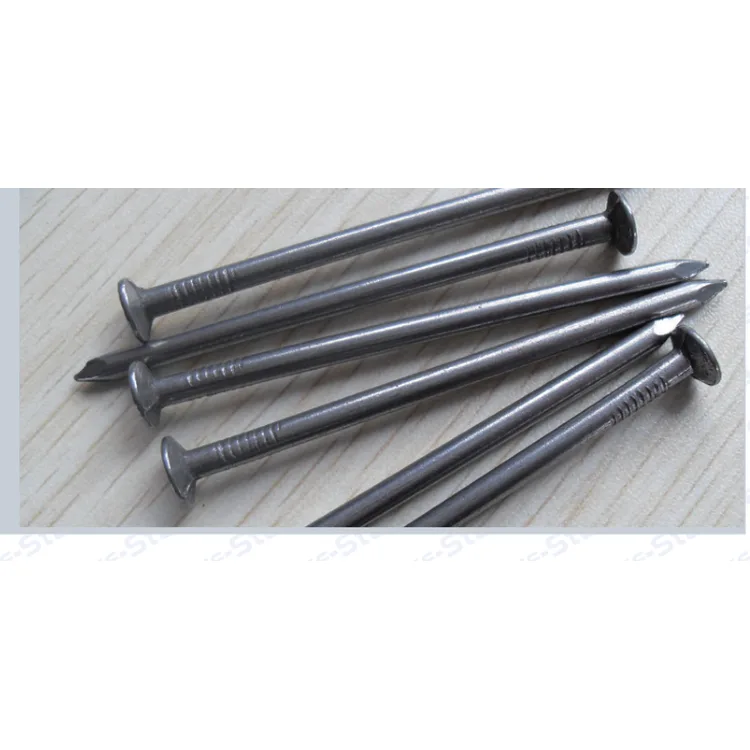
We are Hebei Leeter Import and Export Co., Ltd ("Leeter"), a construction hardware manufacturer in Dingzhou, Hebei, exporting since 2006. We make construction nails in common, box, finish and sinker patterns, so this is the same count-and-carton math we use to turn a buyer's piece count into a shipment — with the type and finish differences competitor charts usually leave out.
Common nails: count per pound
These are bright common nails — the standard framing nail. Counts cluster tightly across manufacturer catalogs and actual retail pack counts; where sources genuinely split, the range is shown.
| Penny | Length | Wire gauge | Diameter | Nails per lb | Nails per kg |
|---|---|---|---|---|---|
| 2d | 1" | 15 | 0.072" | ~850 | ~1,870 |
| 3d | 1¼" | 14 | 0.080" | ~540 | ~1,190 |
| 4d | 1½" | 12½ | 0.099" | ~290 | ~640 |
| 5d | 1¾" | 12½ | 0.099" | ~250 | ~550 |
| 6d | 2" | 11½ | 0.113" | ~165 | ~364 |
| 8d | 2½" | 10¼ | 0.131" | ~100 (90–130) | ~220 |
| 10d | 3" | 9 | 0.148" | ~66 | ~145 |
| 12d | 3¼" | 9 | 0.148" | ~61 | ~135 |
| 16d | 3½" | 8 | 0.162" | ~47 (45–49) | ~104 |
| 20d | 4" | 6 | 0.192" | ~30 | ~66 |
| 30d | 4½" | 5 | 0.207" | ~23 | ~51 |
| 40d | 5" | 4 | 0.225" | ~17–18 | ~39 |
| 50d | 5½" | 3 | 0.244" | ~14 | ~31 |
| 60d | 6" | 2 | 0.262" | ~11 | ~24 |
The most reliable anchor is 16d common ≈ 47 per pound — a figure agreed by manufacturer catalogs, a US structural-connector engineering table, and retail pack counts (a 50 lb box holds about 2,350 pieces). Treat these as bright-nail counts: hot-dip galvanizing adds zinc mass and drops the count roughly 10–20%.
Two cells honestly disagree across sources. 8d common is quoted anywhere from ~90 to ~130; the physics of a 0.131" × 2½" nail supports roughly 90–104 for bright, so ~100/lb is the safe planning figure with a real spread. And 40d shows a likely catalog typo in one table (14/lb); the handbook value is about 17–18/lb.
Box, finish and sinker nails count differently
This is the point most "nails per pound" charts get wrong: they print one column with no type label. Box nails are the same length as common but a thinner gauge, so you get more per pound; finish nails are thinner still; sinkers are slightly shorter and coated.
| Penny | Common /lb | Box /lb | Finish /lb |
|---|---|---|---|
| 4d | 290 | ~450 | ~630 |
| 6d | 165 | ~225 | ~228 |
| 8d | 100 | ~136 | ~190 |
| 10d | 66 | ~93 | ~124 |
| 16d | 47 | ~69 | ~93 |
| 20d | 30 | ~50 | ~65 |
At 16d, a box nail gives about 69 per pound versus 47 for a common — roughly 45% more nails for the same weight, because the box shank is 0.135" vs the common's 0.162". Box and finish per-pound figures rest on thinner sourcing than the common table, so treat them as approximate and confirm against the actual product. Note too that a box nail's thinner shank means lower lateral strength (box lateral capacity runs 22–44% below common), which is why framing schedules call out common or box specifically — see our nail penny size chart for the length-and-gauge side.
Why count per pound drops so steeply
The weight of one nail is basically steel density × shank volume, and shank volume is proportional to diameter squared × length. Because diameter is squared, gauge drives the count far more than length does. A 16d common (0.162") and a 16d box (0.135") are both 3½" long, yet the common weighs (0.162 ÷ 0.135)² ≈ 1.44× more — which is exactly the 47-vs-69 gap. The same physics is why coating matters: the extra zinc on a hot-dip galvanized nail lowers the count noticeably versus bright.
Common and box nails use different gauges at each penny size, which is the root of the confusion:
| Penny | Common gauge | Box gauge |
|---|---|---|
| 6d | 11½ (0.113") | 12½ (0.099") |
| 8d | 10¼ (0.131") | 11½ (0.113") |
| 10d | 9 (0.148") | 10½ (0.128") |
| 16d | 8 (0.162") | 10 (0.135") |
| 20d | 6 (0.192") | 9 (0.148") |
Remember that the penny (d) size fixes length only — not thickness. A lower gauge number is a thicker wire.
Converting a piece count to a purchase order
For importers and estimators, the useful direction is pieces → weight → cartons. The standard export carton for nails is 25 kg:
- Nails per kg = nails per lb × 2.2046
- Nails per 25 kg carton = nails per lb × 55.12
Worked example, the one buyers actually run: you need 100,000 × 16d common nails.
- 100,000 ÷ 47 ≈ 2,128 lb ≈ 965 kg
- 965 ÷ 25 ≈ ~39 cartons of 25 kg
| Penny | /lb | /kg | per 25 kg carton |
|---|---|---|---|
| 6d | 165 | ~364 | ~9,100 |
| 8d | 100 | ~220 | ~5,510 |
| 10d | 66 | ~145 | ~3,640 |
| 16d | 47 | ~104 | ~2,590 |
| 20d | 30 | ~66 | ~1,650 |
Export nails are typically packed 1 kg poly bags × 25 to a carton, or 1 lb / 5 lb boxes to 50 lb — a 20 ft container carries about 20–25 t, a 40 ft high-cube about 26–28 t.
Buying nails by weight from China
- Specify type, not just penny size. "16d" alone is ambiguous — state common, box, finish or sinker, because the per-pound count and the strength both change with it.
- State the finish (bright, electro-galvanized, hot-dip galvanized, vinyl/sinker-coated) — it changes the piece count per carton and the corrosion life.
- Confirm the count basis on the label (pieces per box, boxes per 25 kg carton) so a piece-based PO reconciles with the shipped weight.
- Reference the standard: US nail dimensions are governed by ASTM F1667 — cite it on the order for head, shank and length tolerances.
As the manufacturer we supply common, box, finish, sinker, concrete and roofing nails to ASTM F1667 dimensions, bright or galvanized, in 25 kg export cartons — send your piece count and type and we will convert it to cartons and container load.
Frequently asked questions
How many 16d nails are in a pound?
About 47 for a bright 16d common nail (3½", 8 gauge), a figure confirmed by manufacturer catalogs and retail pack counts of roughly 2,350 per 50 lb box. A 16d box nail is thinner (10 gauge) and runs closer to 69 per pound, and hot-dip galvanizing lowers either count by roughly 10–20%. Always specify common vs box, because the counts differ by about 45%.
How many 8d nails are in a pound?
Around 100 for a bright 8d common nail (2½", 0.131"), though sources range from about 90 to 130 depending on head size and coating. An 8d box nail is thinner and runs about 136 per pound. For planning, use ~100 per pound for 8d common and confirm against the actual product's pack count.
Do box nails and common nails have the same count per pound?
No — this is the most common mistake. Box and common nails of the same penny size are the same length but a different gauge, so a 16d box (0.135") gives about 69 per pound while a 16d common (0.162") gives about 47 — roughly 45% more box nails for the same weight. The thinner box nail is also weaker laterally, which is why framing specs name the type.
How do I convert nails per pound to per kilogram or per carton?
Multiply the per-pound count by 2.2046 to get nails per kilogram, and by about 55 to get nails per standard 25 kg export carton. For example, 16d common at 47 per pound is about 104 per kg and roughly 2,590 per 25 kg carton. To size a purchase order, divide your piece count by the per-pound figure, then by 2.2046 for kg and by 25 for cartons.
Does the penny (d) size tell me the nail's thickness?
No. The penny size (2d, 8d, 16d) fixes only the nail's length — 16d is always 3½". The thickness is set by the wire gauge, which differs by type: a 16d common is 8 gauge (0.162") but a 16d box is 10 gauge (0.135"). That is why two nails of the same penny size can have very different counts per pound.
Sources
- ASTM F1667 — Driven Fasteners: Nails, Spikes and Staples (governing dimensional spec)
- MiTek USP Fastener Catalog — nails-per-pound engineering table
- Albany County Fasteners — nail size and gauge chart (common/box/finish)
- JLC — Practical Engineering: Box vs. Common Nails (strength difference)
- Grip-Rite 16d common — 50 lb box ≈ 2,350 pieces (retail pack count)
