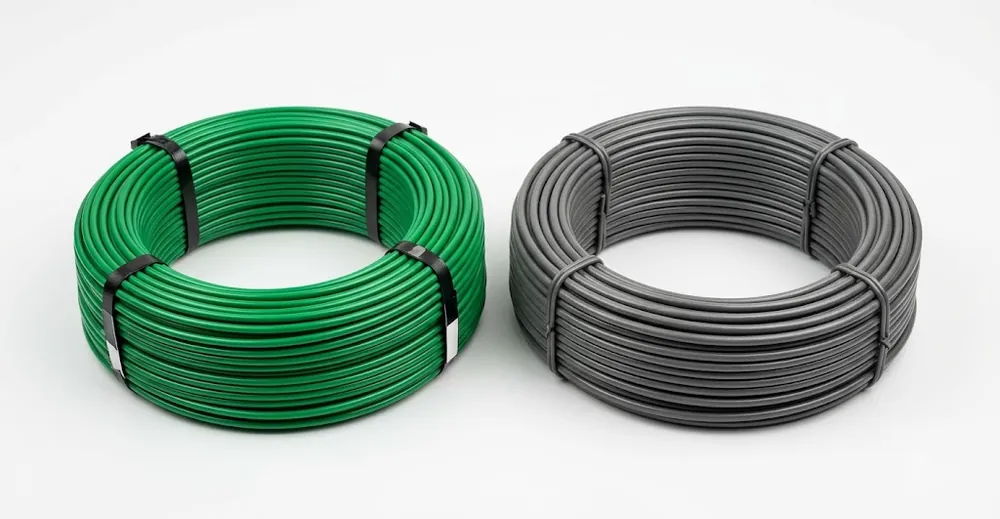
What is PVC-coated tie wire?
PVC-coated tie wire is a soft steel core wire, usually annealed low-carbon steel, wrapped in a bonded layer of polyvinyl chloride plastic. The plastic is extruded or dip-applied over the base wire, then cooled so it grips the metal tightly. The result is a flexible product that keeps the softness needed for hand and tool tying while adding a visible, waterproof jacket.
The coating does two jobs at once. First, it seals the steel from air and moisture, which slows rust dramatically compared with bare wire. Second, the plastic can be pigmented in almost any shade, so PVC tie wire doubles as colored tie wire for job-site sorting and quality control. Green, black, white and blue are common stock colors, and custom colors are easy on larger runs.
Typical PVC film thickness runs from roughly 0.10 mm up to 0.40 mm per side, sitting on a steel core of 0.5 mm to 2.0 mm. That is a fairly heavy jacket, which is exactly why PVC feels rugged in the hand. The trade-off is bulk: the plastic adds diameter, so a PVC wire ties a slightly looser, chunkier knot than an equally strong bare wire.
What is epoxy-coated tie wire?
Epoxy-coated tie wire uses the same annealed steel core, but the barrier is a fusion-bonded or dip-applied epoxy resin rather than a thermoplastic. Epoxy cures into a hard, thin, tightly adhered film. It is the same chemistry family used on epoxy-coated (green) reinforcing bar, which is the whole point of the product.
The defining feature is compatibility. When a structure is built with epoxy-coated rebar, the specification almost always requires that the tie wire, chairs and accessories share a compatible protective system so you do not create a galvanic weak spot at every tie. Bare or zinc-coated wire touching epoxy bar can set up dissimilar-metal corrosion and can also nick the bar coating. Epoxy tie wire keeps the whole cage inside one corrosion-protection scheme.
Epoxy films are thin, commonly around 0.05 mm to 0.20 mm, and hard rather than rubbery. That thin, hard film ties a tighter, cleaner knot than PVC, and it holds up well against the chloride exposure found in bridge decks, parking structures and coastal work. The downside is that a hard film is more prone to cracking or flaking if the wire is bent sharply many times or handled roughly, and any breach becomes a small corrosion start point.
Why coat tie wire at all?
Most tie wire on earth is uncoated black annealed steel, and it works fine for ordinary interior concrete where the wire ends up buried and protected by the pour. So why pay extra to coat it? Three reasons drive the demand, and they often overlap on the same project.
Corrosion protection is the first and biggest. Where tie ends sit near a concrete surface, in thin slabs, in cracked cover zones, or in salt and marine air, bare steel can rust and bleed a stain through the concrete face. A coating buys years before that happens. Color-coding is the second reason: crews use colored tie wire to separate gauges, mark inspection status, or match a general contractor's site system, which cuts sorting errors on busy pours. The third reason is coated-bar compatibility, which applies specifically to epoxy-coated reinforcement and, in a different way, to galvanized reinforcement.
There is also a handling benefit that buyers underrate. A coating keeps coils cleaner in storage, reduces rust bloom during long ocean transit, and keeps workers' gloves and hands cleaner than oily black wire. Small things, but they add up across a large job.
PVC vs epoxy vs galvanized: a direct comparison
The fastest way to choose is to line the three coated options up side by side. The table below reflects typical values we see in production and shipping; exact figures vary by gauge, coating run and specification.
| Property | PVC-coated tie wire | Epoxy-coated tie wire | Galvanized tie wire |
|---|---|---|---|
| Barrier type | Thick plastic (polyvinyl chloride) | Thin hard resin film | Metallic zinc layer |
| Typical coating thickness | 0.10-0.40 mm/side | 0.05-0.20 mm/side | 20-300 g/m2 zinc |
| Corrosion resistance | High, until film is cut | High, especially vs chlorides | Moderate to high, sacrificial |
| Color options | Any color (color-coding) | Usually green/gray | Metallic silver only |
| Coated-rebar compatibility | Not the intended match | Designed for epoxy rebar | Suits galvanized rebar |
| Knot tightness / diameter | Bulkier, softer knot | Tight, clean knot | Tight, like bare wire |
| Abrasion / bend durability | Very tough, flexible | Hard but can crack if abused | Zinc wears but self-protects |
| Relative cost | Low to moderate | Moderate to high | Low |
| Best fit | Color-coding, general corrosion, fencing/mesh crossover | Epoxy-coated rebar cages, marine, deicing salt | General galvanized cages, mild outdoor exposure |
Read the table as a set of trade-offs rather than a scoreboard. No single column wins every row, which is exactly why all three products stay in production.
When should you choose PVC-coated tie wire?
Choose PVC coated tie wire when the primary goals are visible color-coding, a thick forgiving barrier, and low cost. The plastic jacket is genuinely tough. It shrugs off abrasion, bending and rough handling far better than a hard resin film, so it suits crews that are hard on materials. Because the coating comes in any color, PVC is the default when a site runs a color system to keep gauges or inspection states straight.
PVC is also the natural fit where tie wire overlaps with fencing, mesh, trellis, gabion lacing and horticultural uses, because those markets already run on colored PVC wire and expect the same look. For general reinforced concrete that needs better corrosion life than bare wire, but is not built with epoxy-coated bar, PVC gives you strong protection per dollar.
Where PVC struggles is high-heat environments and jobs with strict coated-bar chemistry rules. PVC is not the specified match for epoxy rebar, and its added diameter makes very tight, low-profile ties harder. If your knot must be small and hard, PVC is not your first choice.
When should you choose epoxy-coated tie wire?
Choose epoxy coated tie wire whenever the structure uses epoxy-coated reinforcing bar, or whenever chloride attack is the main threat. Bridge decks, parking garages, water-treatment tanks, coastal foundations and any deck exposed to deicing salt are classic cases. In those settings the specification usually names an epoxy-compatible tie system, and using anything else can flag a nonconformance during inspection.
The technical reason is coating continuity. A reinforcement cage protected by epoxy stays protected only if every contact point stays within the same system. Epoxy tie wire keeps that continuity, avoids dissimilar-metal cells at the ties, and matches the chloride resistance of the surrounding bar. The thin hard film also ties a neat, tight knot that sits close to the bar, which matters for cover and for pull-through resistance.
Handle epoxy wire with a little more care than PVC. The film is hard, so repeated sharp bends or dragging coils across sharp edges can chip it, and each chip is a corrosion start. Trained crews rarely have trouble, but it is an honest limitation worth stating.
What about plain and galvanized tie wire?
Plain black annealed wire remains the workhorse for interior, non-aggressive concrete, and it is the cheapest option by a wide margin. When ties will be fully buried in sound concrete with good cover, the extra cost of any coating is often unnecessary, and that honesty matters more than an upsell. Coatings earn their price only where exposure, appearance or specification demands them.
Galvanized tie wire sits between bare and the coated products. Its zinc layer protects sacrificially, meaning the zinc corrodes first and shields the steel even at small scratches, which PVC and epoxy cannot do once their film is cut. Galvanized wire is the logical partner for galvanized reinforcement and for mild outdoor exposure where color is irrelevant. For a fuller breakdown of gauges, tensile ranges and packaging across all of these, our main rebar tie wire guide goes deeper than we can here.
One more practical note from the loading dock: coated wires ship and store better over long ocean routes because the barrier resists condensation rust in the container. That is a minor point next to corrosion engineering, but for importers moving pallets across the Pacific it saves the odd rejected coil.
Frequently asked questions
Is PVC or epoxy tie wire better for corrosion resistance?
Both resist corrosion well while the coating stays intact, so the honest answer depends on exposure and damage. Epoxy handles chlorides, salt spray and deicing environments a little better and is the match for epoxy rebar. PVC offers a thicker, more damage-tolerant barrier, so it often lasts longer where wires get scuffed and bent.
Can I use PVC-coated tie wire on epoxy-coated rebar?
We do not recommend it when the specification calls for an epoxy-compatible tie system. Epoxy-coated rebar projects usually require ties, chairs and accessories that stay within the same coating chemistry to preserve corrosion continuity. Use epoxy coated tie wire there. PVC is fine for uncoated, galvanized-adjacent or general corrosion jobs where no such rule applies.
What coating thickness should I expect?
PVC films typically run 0.10 to 0.40 mm per side, giving a thick, visible, rubbery jacket. Epoxy films are thinner and harder, usually 0.05 to 0.20 mm. Steel cores for both commonly sit between 0.5 mm and 2.0 mm depending on gauge. Exact numbers vary by order, so confirm the target on your specification before production.
Does coated tie wire come in different colors?
PVC coated tie wire does, and that is one of its main advantages. Green, black, white, blue and custom colors are all achievable, which makes it ideal for color-coding gauges or inspection status on busy sites. Epoxy tie wire is usually green or gray to match epoxy rebar, so treat epoxy as function-driven and PVC as your colored tie wire option.
Is coated tie wire worth the extra cost over plain wire?
Only when exposure, appearance or specification justifies it. For interior concrete with good cover, plain black annealed wire performs fine and costs the least. Coatings pay off in marine, deicing-salt, thin-cover, color-coded or coated-rebar situations. We would rather match you to the right grade than sell a coating a buried interior tie does not need.
Talk to a manufacturer before you order
Picking between PVC and epoxy is easier once someone has seen your drawings, exposure class and rebar type. If you tell us the environment and whether the bar is epoxy-coated, galvanized or plain, we will recommend the coating, gauge and packaging that fit, and price it honestly. Request a quote and we will follow up with samples and specifications.
