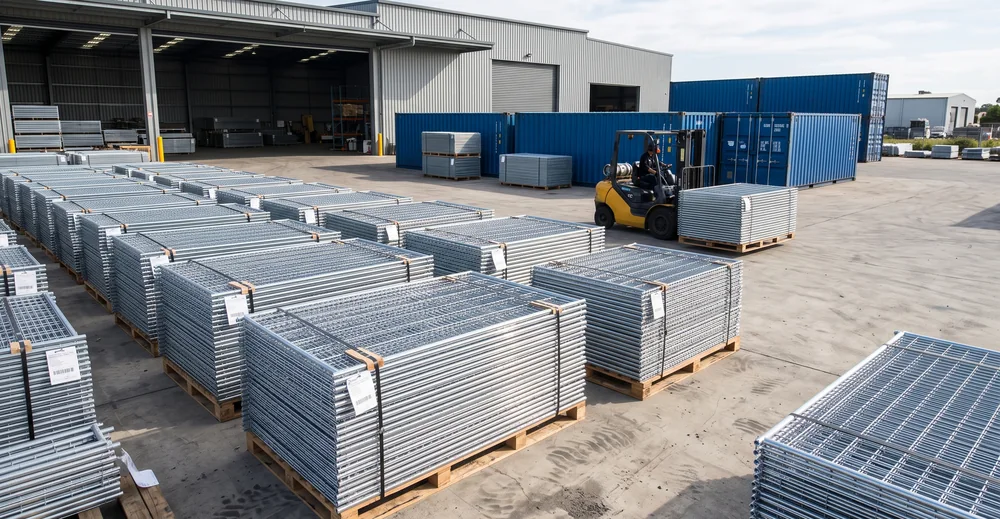
We are Hebei Leeter Import and Export Co., Ltd ("Leeter"). We manufacture welded-mesh, chain-link and steel-tube temporary fencing in Hebei — and, since May 2026, at our joint-venture fence factory in Vietnam, which exists precisely for markets where China-origin fencing carries trade measures.
The cluster map
- Anping County (Hengshui, Hebei) dominates: the same 13,000-enterprise wire mesh cluster that makes welded mesh also frames, welds and galvanizes temporary fence panels. Most named suppliers in any directory table sit here.
- Dingzhou (Hebei) — our base — contributes the upstream: wire drawing, mesh welding and tube work in the Shahe industrial zone.
- Tianjin is the export gateway (23.28 million TEU in 2024); Hebei panels quote FOB Tianjin (Xingang), about 300 km by truck.
- Vietnam is the new node on the map: several China-linked producers (ours included) now run Vietnamese plants so that US-bound fencing can ship with non-China origin. Treat this as a first-class sourcing criterion, not a footnote.
Match the factory to your market's format
Temporary fencing is far less standardized than buyers expect — a factory tooled for one market isn't automatically right for another:
| Market | Format to ask for | Details that matter |
|---|---|---|
| Australia / NZ | Welded panels 2.1 × 2.4 m | AS 4687-style systems; concrete-filled plastic feet, top clamps, stays, gates |
| Canada | Welded panels 6 × 9.5 / 6 × 10 ft | Often powder-coated frames; matching feet and connectors |
| United States | Chain-link panels 6 × 10 / 6 × 12 ft (also welded portable panels) | Galvanized woven mesh in tube frames — and the origin/duty question below |
| Events / pedestrian | Steel-tube crowd-control barriers | Hook-and-eye interlocks, flat or bridge feet |
Full dimensions and specs are in our panel specifications guide and panel sizes by region.
The US duty question — and the Vietnam answer
In 2026 the US imposed anti-dumping and countervailing duty orders on temporary steel fencing from China (Commerce final determinations March 2026; orders effective May 2026), with China-wide dumping margins well above 100%. Rates and scope can change — verify the current figures on the Federal Register order or with your customs broker before quoting a landed price. Three practical consequences:
- China-origin temporary fencing into the US now carries a prohibitive duty stack (AD/CVD on top of Section 232/301). A $/panel FOB price that ignores this is meaningless.
- Origin is determined by where the fencing is made, not who owns the factory. A Vietnamese-made panel from a Vietnamese plant is Vietnam-origin — which is why we brought our joint-venture fence factory — UNION TOP METAL (VIET NAM) LTD, Tay Ninh Province — into production in May 2026. US-bound orders ship from Vietnam; AU/NZ, Canadian and other orders ship from Hebei via Tianjin, whichever lands cheaper.
- Ask any supplier claiming "no duty" to prove origin — mill certs, production records and a factory you can audit in Vietnam (or elsewhere), not paperwork gymnastics on China-made panels. Transshipment mislabeling is customs fraud, and CBP actively pursues it.
The RFQ that compares real steel
Panel price is the easiest number to game — thinner frame tube, lighter wire, less zinc, cheaper feet. Send one identical spec and compare kilograms of steel and grams of zinc, not dollars per panel:
| Field | Example |
|---|---|
| Product | Australian temporary construction fence |
| Panel | 2.1 m H × 2.4 m W |
| Infill wire | 4.0 mm actual diameter, 60 × 150 mm mesh |
| Frame tube | 32 mm OD × 1.5 mm wall (state actual wall) |
| Finish | Hot-dip galvanized — supplier to state actual g/m² |
| Feet / clamps | Concrete-filled HDPE feet; HDG top clamps |
| Quantity | 1 × 40' HC container |
| Standard | AS 4687 where required |
| Documentation | Mill test report; galvanizing certificate |
| Price basis | FOB Tianjin — and/or FOB Vietnam for US-bound |
Then require each factory to state: panel weight, tube wall thickness, actual wire diameter, zinc coating, panels/feet/clamps per container, gate price, MOQ and lead time. The panels-per-container number matters as much as price — our container guide covers the loading math.
Leeter's supplier snapshot
| Company | Hebei Leeter Import and Export Co., Ltd (Leeter) |
| Factories | Hebei, China + UNION TOP METAL (VIET NAM) LTD, Tay Ninh Province, Vietnam (joint venture, producing since May 2026) |
| Formats | AU/NZ 2.1 × 2.4 m welded panels; Canada 6 × 9.5 / 6 × 10 ft; US 6 × 10 / 6 × 12 ft chain-link; steel-tube crowd-control barriers |
| System parts | Concrete-filled and steel feet, top clamps, couplers, stays, gates — full rental-fleet kit |
| Finish | Hot-dip galvanized (stated g/m²), powder-coat options |
| Origin flexibility | China origin FOB Tianjin, or Vietnam origin for markets with China trade measures |
| Quality | ISO 9001; mill test reports; pre-shipment inspection |
Frequently asked questions
Where are China's temporary fencing suppliers located?
Mostly in Anping County, Hebei — the wire mesh capital with over 13,000 wire-product enterprises — alongside wire-processing bases like Dingzhou and port-city producers near Tianjin, the export gateway. Since 2026, Vietnam has become part of the same sourcing map, as China-linked producers (including Leeter) run Vietnamese plants for markets where China-origin fencing carries trade duties.
Does US anti-dumping duty apply to temporary fencing from China?
Yes — the US imposed anti-dumping and countervailing duty orders on temporary steel fencing from China effective May 2026, with margins well above 100%. Rates and scope can change, so verify the current figures on the Federal Register order or with your customs broker. For US-bound orders the practical answer is non-China origin, such as panels genuinely manufactured in Vietnam.
Can I avoid the duty by shipping China-made panels through Vietnam?
No — origin follows where the fencing is manufactured, not the route or the paperwork. Relabeling China-made panels as Vietnamese is customs fraud, which CBP actively pursues. The legitimate path is a supplier with a real production facility outside China; ask for the plant's records and the option to audit it.
What sizes should I specify for my market?
Australia/NZ: 2.1 × 2.4 m welded panels (AS 4687-style). Canada: 6 × 9.5 or 6 × 10 ft welded panels. US: 6 × 10 or 6 × 12 ft chain-link temporary panels. Always specify actual wire diameter, frame tube OD and wall, zinc coating in g/m², and the feet/clamps/gates as line items — the cheapest panel usually saves cost in exactly those places.
What is a fair way to compare temporary fence quotes?
Send every factory an identical specification and compare kilograms of steel per panel (tube wall × wire diameter × dimensions), zinc grams per m², and panels-plus-hardware per container — not the headline panel price. Require the mill test report and galvanizing certificate, and for US-bound orders make the price basis explicit: FOB Vietnam, not just FOB Tianjin.
Sources
- Federal Register — Temporary Steel Fencing from China: antidumping and countervailing duty order
- USITC — temporary steel fencing injury determination
- Global Times — Anping: 13,000+ wire mesh enterprises
- Global Times — Port of Tianjin container throughput record
- AS 4687 — Temporary fencing and hoardings (Standards Australia)
