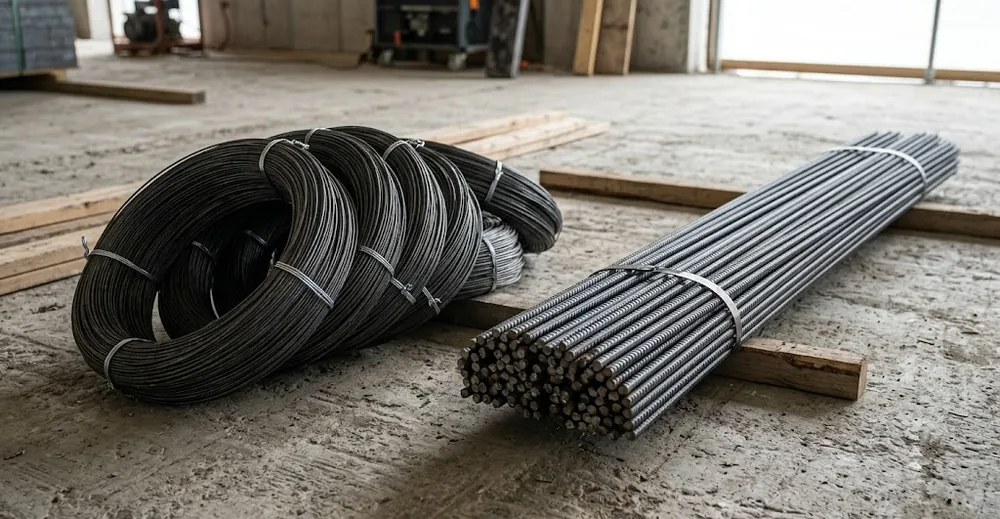
We are Hebei Leeter Import and Export Co., Ltd, a Dingzhou manufacturer that has shipped construction wire since 2006. Buyers on jobs across North America and Europe ask us the same thing every week: how much rebar tie wire should I put on the order? Below is how we work it out, and how you can too.
The short answer, and why it holds
Use 10 kg per metric tonne as a safe planning default, then adjust up or down for your bar layout. In imperial terms that is about 20 lb per US ton. This mid-range number covers the majority of slabs, footings, walls, and grade beams we supply. It already assumes hand tying with annealed wire and a normal amount of offcut waste.
Why does a single ratio work at all? Because tie wire is spent at intersections, and intersections scale fairly predictably with the tonnage of steel in a given element. Heavier rebar means fewer bars per ton, but each bar covers more area and crosses more counterparts. Lighter rebar means many thin bars packed close, so more ties per ton. The two effects partly cancel, which keeps most real jobs inside that 8 to 14 kg band.
The honest caveat: the band is a planning tool, not a guarantee. Congested joints, machine tying, and crew habits all move the needle. Treat the number as a starting quantity, add a margin, and confirm against a sample bay once steel is on site.
What drives tie wire consumption?
Three variables move your usage more than anything else: bar size, tie spacing, and wire gauge. Bar size sets how many intersections exist per ton of steel. Tie spacing decides how many of those intersections you actually tie. Wire gauge and tie style set how much wire each knot swallows. Get a rough read on these three and your estimate tightens quickly.
Bar size and bar count
Smaller bars mean more pieces per ton, and more pieces mean more crossings to tie. A ton of #4 (12 mm) bar contains far more linear meters than a ton of #8 (25 mm) bar. More meters equals more grid intersections across the same slab area. That is the main reason thin-bar slabs and mesh-style mats consume wire near the top of the range while heavy column cages sit lower per ton, even though each column knot is bulky.
Tie spacing and tie pattern
You rarely tie every single intersection. Common practice ties every other crossing in a slab, or follows a staggered pattern the engineer specifies. A "tie every intersection" spec can nearly double wire use versus a 50 percent pattern. Column and beam stirrups add ties at each hoop, which concentrates consumption in cages. Always read the tying schedule before trusting a generic ratio.
Wire gauge and tie style
Heavier wire uses more mass per tie, plainly. A 16-gauge tie weighs more than the same wrap in 16.5 or 18 gauge. Tie style matters too: a simple snap tie uses less wire than a saddle or a wrap-and-twist, and pre-formed double loop bar ties meter out a fixed length per knot, which actually makes estimating easier. Machine tools like battery tie guns use tidy, repeatable loops that often trim waste versus hand work.
| Element type | Typical bar size | Tie pattern | Tie wire per tonne |
|---|---|---|---|
| Foundation footings | #5 to #8 (16-25 mm) | Every other crossing | 7-9 kg |
| Slab on grade | #4 to #5 (12-16 mm) | 50% of crossings | 9-11 kg |
| Suspended slab | #4 to #6 (12-20 mm) | Most crossings | 11-13 kg |
| Walls and grade beams | #5 to #7 (16-22 mm) | Staggered | 9-12 kg |
| Columns and cages | #7 to #10 (22-32 mm) | Each hoop/stirrup | 12-16 kg |
Read the table as guidance, not gospel. Your engineer's tying schedule always wins over any generic figure.
How do you estimate tie wire from tie count?
Work bottom-up when you want precision: count the ties, multiply by wire per tie, then add waste. Each hand tie consumes roughly 300 to 350 mm (12 to 14 inches) of wire once you account for the wrap and the twisted tail. Multiply your total tie count by that length, convert to mass using the gauge, and add 10 to 15 percent for offcuts, dropped ties, and rework.
Here is the method in five steps:
- Estimate the grid. Count bar lines each way, or divide the element dimensions by bar spacing to get intersections.
- Apply the tie pattern. Multiply intersections by the fraction you actually tie (50 percent, 100 percent, or as specified).
- Set wire per tie. Use 325 mm (about 13 inches) as a working average for hand ties.
- Convert length to mass. Use the gauge's mass per meter, then total it.
- Add waste. Tack on 10 to 15 percent, and round up to whole coils or cartons.
The gauge-to-mass conversion trips people up, so keep a short reference handy. Approximate mass per meter for annealed tie wire runs near these values: 16 gauge (1.6 mm) about 15.8 g/m, 16.5 gauge (1.5 mm) about 13.9 g/m, and 18 gauge (1.2 mm) about 8.9 g/m. Multiply grams per meter by your total meters of wire, then divide by 1,000 for kilograms.
A worked example
Take a suspended slab, 10 m by 20 m, so 200 square meters. Reinforce it with #4 bar at 200 mm centers each way, top and bottom. That gives about 51 bars in one direction and 101 in the other, per layer. Intersections per layer land near 5,151, and with two layers you reach roughly 10,300 crossings.
Say the schedule ties 50 percent of crossings: that is about 5,150 ties. At 325 mm per tie, you spend about 1,674 meters of wire. Using 16-gauge wire at 15.8 g/m, that is roughly 26.4 kg. Add 12 percent waste and you round to about 30 kg for the slab. Against 200 square meters of #4 mat, the steel weighs on the order of 2.4 tonnes, which puts consumption near 12 kg per tonne. That sits right where the table predicted for a suspended slab, a good sign the estimate is sound.
Switch to 18-gauge wire on the same slab and the mass drops to about 15 kg before waste, near 17 kg after. Same tie count, lighter wire, far less mass. That single swap shows why gauge belongs in every estimate, not just spacing.
How much should you actually order?
Order to your calculated mass plus a buffer, then round up to full coils or cartons. We tell buyers to add 10 percent above the bottom-up figure, or simply to use the top of the per-tonne range if they only have tonnage to work from. Running short mid-pour costs far more than a spare coil. A single carton left over is cheap insurance; a stalled crew waiting on wire is not.
If you only know your steel tonnage, this is the fast path: multiply tonnes by 12 kg for slabs and cages, or by 9 kg for footings and lighter mats, then add a coil or two. For a 20-tonne rebar package on a mixed job, that is roughly 220 to 260 kg of wire. We would ship that as full coils in standard cartons and suggest keeping one carton in reserve.
Two practical notes from the loading dock. First, coil weight and length vary by gauge, so confirm meters per coil, not just kilograms, when you compare quotes. Second, storage matters: keep annealed wire dry and off the ground, because rust and kinks waste more wire than any spacing decision. When you are ready to size a package precisely, send us the drawings and we will help you request a quote with the right gauge and coil format.
Frequently asked questions
How many kg of tie wire per ton of rebar is normal?
Most reinforced concrete work uses 8 to 14 kg of tie wire per metric tonne of rebar, with 10 kg a safe planning default. Footings sit near the low end and columns near the high end. Dense, heavily tied seismic details can exceed the range, so always check the tying schedule.
How much tie wire does one tie use?
A single hand tie uses roughly 300 to 350 mm (12 to 14 inches) of wire, including the wrap and the twisted tail. Simple snap ties use less; saddle and wrap-and-twist ties use more. Battery-powered tie guns meter a consistent loop and often trim waste compared with hand tying.
Does wire gauge change how much I need?
Yes, significantly. Heavier gauges carry more mass per tie, so 16-gauge wire weighs almost twice as much as 18-gauge for the same tie count. Your tie count stays constant, but total kilograms shift with gauge. Always confirm the specified gauge before converting tie count into an order weight.
How do I estimate tie wire if I only know the tonnage?
Multiply your rebar tonnage by a per-tonne factor: about 12 kg for slabs and cages, 9 kg for footings and light mats. Then add 10 percent and round up to full coils. It is a coarse method, but it keeps you from running short when detailed tie counts are not yet available.
How much extra should I order for waste?
Add 10 to 15 percent above your calculated figure for offcuts, dropped ties, and rework. On smaller jobs, round up to at least one full spare carton. Wet or rusted wire also drives up waste, so factor in a margin if storage on site is less than ideal.
Need help sizing your next order? Send us the drawings or bar list and we will match the gauge, tie style, and coil format to the job. Request a quote and we will make sure you never chase wire mid-pour.
