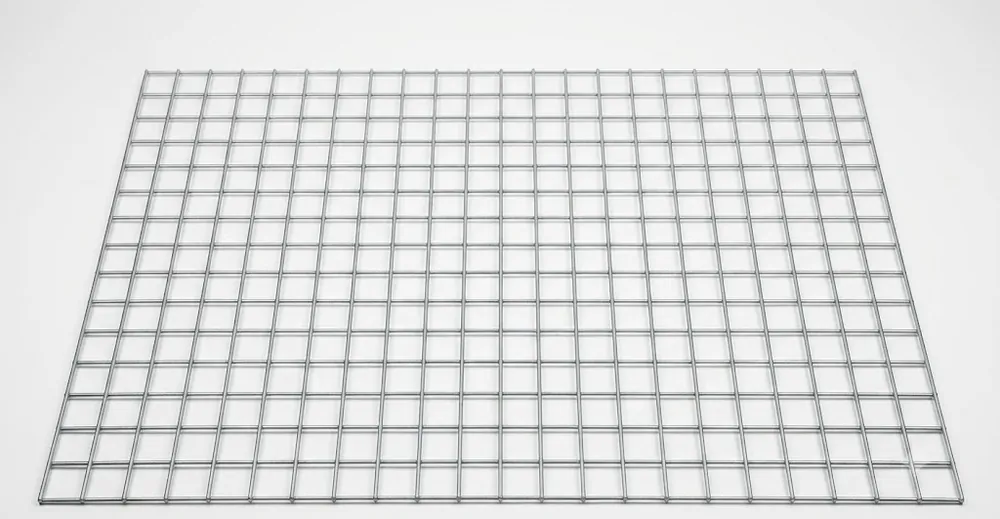
I run the export desk at Hebei Leeter Import and Export Co., Ltd ("Leeter"), a welded-mesh and fence manufacturer in Dingzhou, Hebei, exporting since 2006. Below is how we actually build a number when a buyer asks "how much?"
How a welded wire mesh price is built
A welded mesh quote is a stack, not a single figure. From the mill to your yard:
| Cost layer | What it is | Rough share of FOB |
|---|---|---|
| Steel wire rod | Low-carbon rod, drawn down to the wire gauge | 55-70% |
| Drawing + welding | Pulling rod to size, resistance-welding the grid | 10-20% |
| Surface finish | Galvanizing (before or after weld) or PVC coating | 5-20% |
| Packing + handling | Pallets, waterproof wrap, loading | 3-8% |
| Factory margin | Overhead and profit | the balance |
| then Ocean freight | FCL to your port (on top of FOB) | varies by lane |
| then Duty | Section 232 + any trade remedy, at landed | varies by market |
Because steel wire rod is the majority of the cost, the single biggest thing that moves a welded mesh price is the steel market — not the factory. When buyers see a quote move between orders, it is almost always the rod index, not margin games. The China export FOB for long products was about US$500/t (rebar grade) to US$578/t (HDG coil) in early October 2026; track that index and you can predict which way your next quote moves.
The specs that change the price
Hold the steel index constant and the quote still swings with the specification. The five levers, biggest first:
- Wire diameter and aperture (the weight). Mesh is sold by weight, so a heavier gauge or a tighter aperture puts more kilograms into every square metre and costs proportionally more. A 3.0 mm wire on 100 × 100 mm is far cheaper per m² than 5.0 mm on 50 × 50 mm. Work out the weight before you compare prices — our wire mesh weight guide and the mesh weight calculator turn a spec into kg/m².
- Coating. Plain is cheapest. Galvanized before welding (pre-galv / GBW) is lighter-coated and cheaper; hot-dip galvanized after welding (GAW) seals the welds and lasts far longer outdoors but adds the most cost. PVC over galv adds again. See galvanized before vs after welding.
- Format. Flat rigid panels cost more to pack and ship than rolls, and odd panel sizes that do not nest waste container space — which shows up as a higher delivered cost even at the same FOB.
- Volume. Price per tonne falls with order size: a full 20 ft or 40 ft container prices better than a part load, because setup, packing and freight amortise over more weight.
- Standard and QC. Mesh certified to ASTM A1064 with a mill test report and third-party inspection carries a small premium over uncertified material — worth it when the mesh goes into structural concrete.
Per ton or per square metre — read the quote the same way
Suppliers quote welded mesh two ways, and they are not comparable until you convert:
- Per tonne (US$/t) is the honest basis, because mesh is made and sold by weight. Public B2B pages in 2026 showed galvanized welded mesh and reinforcement roughly in the US$600-1,100/t band depending on gauge, coating and volume — moving with the steel index above.
- Per square metre (US$/m²) or per roll is what distributors often show. A per-m² price only means something once you know the weight per m², because a cheap-looking $/m² on a light gauge can be a worse $/t than a "dearer" heavy panel.
To compare two quotes: convert both to US$ per tonne using the mesh weight, then add freight and duty to each to get landed cost per tonne. A low FOB from a far port with a light-gauge panel can land higher than a dearer, heavier, closer quote. Run it in the landed cost calculator rather than trusting the FOB sticker.
From FOB to landed — the number that actually matters
FOB is the price at the Chinese port. Your delivered cost adds:
- Ocean freight (FCL rate to your port) and local charges.
- Duty. Into the US, welded mesh of steel carries the Section 232 steel tariff (a 50% ad-valorem rate on the steel content in 2026), stacked on any most-favoured-nation rate — a material line item that a per-m² FOB quote hides entirely. The full 2026 duty stack and HTS logic are in choosing a Hebei fence manufacturer for North American importers.
- Insurance, customs brokerage, drayage and your margin.
The practical rule: never sign off on an FOB quote alone. A quote that looks 15% cheaper at FOB can be the more expensive option landed once a lighter gauge, a longer freight lane and the same duty rate are all applied. The landed cost per tonne — not the FOB — is what you compare between suppliers.
What a fair quote looks like
When you ask us for a price, a real quote names all of this so you can check it: the wire gauge and aperture, the coating type and zinc weight, panel or roll size, the resulting kg per m² and per panel, the standard (e.g. ASTM A1064), the FOB port, and the container stuffing count. If a quote gives you only a single per-m² number with no weight, no coating detail and no standard, you cannot compare it and it will not match on delivery. A price you can audit beats a price that looks low.
Frequently asked questions
How much does welded wire mesh cost?
Welded wire mesh is priced by weight. In 2026, China export FOB for galvanized welded mesh and reinforcement ran roughly US$600-1,100 per tonne depending on wire gauge, aperture, coating and order volume, tracking the steel wire rod index (China long-product export FOB was about US$500-578/t in early October 2026). On a per-area basis, light to standard galvanized panels showed around US$0.50-2.00/m² on public B2B listings. Your delivered cost is higher once ocean freight and import duty (e.g. the US Section 232 steel tariff) are added, so compare landed cost, not FOB.
What is the price of welded wire mesh per ton?
Per tonne is the correct way to price welded mesh because it is made and sold by weight. Public 2026 listings for galvanized welded mesh and reinforcing mesh sat roughly in the US$600-1,100/t range, with the exact figure set mostly by the steel wire rod index of the day plus a conversion margin for drawing, welding and galvanizing. Heavier gauge and hot-dip-after-weld coating push toward the top of the band; plain or pre-galvanized light mesh sits near the bottom.
Why do two welded mesh quotes differ so much?
Usually one of three reasons: a different wire gauge or aperture (more steel per m² = higher weight = higher cost), a different coating (plain vs galvanized-before vs hot-dip-after-weld), or a different basis (a per-m² price on a light gauge can be a worse per-tonne deal than a "dearer" heavy panel). Convert both quotes to US$ per tonne using the mesh weight, then add freight and duty, before deciding which is cheaper.
What makes welded wire mesh prices go up or down?
The steel wire rod market, by far — it is 55-70% of the FOB cost, so welded mesh prices move with the steel index rather than with the factory. Coating choice, wire gauge, order volume and, at the landed level, freight rates and import tariffs (such as the US Section 232 steel duty) account for the rest. Watching the China long-product export FOB index tells you which way your next quote will move.
How do I calculate my landed cost for imported welded mesh?
Start from the FOB price per tonne, add ocean freight and local charges to your port, add import duty on the steel content (into the US, the Section 232 rate), then insurance and brokerage. Use the landed cost calculator with the mesh weight from the mesh weight calculator to turn a per-m² FOB offer into a true delivered cost per tonne you can compare across suppliers.
