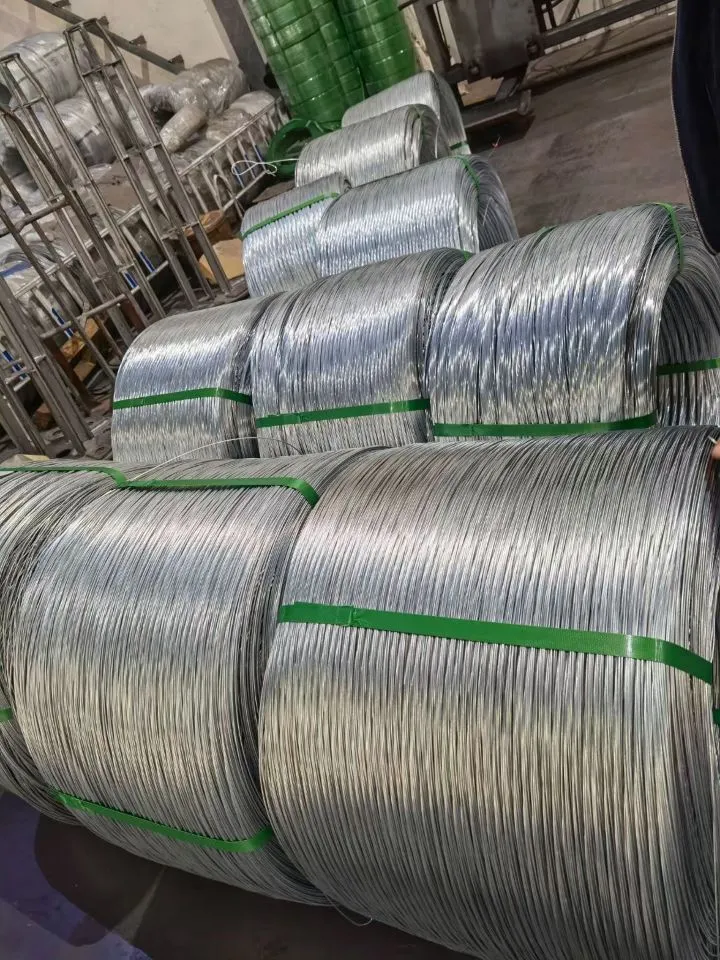
We are Hebei Leeter Import and Export Co., Ltd ("Leeter"), a construction wire, mesh and fencing manufacturer in Dingzhou, Hebei, China, exporting since 2006, and we draw both black annealed wire and galvanized wire on the same mills to the gauges below.
The two wires side by side
| Property | Black annealed wire | Galvanized wire |
|---|---|---|
| Base material | Low-carbon (mild) steel | Low-carbon (mild) steel |
| Coating | Light oil film over bare, annealed steel | Zinc — electro (EG) or hot-dip (HDG) |
| Colour / finish | Dark grey to black, matte | Bright silver, shiny |
| Softness | Very soft, dead-soft after annealing | Firmer; annealed grades still pliable |
| Tensile strength | ~300–550 MPa (soft, low tensile) | ~350–1300 MPa depending on temper |
| Corrosion resistance | Poor — rusts if wet | Good — zinc sacrificially protects steel |
| Relative cost | Lowest | 15–40% more (zinc + process) |
| Typical use | Indoor tying, rebar, baling, handicraft | Fencing, mesh, outdoor tying, binding |
| Common gauges | 8–22 BWG (0.8–4.0mm) | 8–22 BWG (0.8–4.0mm) |
What black annealed wire is
Black annealed wire is mild-steel wire that has been drawn to size, then heat-treated (annealed) to relieve stress and make it dead-soft, and finally given a thin oil coating that leaves the dark blue-black surface it is named for. That anneal is the whole point: the wire bends and twists by hand without springing back or snapping, so a worker can wrap and cinch a tie in one motion. The oil film is a light rust inhibitor for shipping and storage, not a true corrosion barrier — leave black annealed wire in a wet environment and it will rust. Common export gauges run 8–22 BWG (roughly 4.0mm down to 0.8mm), with 16 BWG (1.6mm) and 18 BWG (1.2mm) the workhorse tie sizes.
What galvanized wire is, and electro vs hot-dip
Galvanized wire is mild-steel wire coated with zinc so it resists corrosion outdoors. The zinc protects two ways: it seals the steel from air and moisture, and it corrodes sacrificially so small scratches still don't rust through. There are two coating routes:
- Electro-galvanized (EG): zinc deposited by electroplating — a thin, even, bright layer, typically around 8–25 g/m². Cheaper, smoother and neat for indoor or short-life outdoor work, but the light coat gives limited weather life.
- Hot-dip galvanized (HDG): wire pulled through molten zinc for a much heavier coat, commonly 40–300+ g/m² by class. It costs more and looks slightly rougher, but lasts years outdoors, which is why fencing and mesh use it.
Galvanized wire also comes in soft (annealed) and hard tempers. Soft galvanized wire twists like black annealed but keeps its rust protection; hard-drawn galvanized holds tension for fencing lines. See our electro vs hot-dip galvanized wire guide note on coating weight when you match a class to service life.
Gauge, softness and tensile — reading the specs
Both wires are specified the same way: gauge (BWG in most export markets, sometimes SWG) plus diameter in mm, and a temper. The gauge sets diameter and therefore break load; the temper sets how the wire behaves in the hand.
| Gauge (BWG) | Diameter (mm) | Common role |
|---|---|---|
| 8 | 4.0 | Heavy baling, mesh backbone |
| 10 | 3.4 | Baling, heavy tying |
| 12 | 2.8 | Mesh, medium tying |
| 14 | 2.1 | General tying, weaving |
| 16 | 1.6 | Rebar tie wire (standard) |
| 18 | 1.2 | Rebar tie wire, light bundling |
| 20 | 0.9 | Handicraft, fine tying |
| 22 | 0.7 | Craft, floristry, fine mesh |
For tie wire, softness matters more than strength — a soft 16 BWG black annealed wire that twists tight beats a stiffer wire that fights back. For fencing and load-bearing mesh, you want the tensile of a harder galvanized temper. Do not over-spec tensile on a tie wire; it only makes the job slower. Our high-tensile vs mild-steel wire guide covers where high tensile genuinely earns its cost.
Which wins for tie wire, mesh, baling and handicraft
- Rebar tie wire: black annealed, 16 BWG (1.6mm) soft, cut-and-looped or in coils. It is the cheapest wire that twists tight and the reo is cast in concrete, so rust never gets a chance. Choose galvanized only for exposed or marine rebar cages.
- Mesh (welded, woven, chain-link): galvanized. Mesh usually lives outdoors, so zinc is essential; HDG for fences and gabions, EG or soft galvanized for indoor cages.
- Baling and bundling: black annealed for scrap, waste-paper, cotton and hay baled and used quickly indoors — softness and low cost win. Galvanized where bales sit outside or ship long distances damp.
- Handicraft, weaving and floristry: either, by look. Black annealed gives a dark, matte, workable wire in 20–22 BWG; bright galvanized suits pieces that must not rust or need a silver finish.
Ordering from Leeter
Specify each line as coating (black annealed / EG / HDG), gauge (BWG) with mm, temper (soft or hard), zinc class or coating weight for galvanized, and packing — small coils, spools, or big coils on pallets. As the manufacturer we draw to your gauge, anneal to a true dead-soft temper for tie and baling wire, and hold zinc coating weight on galvanized to the ordered class. MOQ runs from about one pallet up to a 1x20' container (mixed coatings and gauges are fine), lead time 15–35 days FOB or CIF, with mill test reports, pre-shipment inspection and AQL sampling available. Black annealed and galvanized wire ship well together in one mixed container.
Frequently asked questions
Is black annealed wire the same as galvanized wire?
No. Black annealed wire is bare mild-steel wire that has been softened by annealing and given a thin oil film, so it is dark, very soft and cheap but rusts when wet. Galvanized wire is the same steel coated with zinc — either electro or hot-dip — so it resists corrosion outdoors. They share gauges (8–22 BWG) but differ in coating, colour, cost and where they can be used.
Does black annealed wire rust?
Yes. Black annealed wire has only a light oil coating that delays surface rust during storage and shipping; it is not a corrosion barrier. In damp or outdoor conditions black annealed wire rusts, so it is meant for dry indoor work such as rebar tying, baling and bundling where the wire is used quickly or cast into concrete. For any wet or outdoor job, choose galvanized wire instead.
What gauge wire is best for tying rebar?
16 BWG (1.6mm) soft black annealed wire is the standard rebar tie wire because it twists tight by hand and holds without springing back. 18 BWG (1.2mm) is used for lighter bar and faster tying. Both are supplied dead-soft in coils or as pre-cut looped ties. Use galvanized tie wire only where the rebar is exposed or in corrosive, marine conditions.
What is the difference between electro and hot-dip galvanized wire?
Electro-galvanized wire is electroplated with a thin, bright, even zinc layer (about 8–25 g/m²) — cheaper and smoother, but with limited outdoor life. Hot-dip galvanized wire is drawn through molten zinc for a much heavier coat (roughly 40–300+ g/m²), so it lasts far longer outdoors and is the choice for fencing, mesh and gabions. Match coating weight to how long the wire must survive exposure.
Which is cheaper, black annealed or galvanized wire?
Black annealed wire is cheaper because it skips the zinc and the galvanizing process — only annealing and an oil film are added to the drawn steel. Galvanized wire typically costs 15–40% more, driven by zinc price and coating weight, with hot-dip costing more than electro-galvanized. Buy black annealed where corrosion is not a risk and pay for galvanized only when the wire must resist rust.
