
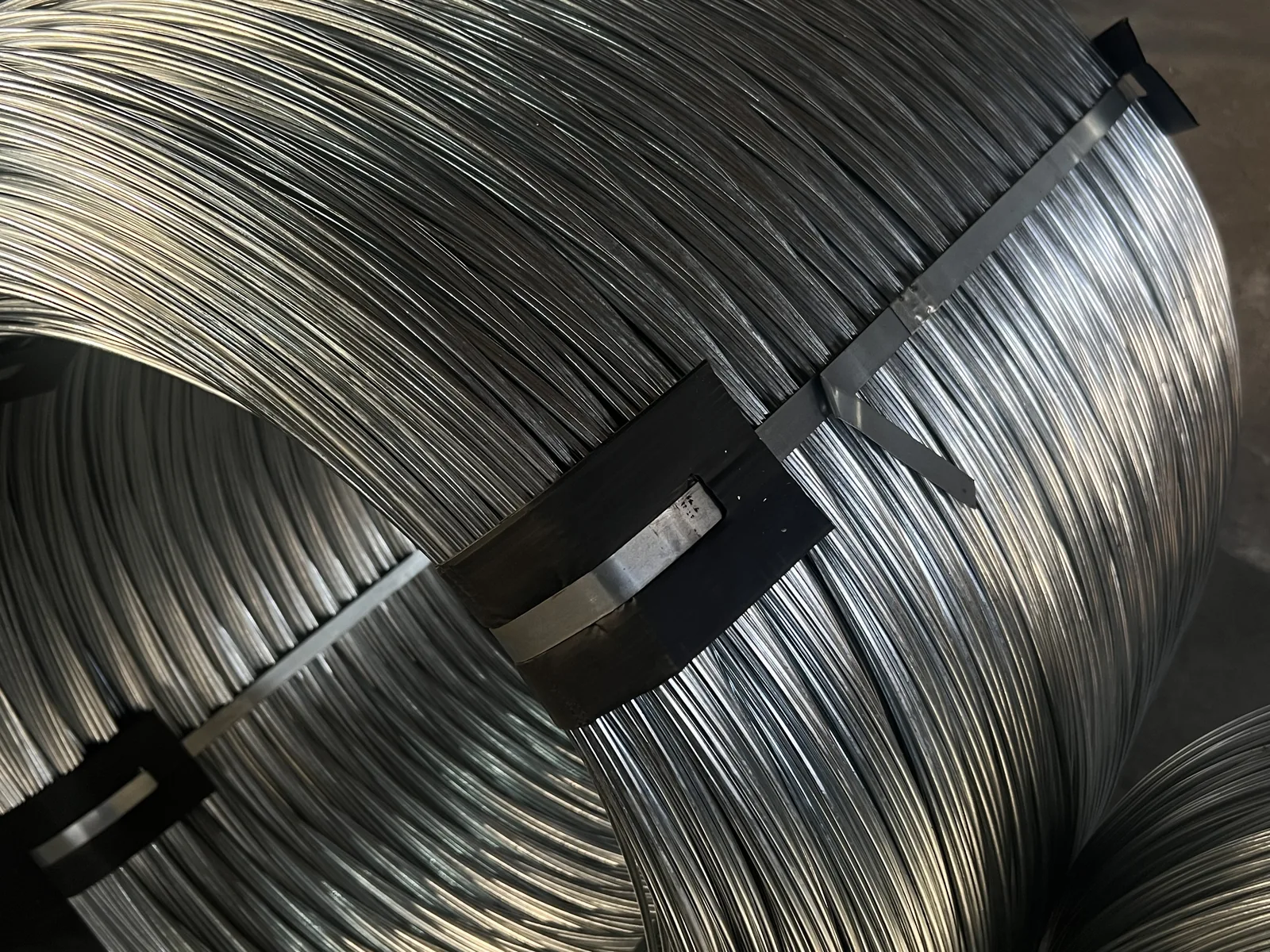
At our Dingzhou, Hebei wire mill, we draw, anneal and hot-dip galvanize galvanized tie wire, PVC-coated wire and small coil binding wire for coastal contractors and distributors. Use our tie wire quantity calculator to estimate total coil and carton counts before locking your coating specification.
Why does tie wire corrode before the rebar it holds?
Tie wire sits closer to the formwork face than the main reinforcing bar. After an ironworker twists a saddle or snap tie and clips the pigtail, the cut wire tail often projects 6 to 15 mm (1/4" to 5/8") into the nominal concrete cover zone.
In a marine splash zone, bridge deck or parking garage with de-icing salts, chloride ions diffuse through the outer 15–25 mm (0.6"–1.0") of concrete far faster than they reach the 50–75 mm (2.0"–3.0") main bar cover. When an uncoated black annealed tie wire tail oxidizes:
- Volumetric expansion (3× to 6×): Iron oxide expands up to 600% of the original steel volume, generating internal tensile stresses exceeding 15–25 MPa (2,175–3,625 psi) — more than triple the tensile cracking threshold of typical 35 MPa (5,000 psi) concrete.
- Surface rust bleed and micro-spalling: Rust migrates along the tie wire capillary path to the concrete surface, leaving permanent orange-brown stains or popping a 20–40 mm (3/4"–1-1/2") cone of concrete off the face.
- Galvanic coupling Risk: Mixing bare carbon-steel tie wire with stainless steel rebar creates an unfavorable anode-to-cathode area ratio, accelerating anodic dissolution of the small tie wire cross-section.
How do tie wire coatings compare for coastal & aggressive exposure?
Selecting the right tie wire coating depends on two variables: how long the tied rebar cage stands exposed to salt air before the concrete pour, and the final service exposure class of the cured structure.
| Tie Wire Specification | Coating Mass / Composition | Tensile Strength & Elongation | Salt-Air Pre-Pour Life (Uncovered Cage) | Target Concrete Exposure & Rebar Match | Relative Material Cost Index |
|---|---|---|---|---|---|
| Black Annealed (ASTM A82) | Thermal black oxide + light oil (0 g/m² zinc) | 350–450 MPa (50.7–65.2 ksi) · ≥15% | 2–5 days (coastal) / 2–4 weeks (inland dry) | Interior slabs, foundations poured promptly with black A615 rebar | 1.00× (Baseline) |
| Electro-Galvanized (EG) | 15–25 g/m² (0.05–0.08 oz/ft²) pure zinc | 350–480 MPa (50.7–69.6 ksi) · ≥14% | 2–4 weeks (coastal) / 3–6 months (inland) | General outdoor slabs, light moisture, short pre-pour delays | 1.12× – 1.18× |
| Hot-Dip Galvanized Class 1 (ASTM A641) | 90–150 g/m² (0.30–0.50 oz/ft²) HDG zinc | 380–480 MPa (55.1–69.6 ksi) · ≥14% | 3–9 months (coastal) / 2–5 years (inland) | Exterior walls, precast panels, ASTM A767 galvanized rebar | 1.25× – 1.35× |
| Hot-Dip Galvanized Class 3 (ASTM A641) | ≥240 g/m² (0.80 oz/ft²) heavy HDG zinc | 380–500 MPa (55.1–72.5 ksi) · ≥12% | 2–5 years (coastal atmosphere) | Coastal foundations, ports, bridge substructures, long pre-pour staging | 1.45× – 1.60× |
| PVC / Epoxy Coated (ASTM A884 ref.) | 0.20–0.40 mm (8–16 mil) organic jacket over steel core | 350–450 MPa core · ≥15% | 1–3+ years (UV-stabilized PVC) | ASTM A775 / A934 epoxy-coated rebar (prevents coating nicking) | 1.50× – 1.75× |
| 304 / 316 Stainless Steel (ASTM A580) | 18% Cr–8% Ni (304) or 16% Cr–10% Ni–2% Mo (316) | 520–680 MPa (75.4–98.6 ksi) annealed · ≥30% | Indefinite (zero red rust) | Seawalls, piers, splash zones, ASTM A955 stainless or GFRP rebar | 4.20× – 5.80× |
When should you choose Class 3 Galvanized vs PVC-Coated vs Stainless tie wire?
1. Choose ASTM A641 Class 3 Hot-Dip Galvanized (≥240 g/m² / 0.80 oz/ft²) when:
- You are tying black carbon-steel rebar (ASTM A615 / A706) or hot-dip galvanized rebar (ASTM A767) on coastal commercial buildings, highway bridges or marine foundations where the rebar cage may sit exposed to humid salt air for 30 to 180 days before formwork closure and pouring.
- Pros: Sacrificial cathodic protection even at cut ends; 3× thicker zinc layer than Class 1 and 10× thicker than electro-galvanized wire; withstands ironworker plier jaw abrasion without stripping.
- Cons / Trade-offs: Slightly stiffer twist feel than dead-soft black wire (380–500 MPa vs 350–450 MPa); not permitted for tying stainless steel rebar due to bimetallic coupling.
2. Choose PVC-Coated or Epoxy-Coated Tie Wire when:
- Your structural specification calls for epoxy-coated rebar (ASTM A775 / A934) or FRP/basalt bar. Bare steel tie wire scratches the epoxy coating on the main bar during twisting, creating pinhole holiday defects where corrosion concentrates.
- Pros: Cushioned 0.20–0.40 mm (8–16 mil) polymer jacket prevents metal-to-epoxy abrasion; electrical insulation breaks stray-current circuits on transit and bridge decks.
- Cons / Trade-offs: Larger outer diameter (e.g., 1.20 mm core / 1.60–1.80 mm OD) requires matching belt reels or pre-cut double loop bar ties.
3. Choose 304 or 316 Annealed Stainless Steel Tie Wire when:
- You are tying stainless steel rebar (ASTM A955), architectural precast cladding with thin cover (<25 mm / 1.0"), or marine splash-zone structures (piers, wharves, desalination plants).
- Pros: Zero rust bleed over a 75–100 year design life; non-magnetic austenitic structure; high elongation (≥30%).
- Cons / Trade-offs: Higher material cost (4.2×–5.8× carbon wire) and higher work-hardening rate — ironworkers must stop twisting once snug rather than over-torquing to shear.
Why rebar chairs must match your coastal tie wire specification
Upgrading tie wire to Class 3 galvanized or stainless fails if the crew sets the bottom mat on bare steel wire chairs. Even a galvanized wire chair resting directly on plywood formwork exposes its cut foot tips at the soffit face once forms are stripped.
| Support Type | Soffit Contact Material | Compressive Load Capacity | Coastal / Architectural Suitability |
|---|---|---|---|
| Plain Wire Bar Chair | Bare carbon steel | 300–600 lbs (136–272 kg) | Fail (CRSI Class 3): Immediate rust spots on exposed soffits |
| Plastic-Tipped Wire Chair | 3–5 mm PE dip on feet | 300–600 lbs (136–272 kg) | Moderate (CRSI Class 2): Suitable for sheltered slabs; dip can puncture under heavy mat loads |
| Heavy-Duty Virgin PP Plastic Chair | 100% non-corrosive polymer | ≥500 lbs (227 kg / 2.22 kN) | Pass (CRSI Class 1): Zero rust bleed; ideal for coastal slabs and walls up to 6" (150 mm) cover |
For coastal slabs, beams and precast elements, pair your galvanized tie wire with our CRSI Class 1 heavy-duty plastic rebar chairs or plastic-tipped wire bar chairs.
Field checklist: 4 rules to prevent coastal reinforcement spalling
- Bend tie wire tails inward: Instruct ironworkers to bend every twisted pigtail downward and inward away from the formwork face so the wire tail never encroaches on the outer 38–50 mm (1.5"–2.0") concrete cover.
- Ban electro-galvanized wire on coastal jobs: Standard 15–25 g/m² (0.05–0.08 oz/ft²) electro-galvanized wire develops white and red rust within 2–3 weeks of marine fog. Always write "Hot-Dip Galvanized to ASTM A641 Class 3 (min. 240 g/m² / 0.80 oz/ft²)" on the purchase order.
- Require VCI ocean-transit packaging: Container humidity swings between 30 °C and 60 °C during sea freight from China, causing wet-storage stain (white rust) on bare zinc. Specify VCI anti-corrosion paper + sealed PE shrink film inside every master carton.
- Verify zinc mass on the Mill Test Report (EN 10204 3.1): Audit the gravimetric acid-strip zinc weight (ASTM A90) on the factory MTR before shipment release.
Frequently asked questions
What is the minimum zinc coating for coastal rebar tie wire?
For coastal or marine concrete exposure, specify hot-dip galvanized tie wire to ASTM A641 Class 3, which requires at least 240 g/m² (0.80 oz/ft²) of zinc on 16-gauge (1.60 mm) wire. Standard electro-galvanized wire (15–25 g/m²) is intended only for indoor or dry-climate binding and will corrode rapidly in salt air.
Can you use black annealed tie wire on galvanized or epoxy-coated rebar?
No. Using bare black annealed wire on epoxy-coated rebar (ASTM A775) nicks the epoxy barrier and leaves an unprotected rust wick in the cover zone; always use PVC-coated or epoxy-coated tie wire. On hot-dip galvanized rebar (ASTM A767), use hot-dip galvanized tie wire so the zinc sacrificial anode system remains uniform across all intersections.
How much 16-gauge Class 3 galvanized tie wire is needed per ton of rebar?
Consumption is identical by weight to black annealed wire: 7 to 12 kg per metric tonne (15 to 26 lbs per short ton) of #4–#5 (12–16 mm) rebar, or roughly 1.8 to 2.2 lbs (0.82–1.00 kg) per ton on wide 12-inch (300 mm) slab grids. One 3.5 lb (1.58 kg) coil yields approximately 335 ft (102 m) and ties 700 to 900 intersections.
Manufactured by Hebei Leeter Import and Export Co., Ltd., operating dedicated cold-drawing, thermal pit-annealing and continuous hot-dip galvanizing facilities in Dingzhou, Hebei, China under ISO 9001:2015.
