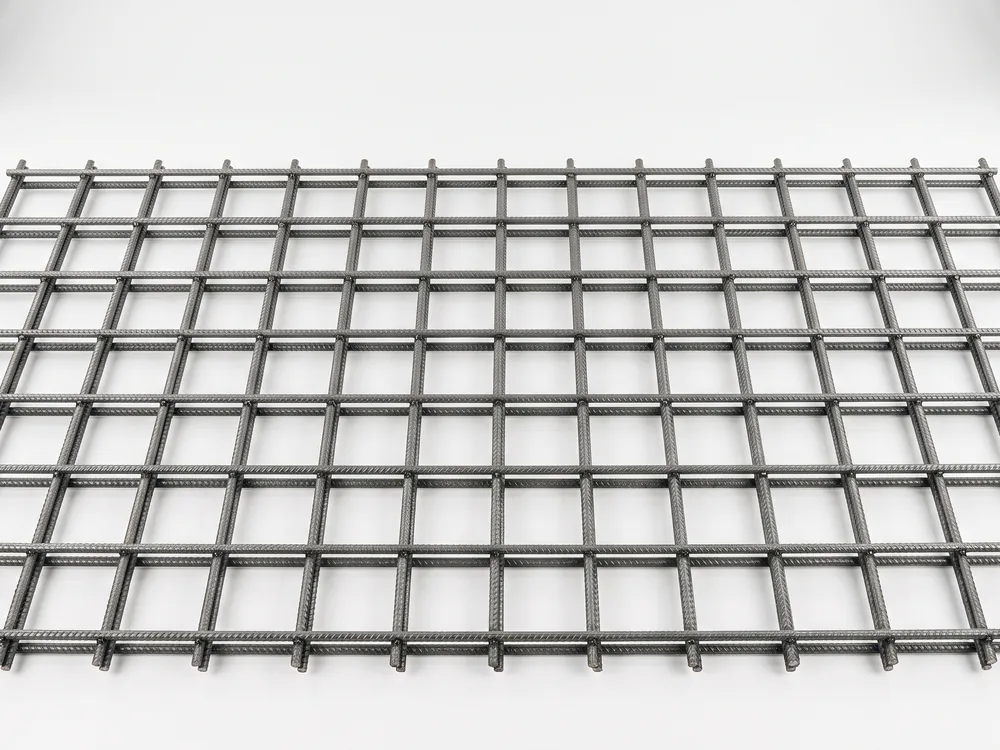
We are Hebei Leeter Import and Export Co., Ltd ("Leeter"), a manufacturer of welded wire mesh and reinforcing mesh in Dingzhou, Hebei. We make the steel side of this comparison, so here is the honest division of labour — including where fibers genuinely make our product unnecessary.
What each one actually does
| Synthetic micro-fiber | Welded wire mesh | |
|---|---|---|
| Works when | First hours (plastic state) | Entire service life |
| Main job | Prevent plastic-shrinkage micro-cracks | Hold drying-shrinkage cracks tight; aggregate interlock |
| Post-crack strength | Minimal (micro-fibers) | Real — steel carries across the crack |
| Placement risk | None — it's in the mix | Must sit mid-slab on chairs (the classic failure is mesh on the ground) |
| Cost | Low (dosed per m³) | Moderate (sheets + chairs + labour) |
| Finishing | Can show fiber "hairs" on surface | None |
Two honest caveats on each side. Fibers: the common polypropylene micro-fiber dose (~0.6–0.9 kg/m³) is a plastic-shrinkage product — it is not a substitute for structural reinforcement, and vendors' "replaces mesh" claims refer only to crack-width control in specific light-duty cases. (Steel or macro-synthetic fibers at high doses are a different, engineered product.) Mesh: it only works in the right position — a sheet lying on the subbase "ends up at the bottom and provides nothing," as the forum consensus puts it. Mesh must be supported mid-slab on chairs, not hook-pulled during the pour; that placement discipline is the price of its benefits. See where mesh goes in a slab.
When fibers alone are enough
- Light-duty, foot-traffic slabs — patios, walkways, shed floors — on a well-compacted granular base with proper joint spacing and curing.
- Slabs where surface appearance can tolerate (or finishing will hide) minor fiber hairs.
- The real crack insurance in these pours isn't the reinforcement at all: it's base compaction, joint layout and curing. A fiber slab on a good base with joints at 24–30× thickness outperforms a mesh slab on mud.
When you want steel
- Vehicles and point loads — driveways, garages, workshops: field reports are consistent that fiber-only garage slabs show more visible cracking than steel-reinforced ones under wheel loads.
- Doubtful or variable base, expansive soils, or fills you didn't compact yourself.
- Long joint spacings or odd panel shapes, where drying-shrinkage cracks are likely and must be held tight.
- Anything the engineer designed as reinforced — mesh designations (SL, A-series, 6×6-W) are structural steel areas; fibers don't substitute. For heavy loads the comparison moves to mesh vs rebar.
The both-and option
On residential driveways and garages, running fibers in the mix plus mesh on chairs is a legitimate belt-and-braces spec: fibers suppress day-one plastic cracking (especially in hot, windy pours), steel handles everything after. The incremental fiber cost is small; the failure it prevents (early map-cracking that telegraphs through the surface) is the one customers see first.
Specifying the steel side properly
If mesh is in the spec, make it real: sheets not rolls for anything structural (rolled remesh is lighter wire and nearly impossible to flatten), a designation with actual steel area (e.g. 6×6-W2.9, SL72, A142 — see the designation reference), one mesh-square overlap at laps, and chairs at ~1 per m² so the steel sits in the middle third of the slab. As the manufacturer we supply welded and reinforcing mesh to ASTM A1064, BS 4483 and AS/NZS 4671 in sheets cut to your schedule, with the chairs and tie wire in the same container.
Frequently asked questions
Can fiber mesh replace wire mesh in a concrete slab?
For light-duty, foot-traffic slabs on a well-compacted base — yes, reasonably: micro-fibers control the plastic-shrinkage cracking that matters there, and joints plus curing do the rest. For driveways, garages, doubtful bases or anything engineered as reinforced — no: the common micro-fiber dose has minimal post-crack strength, while steel mesh holds cracks tight for the slab's life.
What does fiber mesh actually do in concrete?
Synthetic micro-fibers distribute millions of tiny fibers through the mix that arrest plastic-shrinkage micro-cracking during the first hours after placement, while the concrete is still soft. Once the slab hardens their structural contribution is minimal — they are a fresh-concrete product, not a substitute for reinforcement in the hardened slab.
Why did my fiber-only garage slab still crack?
Concrete cracks from drying shrinkage regardless of fibers — the saying on the forums is that concrete does two things: gets hard and cracks. Fibers only handled the first-day plastic cracking; without steel, the later shrinkage cracks open wider and nothing holds the sections interlocked under wheel loads. Joint layout, base compaction and curing govern how visible those cracks are.
Is wire mesh worth it if the crew just lays it on the ground?
No — mesh on the subbase contributes almost nothing; it must sit in the middle third of the slab on chairs (about one per square metre). Don't accept the "we'll pull it up during the pour" method: where the mesh ends up is anybody's guess. If the crew won't chair it, fibers plus good jointing may honestly serve you better than mislaid steel.
Should I use both fibers and mesh?
On driveways and garages it's a sensible combination: fibers suppress day-one plastic cracking (valuable in hot or windy pours), and properly chaired mesh holds the slab together for its service life. The fiber adds little cost; the mesh does the long-term work. Neither replaces base compaction, joints at 24–30× slab thickness, and curing.
Sources
- ACI 302.1R — Guide to Concrete Floor and Slab Construction (placement, curing, joints)
- Garage Journal — wire mesh or not with fibre in cement (field outcomes)
- TexasBowhunter — fiber in concrete vs wire mesh or rebar (field reports)
- Practical Machinist — wire mesh placement ("pull it up" myth)
- ASTM A1064 — welded wire reinforcement
