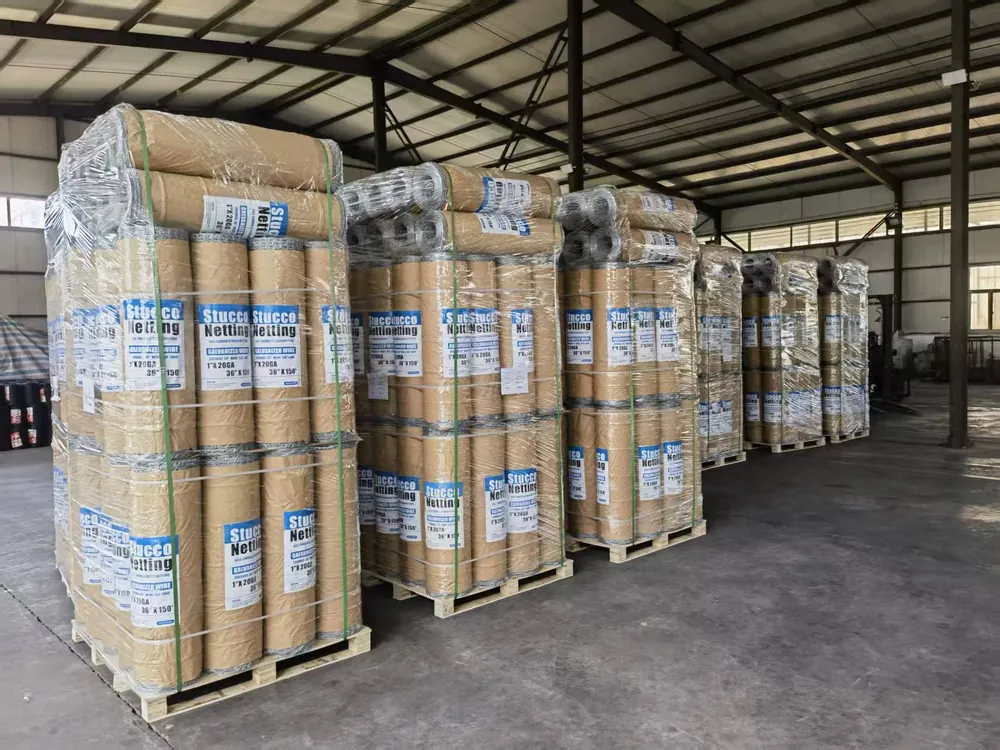
We are Hebei Leeter Import and Export Co., Ltd ("Leeter"), a wire and mesh manufacturer in Dingzhou, Hebei, China, exporting since 2006. We make the galvanized steel side of this — stucco netting and welded wire mesh — so the honest framing below is about which reinforcement the job needs, not a pitch for one over the other.
What each one actually does
Fiberglass mesh is a woven glass scrim, coated to resist the alkalinity of cement, laid into the wet base coat so it ends up buried in the plaster. It does not fasten to the wall and it carries no real structural load; its job is to distribute shrinkage and impact stress across the surface so hairline cracks don't telegraph through. Weights run roughly 4 to 5 oz/yd² for standard, up to 10–20 oz/yd² for high-impact areas.
Galvanized steel wire mesh (woven stucco netting or welded wire lath) is fastened to the framing or substrate and furred off it, so the scratch coat passes behind the wire and locks around it. It gives full-thickness cement stucco its mechanical key and holds the plaster mass to the wall. This is the stucco wire mesh base that three-coat work is built on.
One is embedded in the coat; the other is the base the coat is applied over. That is the whole difference.
Which system uses which
| Stucco system | Reinforcement | Where the mesh sits |
|---|---|---|
| Traditional three-coat cement | Galvanized steel wire lath / netting | Fastened to wall, plaster keys around it |
| One-coat cement | Steel lath, sometimes with fiberglass at the surface | Steel fastened; fiberglass in the coat |
| EIFS (synthetic / acrylic) | Fiberglass mesh | Embedded in the base coat over foam board |
| Crack repair / skim | Fiberglass mesh | Embedded in the patch |
Can fiberglass replace wire lath?
Not for full-thickness cement stucco. Fiberglass mesh has no fastening and won't hold the weight or thickness of three-coat plaster to a wall — that is the steel lath's job. Fiberglass earns its place in thin synthetic systems and as surface crack control. On a traditional cement job you often see both: steel lath as the base, and a strip of fiberglass at high-crack-risk details. Use them together, not one instead of the other.
Frequently asked questions
Is fiberglass or metal mesh better for stucco?
Neither is universally better — they do different jobs. Metal (galvanized steel) mesh is the fastened lath base for traditional three-coat cement stucco; fiberglass mesh is embedded reinforcement inside thin one-coat and EIFS base coats. Choose by your coat system: full-thickness cement plaster needs a steel lath; synthetic and one-coat systems use fiberglass in the coat.
Can I use fiberglass mesh instead of wire lath?
No, not for full cement stucco. Fiberglass mesh isn't fastened to the wall and can't carry the weight of three-coat plaster — it is designed to be embedded in a thin base coat for crack control. Traditional cement stucco needs a fastened, furred galvanized steel wire lath as its base.
What is fiberglass mesh for stucco used for?
It reinforces the base coat of one-coat and EIFS (synthetic) stucco systems: laid into the wet mortar, it spreads shrinkage and impact stress so the surface resists cracking. It is also used as a reinforcing strip over cracks, joints and high-stress details in cement stucco.
What is galvanized steel stucco netting?
It is woven hexagonal wire mesh, hot-dip or electro-galvanized for corrosion resistance, fastened to a wall as a plaster base — the traditional lath for three-coat cement stucco. As a manufacturer we supply it plain or self-furring, in specified wire gauge, mesh opening and roll size to ASTM C1032.
