We are Hebei Leeter Import and Export Co., Ltd ("Leeter"), a construction wire and mesh manufacturer in Dingzhou, Hebei, China, exporting since 2006. We draw and weave stucco netting and welded wire mesh to a specified diameter and opening rather than to a loose gauge label, because that is what keeps a plaster base consistent from roll to roll.
Woven vs welded: two kinds of stucco wire mesh
There are two families, and they behave differently under plaster.
Woven hexagonal netting is the classic "stucco netting" or "chicken wire for stucco." Wires are twisted into a flexible hex net that follows curves, arches and irregular masonry without fighting the surface. It is cheaper, lighter and the dominant choice for traditional three-coat stucco on wood-framed and sheathed walls.
Welded wire mesh uses straight wires resistance-welded at each crossing into a rigid, flat sheet — typically 2 in × 2 in (50 × 50 mm) or 1 in × 1 in. It holds its plane, so it suits flat framed walls and gives a stiffer plaster base, but it will not conform to curves the way woven netting does. Welded wire lath is covered by ASTM C933.
If the wall is flat and framed, either works; if it curves or is masonry, woven netting is easier to install cleanly.
Wire gauge and mesh opening
This is the spec buyers most often leave off. "Stucco mesh" without a gauge is not an order.
| Wire gauge | Wire diameter | Typical use |
|---|---|---|
| 20 ga | ~0.9 mm | Light interior plaster base |
| 18 ga | ~1.2 mm | General woven stucco netting |
| 17 ga | ~1.4 mm | Standard exterior stucco netting |
| 16 ga | ~1.6 mm | Heavy / commercial base |
Name the gauge and the system, or better, the diameter in millimetres — "17 gauge" differs slightly between BWG, SWG and the US steel wire gauge, as our wire gauge chart sets out. Common mesh openings run 1 in (25 mm) up to 1-1/2 in (40 mm) for hex netting.
Self-furring and finish
Most exterior stucco mesh is self-furring: crimped dimples hold the wire about 1/4 in (6 mm) off the substrate so plaster passes behind the mesh and fully embeds it, keying to the wall per ASTM C1063. Flat (non-furring) mesh is used where furring is provided another way. See self-furring lath for how the dimple depth works.
For finish, the wire is galvanized. Galvanized-before-weaving is economical; galvanized-after-weaving (hot-dip over the finished net) seals the twisted joints and lasts longer in wet or coastal exposure. Name a coating weight in g/m², not just "galvanized."
How to specify a stucco wire mesh order
For a quote that comes back accurate the first time, give five lines: wire diameter (mm) and gauge, mesh opening, self-furring or flat, galvanizing type and coating weight, and roll size (width × length, e.g. 36 in × 150 ft). Add your port and quantity and a manufacturer can return per-roll weight and container loading. Standardizing on one or two specs keeps the whole shipment interchangeable on site.
Frequently asked questions
What is stucco wire mesh?
Stucco wire mesh is galvanized steel wire — woven into hexagonal netting or welded into a square grid — fixed to a wall or ceiling as a plaster base. It gives the scratch coat a mechanical key so stucco grips the surface and resists cracking, and it is manufactured to ASTM C1032 (woven) or ASTM C933 (welded).
What gauge wire mesh is used for stucco?
Exterior stucco netting is typically 17 gauge (about 1.4 mm), with 18 gauge (1.2 mm) for general use and 16 gauge (1.6 mm) for heavier or commercial work. Always confirm the diameter in millimetres and the gauge system, because "17 gauge" is not identical across BWG, SWG and US steel wire gauge.
Is stucco mesh the same as chicken wire?
They look similar — both are woven hexagonal netting — but stucco netting is made and finished as a plaster base: it is usually heavier gauge, self-furring, and galvanized for wall exposure, whereas garden chicken wire is lighter and not furred. Use netting sold and specified for stucco, not general poultry netting.
Should I use woven or welded wire mesh for stucco?
Use woven hexagonal netting for curved, arched or masonry surfaces and traditional three-coat stucco — it conforms without fighting the wall. Use welded wire mesh for flat framed walls where a rigid, planar base is wanted. Both need to be fastened and furred so plaster fully embeds the wire.
How is stucco wire mesh packed and sold?
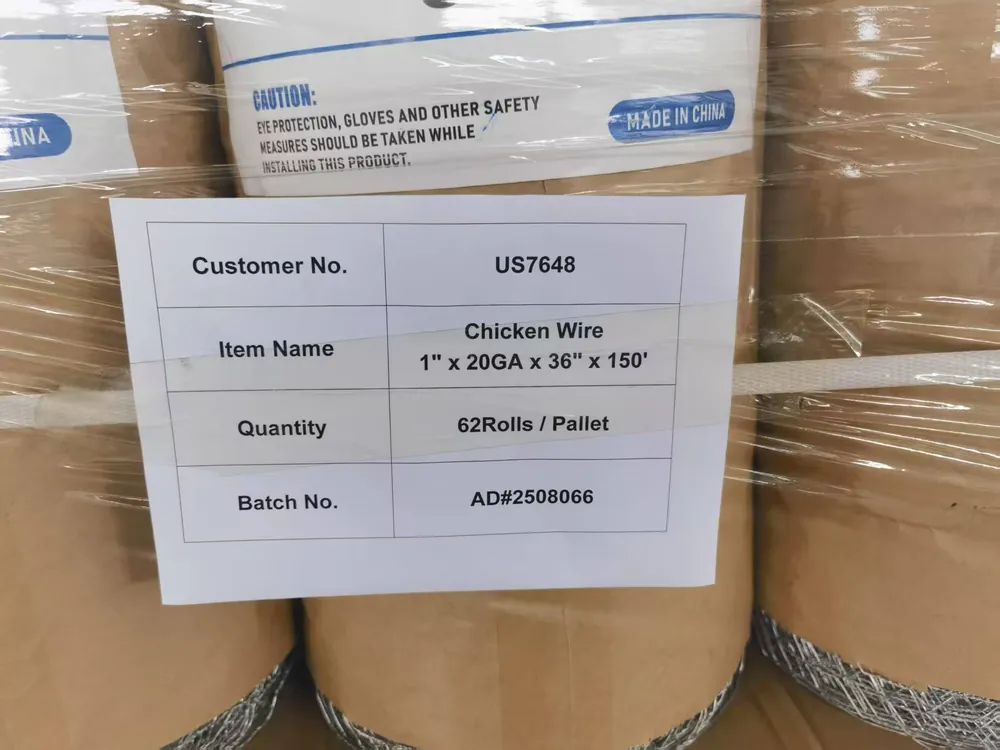
It ships in rolls, commonly 36 in (900 mm) wide by 150 ft (45 m) long, though width, length, gauge and mesh are built to your order. As a manufacturer we supply plain or self-furring netting with mill test details, and pack rolls by the pallet up to a full container with 15–30 day lead times.
