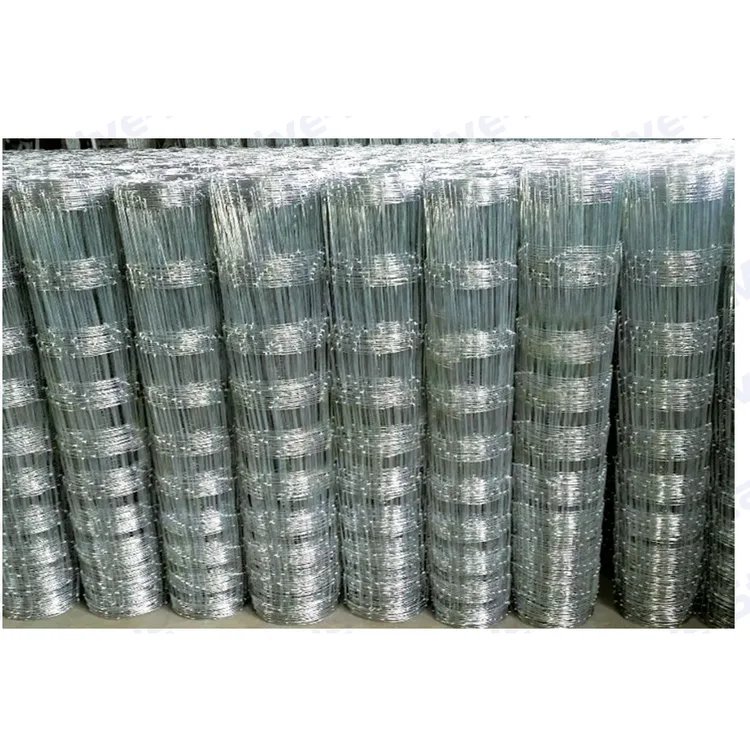
We are Hebei Leeter Import and Export Co., Ltd ("Leeter"), a wire and fencing manufacturer in Dingzhou, Hebei, China, exporting woven-wire field fence since 2006. We weave all three knot styles on the same line, so the guidance below is about which to order for the job, not a sales pitch for one construction.
The three knots at a glance
| Knot | How it is made | Behaviour | Best for |
|---|---|---|---|
| Hinge joint (Monarch) | The vertical stay wraps around each line wire, forming a hinge | Flexes under impact and springs back; economical | Cattle, general farm and field fence, rolling ground |
| Square deal / S knot | A separate short stay is tied to the line wires with an "S" bend | Extra vertical rigidity that resists buckling and sag | Sheep, goats, mixed stock, hilly terrain |
| Fixed knot (Solidlock) | A separate continuous knot wire wraps line and stay together | Strongest joint; will not slip; allows longer post spacing | Deer, game, wildlife and high-tension boundary fence |
Hinge joint: flex and spring-back
The hinge joint — also called the Monarch knot — is the classic field-fence construction. The vertical stay wire wraps around each horizontal line wire so the intersection works like a hinge: when an animal or a falling limb pushes on the fence, the joint gives a little and then springs back to shape without permanent deformation. That flexibility, plus the lowest steel cost of the three, is why hinge joint is the volume choice for cattle and general farm fence, and why it handles rolling ground well.
Its limit is exactly its strength: because the joint can move, hinge joint fence can be pushed down over time by heavy, persistent stock, and it is not the choice where you need a rigid, climb-resistant barrier.
Square deal (S) knot: rigidity on uneven ground
The square deal knot — also called the S knot — ties the vertical stay to the line wires with a separate piece bent into an "S." That extra wire adds vertical rigidity and stops the mesh from buckling or sagging between posts, while still allowing the fabric to follow a slope. It is the middle option: stiffer than hinge joint, cheaper than fixed knot. Buyers choose it for sheep, goats and mixed stock, and for fence lines that run over hills where a hinge joint would sag.
Fixed knot: maximum strength for deer and game
The fixed knot (sold under names like Solidlock or cross-lock) uses a separate continuous knot wire wrapped tightly around both the line wire and the stay wire, locking the intersection so it cannot slip. It is stronger than the square deal knot and gives the fabric the most vertical strength of the three, which does two things: it stands up to deer, elk and wildlife impact, and it lets you space line posts farther apart — lowering the installed cost on long runs even though the fabric itself costs more. Fixed-knot construction started in deer and wildlife fence and has moved into premium cattle and boundary fence for the same reasons.
The coating still decides how long it lasts
Whatever knot you pick, the zinc coating sets the service life. Field fence is drawn from Class 1 or Class 3 galvanized wire: Class 1 carries a lighter zinc coat and suits dry-climate or short-life fence, while Class 3 carries roughly three times the zinc and is what earns its cost on humid, coastal or long-service runs. Confirm both the knot and the coating class on the order — a fixed-knot fence on Class 1 wire in a wet climate will still rust out before its strength is used up.
How to specify field fence in one line
State: knot type (hinge / square deal / fixed), fabric height and the wire-spacing pattern, line and stay wire gauge, coating class (Class 1 or Class 3), and roll length. For example: "48-inch fixed-knot game fence, 2-inch vertical spacing, 12½ ga line / 12½ ga stay, Class 3, 330 ft rolls." Give a manufacturer those and the quote reflects the fence you actually want.
For the height and spacing side of the decision, see our field fence heights and spacing guide; for rigid welded alternatives where you need panels rather than rolls, see welded vs woven wire mesh.
Frequently asked questions
What is the difference between hinge joint and fixed knot fence?
A hinge joint fence wraps the vertical stay wire around the horizontal line wire, so the joint flexes under pressure and springs back — economical and good for cattle and rolling ground. A fixed knot fence uses a separate knot wire to lock the stay and line wires together so the joint cannot slip, giving higher vertical strength and allowing longer post spacing. Fixed knot is stronger and preferred for deer, game and premium boundary fence; hinge joint is the economical general-purpose choice.
What is a square deal knot?
The square deal knot, or S knot, ties the vertical stay to the line wires with a separate short wire bent into an "S." It adds vertical rigidity that resists buckling and sag while still letting the fence follow a slope, which makes it a good middle option for sheep, goats and mixed stock on uneven terrain.
Which knot is best for deer or game fence?
The fixed knot. Its locked intersection gives the fabric the highest vertical strength of the three knots, so it withstands deer and wildlife impact and can be run at tall heights (typically 6–8 ft) with wider post spacing. It costs more per roll than hinge joint but lowers installed cost on long high-tension runs.
Are all these knots made to the same standard?
Yes. ASTM A116, Metallic-Coated Steel Woven Wire Fence Fabric, covers woven field fence with either the hinge joint (stay wrapped around the line wire) or the fixed-knot construction, for farm, wildlife and right-of-way fencing. The standard also sets the wire gauges and the zinc coating class, so quote the A116 designation plus the knot and coating class you need.
