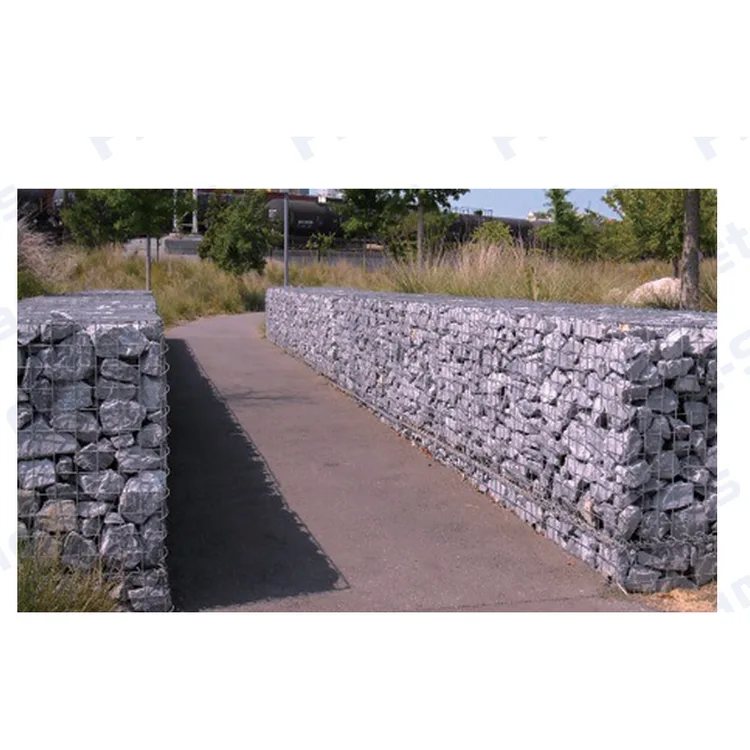
We are Hebei Leeter Import and Export Co., Ltd ("Leeter"), a wire, mesh and fencing manufacturer in Dingzhou, Hebei, China, exporting since 2006 to buyers across North America and Europe. We weave double-twist gabion boxes and reno mattresses in all three coatings, and coating choice is the single most common technical question our gabion buyers ask.
Why coating is the life of a gabion
A gabion structure has no maintenance access: once the baskets are filled and the wall or revetment is in service, nobody recoats the wire. The steel core does the structural work, but the coating decides how many decades pass before corrosion reaches that core. All three systems are sacrificial or barrier layers over the same drawn steel wire — typically 2.7mm wire on 80 x 100mm box mesh and 2.2mm on 60 x 80mm mattress mesh — so when you compare quotes, you are really comparing how long the coating holds off the environment. In abrasive flowing water there is a second factor: stone and sediment moving against the mesh can wear a soft coating away mechanically, which is where the PVC jacket earns its keep.
The three coating systems compared
| Coating | What it is | Relative coating life | Best for |
|---|---|---|---|
| Heavy galvanized | Thick hot-dip zinc layer | Baseline | Dry sites, mild inland climates, landscape walls |
| Galfan (Zn-5%Al) | Zinc–5% aluminium alloy coating | Roughly 2x heavy galvanized at similar coating weight | Longer design lives, damp ground, intermittent wetting |
| PVC over galvanized | Polymer jacket extruded over zinc-coated wire | Longest; barrier protection | Rivers, channels, coastal and polluted environments |
Heavy galvanized
Hot-dip galvanizing is the baseline: a heavy zinc layer that corrodes sacrificially, protecting the steel even at small nicks and scratches. For inland retaining walls, rockfall works and architectural landscape gabions in mild climates, heavy galvanized wire is the economic default and the version most stock programs carry. Its life scales with coating weight, so when comparing suppliers, ask for the zinc coating weight in g/m² — "galvanized" alone tells you little.
Galfan (Zn-5%Al)
Galfan replaces pure zinc with a zinc–5% aluminium alloy. The aluminium changes how the coating weathers: the alloy corrodes more slowly and more evenly, delivering roughly twice the service life of conventional galvanizing at a similar coating weight. It also stays ductile, which matters on gabion wire — mesh is twisted during weaving, and units are folded flat for shipping and bent again during assembly, exactly the kind of working that cracks brittle coatings. Galfan has become the default specification for serious civil gabion work in Europe and North America: the upcharge over heavy galvanized is small against the doubled life on a structure nobody will ever maintain.
PVC over galvanized
For permanent immersion, splash zones, salt air, acidic soils or contaminated urban runoff, we extrude a PVC jacket over galvanized wire — the finished wire has a metallic coating and a polymer barrier on top. The PVC stops the electrolyte reaching the zinc, so the metallic layer underneath is barely consumed, and the jacket also takes the abrasion from sediment-laden flow. Standard PVC color is grey or green, which incidentally softens the visual impact of river works. The jacket adds to the finished wire diameter, and the mesh is woven so that coating integrity is preserved at the twists — one more reason double-twist woven mesh suits coated wire better than welding, which would burn a polymer or alloy coating at every joint. The same trade-off appears across coated fencing generally; see how it plays out on lighter products like chain link fence and welded wire mesh.
Matching coating to environment
| Site condition | Recommended coating |
|---|---|
| Dry inland wall, landscape feature | Heavy galvanized |
| Damp ground, seasonal wetting, long design life | Galfan (Zn-5%Al) |
| Freshwater river or channel, constant flow | PVC over galvanized (Galfan under PVC for premium spec) |
| Coastal, brackish or salt-spray exposure | PVC over galvanized |
| Polluted runoff, acidic or industrial soils | PVC over galvanized |
| Rockfall and impact structures, mild climate | Heavy galvanized or Galfan |
Two practical rules sit behind the table. First, water contact means PVC: any gabion or reno mattress that lives in flowing or standing water — channel linings, revetments, outfall aprons — should be quoted in PVC-coated wire, whatever the budget pressure, because zinc alone is consumed fast under immersion and abrasion. Second, when in doubt between galvanized and Galfan, take Galfan: the price difference is small, and on a 30–60 year civil asset the doubled coating life is the cheapest insurance available. The exception is short-life or decorative work, where heavy galvanized keeps the quote sharp.
Remember that the lacing wire and any bracing wire must match the mesh coating — a PVC-coated basket stitched with bare galvanized lacing wire corrodes first at the seams. We supply matching lacing wire with every order by default.
What this means for importers and distributors
If you distribute erosion-control or civil products, stock the coating tiers the way the market actually buys: heavy galvanized boxes for landscapers and light retaining work, Galfan as your standard civil offer, and PVC-coated boxes and mattresses for every water-contact inquiry. All three run on the same standard unit sizes — boxes from 1.5 to 4m long and mattresses from 3 to 6m — so tiering your catalog by coating adds no new geometry to manage. On tenders, read the specification carefully: many DOT, water-authority and consulting-engineer specs now name Galfan or PVC explicitly, and a heavy-galvanized-only quote gets set aside on compliance before price is even compared. Contractors pairing gabion toe walls with fencing above often add welded fence panels or field fence with matching galvanized-plus-coating systems to the same container.
Frequently asked questions
What is Galfan coating on gabion wire?
Galfan is a zinc–5% aluminium alloy coating applied to steel wire in place of conventional pure zinc. At a similar coating weight it lasts roughly twice as long as ordinary galvanizing, corrodes more evenly, and stays ductile through the twisting and folding a gabion basket undergoes, which is why modern civil specifications increasingly require it.
When do gabions need PVC-coated wire?
Whenever the mesh will sit in or against water or aggressive ground: river and channel linings, revetments, culvert aprons, coastal and brackish exposure, and polluted or acidic soils. The PVC jacket over the galvanized wire blocks the electrolyte and takes the abrasion from moving sediment, protecting the metallic coating underneath for the long term.
How long does a galvanized gabion last?
It depends on coating weight and environment: heavy galvanized wire gives decades of service in dry, mild inland conditions, but its zinc is consumed much faster under immersion, salt spray or acidic exposure. As a working rule, Galfan roughly doubles the coating life at similar weight, and PVC over galvanized lasts longest in wet or aggressive sites.
Does the coating change gabion sizes or mesh specs?
No. All three coatings run on the same standard geometry — 80 x 100mm mesh with 2.7mm wire for boxes, 60 x 80mm mesh with 2.2mm wire for mattresses, in the same folded-flat unit sizes. PVC adds a jacket to the finished wire diameter, but the mesh, unit dimensions, diaphragms and lacing-wire supply are unchanged.
Can I mix coatings on one project?
Yes, and well-run projects often do: PVC-coated mattresses in the channel, Galfan boxes in the damp toe courses, and heavy galvanized boxes in the dry upper wall or landscape sections. Just keep each unit's lacing and bracing wire matched to its own mesh coating so no seam becomes the weak point.
