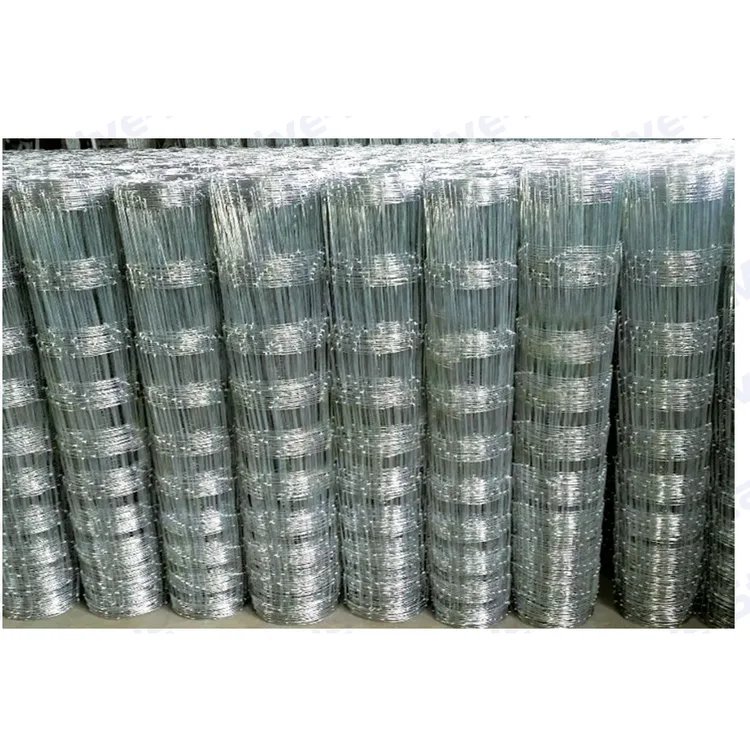
We are Hebei Leeter Import and Export Co., Ltd ("Leeter"), a wire and fencing manufacturer in Dingzhou, Hebei, China, exporting since 2006. We weave woven-wire field and horse fence and build welded panels, so the guidance below is about matching the product to how horses actually behave against a fence.
Which horse fence for which job
| Fence | Construction | Best for | Watch-out |
|---|---|---|---|
| 2×4 no-climb woven mesh | Woven wire, 2 in × 4 in openings | Pasture and paddock perimeter | Specify woven, not welded, for rolls |
| V-mesh (diamond) | Woven diagonal "V" pattern | Premium horse and foal paddocks | Higher cost; best hoof protection |
| Welded horse panels | Rigid welded panel, galvanized before welding | Pens, round pens, arenas, stalls | Welds must be smooth, no burrs |
Why the 2×4 opening matters
A horse explores a fence with its feet and its weight. The 2 in × 4 in mesh opening is sized so a hoof cannot pass through and get trapped, cannot press the horizontal line wires down to a step, and gives no toehold to climb. Wider stock or "sheep" mesh, and any large-diamond field fence, leave openings a hoof can enter — which is how horses get cut, cast, or pull a fence apart. For foals, V-mesh (a woven diagonal pattern) closes the gaps even further and is the safest woven option.
Woven for rolls, welded for panels
For rolled fence fabric, woven construction is preferred over welded: a woven joint flexes and absorbs impact, whereas a welded joint in a light fabric can snap under a strike and leave a sharp broken wire. Quality no-climb horse fence is typically 12½-gauge Class 3 galvanized wire in a 2×4 mesh, joined with an S-knot, with heavier 10-gauge top and bottom line wires for tension.
Rigid welded horse panels are the exception and the right tool for pens, round pens and arenas, where you want a stiff, movable section rather than a stretched fabric. There the requirements flip: the panel must be galvanized before welding and finished with smooth welds and no sharp burrs, because a horse leans and rubs on a pen panel constantly.
Never barbed wire — and be careful with high-tensile smooth wire
Barbed wire is the single most dangerous material around horses; horse-management literature is nearly unanimous that it should never be used to contain them, because a horse that hits or gets caught in it suffers deep lacerations. High-tensile smooth wire can also be risky unless it is highly visible and well-tensioned, because horses may not see a thin wire and can run into it. When in doubt, use a woven 2×4 mesh with a visible top rail or sight board.
The coating still sets the life
As with any field fence, the zinc coating class decides how long the fence survives outdoors. Use Class 3 galvanized (roughly three times the zinc of Class 1) for horse fence that has to stand for decades in weather, especially in humid or coastal paddocks. For how the knot choice interacts with terrain and stock, see our field fence knot types guide; for heights and line spacing by animal, see field fence heights and spacing.
How to specify horse fence in one line
State: mesh type (2×4 no-climb woven, V-mesh, or welded panel), fabric height, wire gauge (e.g. 12½ ga filler / 10 ga top-bottom), knot (S-knot for woven), coating class (Class 3), and roll length or panel size. For example: "60-inch 2×4 no-climb, 12½ ga / 10 ga, S-knot, Class 3, 100 m rolls."
Frequently asked questions
What is the safest fence for horses?
A 2 in × 4 in no-climb woven wire mesh is the safest general horse fence: the openings are too small for a hoof to step through or catch on and give no foothold to climb. V-mesh (a woven diagonal pattern) is the safest option for foals and premium paddocks. Welded horse panels with smooth, burr-free welds are used for pens, round pens and arenas. Barbed wire should never be used to contain horses.
Can you use welded wire for horse fence?
For pens, round pens and arenas, yes — rigid welded horse panels are made for that, provided they are galvanized before welding and have smooth welds with no sharp burrs. For rolled pasture fence, woven construction is preferred over welded, because a woven joint flexes under impact while a welded joint in light fabric can snap and leave a sharp wire.
Why can't you use barbed wire for horses?
Because horses panic and run into or through fences, and barbed wire causes deep lacerations and lasting injuries when they do. Horse-management sources are nearly unanimous that barbed wire should never be used to contain horses. Use a woven 2×4 mesh, ideally with a visible top rail, instead.
What gauge and coating should horse fence be?
Quality no-climb horse fence is commonly 12½-gauge Class 3 galvanized wire in a 2×4 mesh with an S-knot, and heavier 10-gauge top and bottom line wires for tension. Class 3 zinc carries about three times the coating of Class 1 and is worth it for the long service life horse fence needs, especially in wet or coastal climates.
