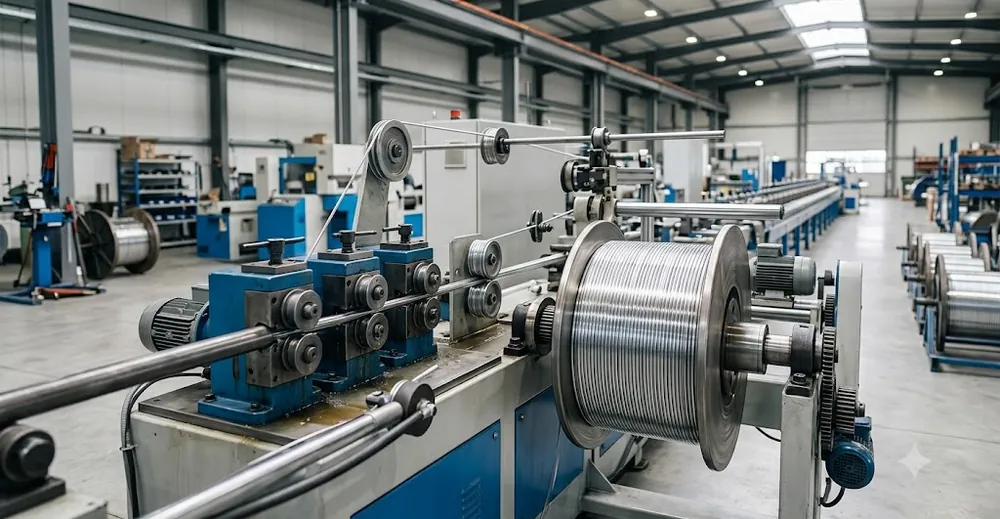
We are Hebei Leeter Import and Export Co., Ltd ("Leeter"), a wire, mesh, anchor, and support manufacturer based in Dingzhou, Hebei, China, exporting to North America and Europe since 2006. This guide walks you through each stage of our production line the way we would if you visited the factory floor.
The short version: five stages from rod to coil
Every reel of rebar tie wire we ship passes through the same sequence. The raw material is low-carbon steel wire rod. That rod is cleaned, drawn, annealed, sometimes coated, and finally packaged. Skipping or shortcutting any stage shows up later as broken ties, inconsistent temper, or rust bleed. Here is the process at a glance.
| Stage | Purpose | Key QC check |
|---|---|---|
| Wire rod intake | Source consistent low-carbon steel | Chemistry certificate, rod diameter |
| Descaling & drawing | Reduce diameter to target gauge | Diameter tolerance, surface finish |
| Annealing | Soften wire, set temper | Tensile strength, elongation, softness |
| Galvanizing (optional) | Add zinc corrosion barrier | Coating weight, adhesion |
| Coiling & packing | Deliver usable, tangle-free product | Coil weight, winding tension |
The rest of this guide expands each row so you know exactly what to ask a supplier before you buy.
What raw material does tie wire start from?
Tie wire starts as steel wire rod, usually low-carbon grades like SAE 1006, 1008, or 1010, delivered in coils weighing around one to two tons. The carbon content matters. Low carbon, typically below 0.10 percent, keeps the finished wire soft and ductile after annealing. Higher carbon steel resists softening and tends to spring back when twisted, which frustrates workers tying rebar all day.
We inspect every rod coil against its mill certificate before it enters the line. Diameter usually runs 5.5mm to 6.5mm at intake. The surface should be clean, with minimal scale and no deep drawing defects. Poor rod is the first hidden cause of bad tie wire. A cheap import that snaps often traces back to inconsistent or high-carbon rod bought on price alone, not to any single production fault downstream.
How is wire rod drawn down to size?
Wire drawing pulls the rod through a series of hardened dies, each slightly smaller than the last, until the wire reaches its target gauge. Before drawing, the rod is descaled to strip off the oxide layer, either mechanically by bending it over sheaves or chemically in an acid bath. A lubricant coating then protects the dies and reduces friction as the wire passes through.
Common finished gauges for tie wire include 16 gauge (about 1.6mm), 16.5 gauge, and 18 gauge, though we draw to customer specification. Each die reduces the cross-section by roughly 15 to 25 percent. As the wire is drawn, it work-hardens. It gets stronger but also stiffer and more brittle. That is expected. Drawing sets the diameter precisely, but it leaves the wire far too hard to twist by hand. The next stage fixes that.
A well-maintained drawing line holds tight diameter tolerances, often within plus or minus 0.02mm to 0.03mm. Worn dies produce oval or oversized wire that jams automatic tying tools. This is one reason die inspection and replacement schedules matter as much as the machines themselves.
Why is annealing the most important step?
Annealing is the heat-treatment stage that softens work-hardened wire, and it is the single step that most determines tie wire quality. The drawn wire is heated in a controlled furnace, typically in the range of 700 to 900 degrees Celsius depending on grade and desired temper, then cooled slowly. This recrystallizes the steel grain structure, relieves internal stress, and returns the wire to a soft, workable state.
The result buyers care about is temper. Properly annealed tie wire is "dead soft," meaning it bends and holds without springing back. On the job, that translates to fast twists, secure knots, and far fewer broken ties. Under-annealed wire stays springy and hard. Over-annealed wire goes too soft and weak, and can tear during tying. Hitting the target window is a matter of furnace temperature control, dwell time, and atmosphere.
We anneal in a controlled or protective atmosphere to limit surface oxidation and keep the finish clean. After annealing, we test samples for tensile strength and elongation. Soft annealed tie wire generally lands in a tensile range around 300 to 550 MPa with high elongation, though exact figures depend on gauge and application. Because temper is so central to performance, we cover it in depth in our companion guide on tie wire tensile strength and temper.
Here is the honest truth from the factory floor: two suppliers can use the same rod and the same drawing dies, yet ship completely different products because one controls annealing carefully and the other rushes the furnace to raise output. When you compare quotes, you are often really comparing annealing discipline.
How does galvanizing add corrosion protection?
Galvanizing coats the wire in zinc to protect it from rust, and it is applied when tie wire will be exposed to moisture, weather, or long storage. There are two main methods, and they produce different results. Electro-galvanizing (EG) deposits a thin, uniform, bright zinc layer by electroplating. Hot-dip galvanizing (HDG) passes the wire through a bath of molten zinc, leaving a thicker, heavier, more durable coating.
The choice comes down to service life and budget. Electro-galvanized galvanized tie wire has a light coating, roughly a few grams of zinc per square meter, and suits interior or short-term applications where appearance and clean handling matter. Hot-dip coatings run much heavier, commonly from tens of grams up to 200-plus grams per square meter, and hold up far longer outdoors and in aggressive environments. Some tie wire skips galvanizing entirely and ships as black annealed wire, which is soft and economical but offers no rust protection.
Coating weight is not a cosmetic detail. It is the number that decides how long the wire survives before red rust appears. We test coating weight and adhesion on galvanized batches, because thin or poorly bonded zinc flakes off during tying and defeats the entire purpose of the coating.
How is finished tie wire coiled and packed?
Coiling winds the finished wire into the format the customer will actually use, and clean winding is what keeps the product tangle-free on site. Tie wire ships in several forms: small coils, large coils, spools, and pre-cut U-ties or loop ties. The winding tension has to be consistent. Too loose and the coil collapses into a bird's nest; too tight and it will not feed smoothly into a tie tool or off a spool.
For machine tying, wire is precisely spooled to feed automatic rebar tie guns without jams. For hand tying, workers often prefer smaller coils they can hang from a belt. We match packaging to how the wire will be used, then protect it against moisture during ocean freight with appropriate wrapping and, where needed, waterproof liners. Rust that forms in a shipping container is a real risk on long routes to North America and Europe, and packaging is the last line of defense.
What quality checks separate good tie wire from cheap imports?
Consistent quality control across every stage is what separates reliable tie wire from cheap imports that pass on paper but fail in the field. Good production is not one heroic test at the end. It is a chain of checks: rod chemistry at intake, diameter during drawing, temper and elongation after annealing, coating weight after galvanizing, and coil integrity before packing.
Cheap imports typically cut corners in the places buyers cannot see in a photo. They may use higher-carbon or mixed rod, under-anneal to push throughput, apply thin zinc while calling it galvanized, or wind coils carelessly. The wire looks identical in a listing. The difference only shows up when a crew is on site and the wire snaps, springs back, or arrives rusted. A supplier that can produce mill certificates, temper data, and coating-weight reports is telling you the process was controlled, not improvised.
If you want documented specifications for your project, you can request a quote and we will confirm gauge, temper, coating, and packaging against your requirements before production.
Frequently asked questions
What is the difference between black annealed and galvanized tie wire?
Black annealed tie wire is softened by heat treatment but has no protective coating, giving it a dark, oxidized surface and low cost. Galvanized tie wire adds a zinc layer, either electro-galvanized or hot-dip, for rust resistance. Choose black annealed for indoor, short-term use and galvanized for exposure to moisture or long storage.
Why does my tie wire keep breaking when I twist it?
Breakage usually means the wire is too hard, which points to under-annealing or high-carbon rod. Properly annealed, dead-soft tie wire bends and twists without springing back or snapping. If wire breaks consistently, ask the supplier for temper and elongation data. It often reveals that annealing was rushed or the rod grade was wrong for the job.
What gauge of tie wire is standard for rebar?
The most common rebar tie wire gauges are 16 and 16.5 gauge, roughly 1.6mm, which balance strength and workability for hand and machine tying. Lighter 18 gauge wire suits smaller bar and lighter duty. The right gauge depends on bar size, tying method, and local practice, so confirm the specification before ordering.
Does annealing affect how well tie wire holds?
Yes. Annealing sets the temper, which controls how the wire behaves when twisted. Correct annealing makes wire soft enough to knot tightly and stay put without recoiling. Over-annealing weakens it; under-annealing leaves it springy. This is why temper control during the annealing process is the single most important factor in tie wire performance.
How can I tell if imported tie wire is good quality before buying?
Ask for documentation: rod chemistry certificates, tensile strength and elongation results, coating weight for galvanized wire, and gauge tolerance. Request a physical sample and test the twist by hand. Consistent diameter, dead-soft temper, clean coating, and neat coils are visible signs of controlled production rather than cost-cut manufacturing.
Get tie wire built to your specification
Now that you know how tie wire is made, you know what to check before you buy: rod quality, drawing tolerance, annealing temper, coating weight, and clean coiling. We control every stage in-house at our Dingzhou facility and back it with test data. Tell us your gauge, temper, coating, and packaging needs, and we will match production to your project. Contact us for a quote and we will confirm the full specification before we run your order.
