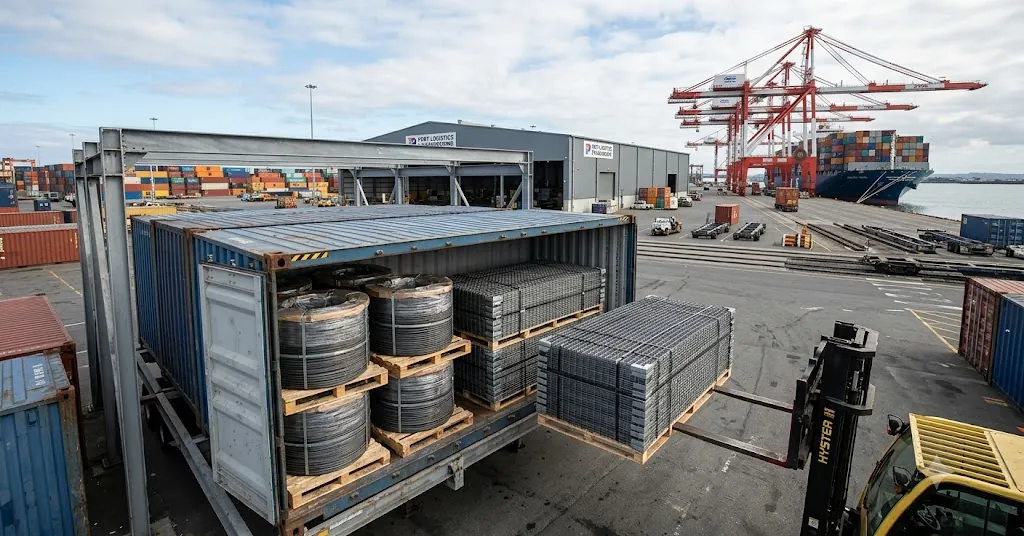
We are Hebei Leeter Import and Export Co., Ltd ("Leeter"), a wire, mesh, anchor, and fastener manufacturer founded in 2006 in Dingzhou, Hebei. We load and ship containers of steel hardware to North America and Europe every week, and rust-on-arrival is a question we answer constantly — sometimes defending our own packing, sometimes helping a buyer work out what actually happened to a container that wasn't ours. This guide lays out the mechanism, the diagnosis, the defense, and the liability the way we explain them to buyers.
What actually rusts your steel: container sweat
A shipping container is a sealed steel box with a huge daily temperature swing. Sitting on deck, a sun-heated container skin can exceed 60°C by day, then dump that heat fast at night — steel conducts and radiates efficiently, and on a clear night the roof can fall several degrees below the surrounding air temperature. The air inside was stuffed at a humid port, often around 30°C and 80% relative humidity, and marine air routinely runs above 80% RH.
Here is the physics that does the damage. Air at 30°C and 80% RH holds roughly 24 grams of water per cubic metre. Cool that same air to 10°C and it can only hold about 9.4 grams per cubic metre — so on the order of 14 grams per cubic metre has to condense out as liquid water. Across a full container over an ocean voyage, that adds up to roughly a litre of water plating out on the ceiling and walls and running back down onto the cargo. (Treat the exact litre figure as illustrative rather than precise; the mechanism is not in dispute.)
It is worth getting one distinction right, because trade blogs get it backwards constantly:
- Container sweat is condensation on the container structure — the roof, walls, and doors — when that steel skin cools below the dew point of the warm, moist air trapped inside. The water forms on the box, then drips onto your goods. This is the "container rain" that soaks the top of a stack.
- Cargo sweat is condensation on the cargo surface itself, when a cold stow is hit by a rush of warm, humid air whose dew point is above the cargo's temperature.
For steel hardware leaving China in the warm months, the dominant failure mode is container sweat dripping down onto the load.
Every extra day at sea is another condensation-and-re-evaporation cycle, so the route matters. Rough 2025–2026 port-to-port transit times are 14–21 days for China to the US West Coast, roughly 28–38 days to the US East Coast, and — with Asia–Europe services still routing around the Cape of Good Hope — on the order of 55–58 days to North Europe. A voyage that also crosses from the tropics into a cool temperate climate suffers the largest ambient temperature drop (an 18°C swing from a Southeast-Asian port to a Northern-European one is realistic), which is exactly what forces the most water out of the trapped air. A short West Coast run is far gentler on bare steel than a long East Coast or European one. (Transit numbers are volatile right now — re-check them at booking.)
Where the water comes from — and why dry dunnage matters
The trapped air is only part of the moisture budget. The bigger reservoir is often the wood you ship on. Green, untreated softwood can run 50–100% moisture content on a dry-weight basis, and a single green pallet can carry more than ten pounds of water — roughly four and a half litres — waiting to evaporate into the sealed container. Kiln-dried and ISPM-15 heat-treated pallets are much better, but "heat treated" is not "bone dry": the common target is around 19% moisture content or below, not zero, and the wood remains hygroscopic. Fibreboard, paper, and hessian packaging are hygroscopic too, and equilibrate with whatever humidity ends up in the box.
The practical lesson: a perfect barrier bag loses to a soaking-wet pallet stuffed in beside it. Dry dunnage, kiln-dried timber, and keeping packaging out of the rain before stuffing are unglamorous but decisive. For the loading-side discipline that goes with this, see our guide to container loading and moisture control for steel hardware.
Red rust or white rust? Know which one you have
The two rusts you will see on arrival are chemically different problems, and they carry very different verdicts.
Red rust is iron oxide forming on bare steel — black-annealed tie wire, bright wire, nails, plain rebar accessories. With no sacrificial coating, a water film is all it takes. An adsorbed water film starts to form around 60% RH and corrosion accelerates sharply once humidity sits high (above roughly 80%) for sustained periods, which is precisely the sealed-container condition. Light surface red rust is often cosmetic and removable; only pitting and section loss are structural damage.
White rust — properly called wet-storage stain — is a different animal, and it only appears on galvanized product: galvanized wire, welded mesh, coated fasteners. When freshly galvanized steel is stacked tightly and shipped damp with little airflow, the zinc reacts with condensed water to form a bulky white or grey zinc-hydroxide powder; with free-flowing dry air it would instead form the protective zinc-carbonate patina. The buyer sees white powder and assumes the coating has failed.
Here is the myth-buster that saves the most money: white rust is usually not grounds for rejection. The American Galvanizers Association is explicit that in the vast majority of cases wet-storage stain is light and does not reduce the expected life of the product, and under ASTM A123 it is not a reason to reject a coil as long as the remaining zinc coating thickness still meets the specified minimum. The correct response to white rust is to measure the coating thickness, not to reject on appearance. Only medium-to-heavy build-up that has consumed the zinc below the A123 minimum is genuinely actionable, and that may require stripping and re-galvanizing. If you are choosing coatings to survive transit in the first place, our comparison of electro-galvanized versus hot-dip galvanized wire covers how much zinc each process actually lays down.
A rust diagnosis you can do on the dock
Before anyone argues about fault, work out which of four things you are looking at. There is no single published standard that separates factory rust from transit rust, so treat the pattern reading below as informed reasoning — and photograph everything the moment the doors open.
| What you see | Most likely cause | The tell |
|---|---|---|
| Rust heaviest on the top layer, tide-lines and drip marks, worse near the roof and doors | Container sweat / transit condensation | Follows where dripping water lands; a gradient from wet top to clean bottom |
| Uniform rust through the interior of a bundle, or rust under packaging that was never opened | Pre-existing / packed rusty at the factory | Water that fell in transit can't reach the inside of a sealed, unopened VCI bag |
| White/grey powder on galvanized only | Wet-storage stain (white rust) | Zinc corrosion product, not iron oxide; test coating thickness before judging |
| Pitting, flaking, section loss on bare steel | Structural corrosion | Genuine damage vs. removable surface bloom |
A clean "shipped on board" bill of lading, plus dated pre-shipment photos, is your leverage: if the goods were photographed sound at loading and arrive with classic drip-path rust, the evidence points at transit, not the factory. This is one more reason a real pre-shipment inspection that opens the packing — rather than a glance at cartons — is worth its fee.
The five-layer defense that actually stops it
No single trick stops container rain. Seaworthy packing is a system, and each layer covers a different failure.
Layer 1 — the coating buys time
The first defense is the steel's own coating. Galvanizing to a heavier zinc class buys corrosion time: under ASTM A641 for galvanized wire, the heavier classes carry roughly two to three times the zinc of Class 1 (Class 1 runs from about 40 g/m² on fine wire up to 190 g/m² on heavy wire, by diameter). More zinc is more sacrificial metal before red rust starts. Bare wire is often shipped with a light rust-preventive oil or passivation for the same reason. One caution: salt-spray hours (ASTM B117) are a relative comparison between coatings only — they do not convert into "months of real service," because the standard's constant salt fog does not mimic a real voyage.
Layer 2 — VCI, inside a sealed enclosure
Volatile Corrosion Inhibitor (VCI) paper and film release a vapor that saturates the enclosed air and adsorbs onto the steel as a molecular passivating layer. The military specs behind it are MIL-PRF-3420 (VCI paper, in Class 1/2/3 weights) and MIL-PRF-22019 (transparent heat-sealable VCI barrier film). Two rules decide whether VCI works:
- It needs a reasonably sealed package. In an open or ventilated load the vapor simply dilutes away and protection collapses. VCI and a loose wrap are not the same thing.
- On galvanized, use a multi-metal grade. Older nitrite-based VCIs protect ferrous metal but can attack zinc, cadmium, and copper — the wrong VCI will grow white powder on your galvanized coils. For zinc-coated goods, specify a multi-metal VCI.
Layer 3 — desiccant, sized to the job
Desiccant lowers the humidity so there is less water to condense. Capacities differ enormously: silica gel absorbs roughly 25–35% of its own weight (up to about 40% at very high humidity), montmorillonite clay around 15–30%, and calcium chloride an enormous 200–300% because it deliquesces into brine (which then must be contained so it can't leak onto the goods). The old procurement unit is the "DMF unit" from MIL-D-3464 — one unit adsorbs about 6 grams of water at 40% RH.
For rough sizing, freight desiccant suppliers use a rule-of-thumb formula, W = (K × V × RH × M) / 14, where W is grams of desiccant, K is a climate constant (about 40 for hot, humid lanes and about 12 for cool, dry ones), V is container volume in m³ (a 20-ft is ≈33 m³, a 40-ft ≈66 m³), RH is the expected humidity as a decimal, and M is the transit in months. For a hot, humid two-month voyage that lands around 5–6 kg of desiccant in a 20-ft and 10–12 kg in a 40-ft. Treat this as a rule of thumb, not a standard — but it stops teams from throwing in two token bags and calling it protected.
Layer 4 — container-level moisture control
Beyond the packages, container-level absorbers manage the box's own air. Calcium-chloride products such as Container Dri II (absorbing up to about 300% of their weight) are dosed roughly 32–36 of the 125 g bags, or 5–6 of the 750 g poles, per 20-ft container, and about double that for a 40-ft. A Tyvek or PE container liner keeps condensate on the walls from reaching the load. There is no single official target humidity, but the practical aim is to hold the internal air's dew point below the coldest surface temperature — keeping RH under about 50% is a common working target, not a specification.
Layer 5 — the barrier and dry dunnage
Finally, the physical wrap: a genuine seaworthy system for steel coils layers a polyethylene film, a woven barrier, a waterproof paper, and VCI, with edge protectors and VCI emitters inside the coil — over dry, kiln-dried dunnage. That is very different from "standard export packing," which is fine for a short inland move and not for a two-month ocean crossing. And skip the folk remedies: bituminised hessian is not a moisture barrier — it tears in transit and traps water against the steel. Our full walk-through of packing and container loading for welded mesh shows what a seaworthy stack looks like in practice; for smaller stock, the same principles appear in storing tie wire to prevent rust.
The one-line summary of the limits: desiccant can't save an unsealed package, VCI can't work in an open load, and galvanizing only delays white rust if the goods are packed damp. You need the layers together.
Who is actually liable when it lands rusty
This is where money is won and lost, and where two expensive misconceptions live.
Incoterms decide when the risk becomes yours — and it is early. Under the sea terms FOB, CFR, and CIF, the risk of loss or damage passes to the buyer when the goods are loaded on board at the origin port, regardless of who pays the freight.
| Term | Risk passes to buyer | Main freight paid by | Insurance bought by |
|---|---|---|---|
| FCA | at hand-over to the carrier at origin | Buyer | Buyer |
| FOB | when on board at origin port | Buyer | Buyer |
| CFR | when on board at origin port | Seller | Buyer |
| CIF | when on board at origin port | Seller | Seller (minimum cover only) |
The trap is CIF. Under CIF the seller pays freight and insurance to the destination port, so buyers assume the seller is responsible for the condition on arrival. They are not. Risk passed on board at the load port; the seller is deemed to have delivered once the goods are loaded, "regardless of whether the goods arrive in sound condition… or at all." If rust develops in transit under CIF, it sits on the buyer's risk account. (What the seller does still owe, under every Incoterm, is packing that is fit for the known transport — a separate contractual duty, and usually the buyer's real remedy for a transit-rust dispute.)
Marine insurance is not the safety net people assume. The Institute Cargo Clauses — A, B, and C — all carry the same key exclusions: clause 4.3 excludes loss from insufficiency or unsuitability of packing to withstand the ordinary incidents of the transit, and clause 4.4 excludes loss from inherent vice or nature of the goods. Steel oxidises in humid air by its nature, so ordinary condensation ("sweat") rust is routinely treated as inherent vice and is typically not covered — even under an "all-risks" ICC(A) policy — unless it results from an insured peril such as seawater ingress or a breached container. In other words: thin packing plus condensation is a double exclusion (4.3 and 4.4), and "I have all-risks cover" does not mean "all rust is covered." What flips a claim is evidence of an insured peril — a hole in the roof, a failed door seal, sea water in the box — not the mere fact that the steel came out orange.
So the liability reality for a buyer is path-dependent: transit condensation on your risk account under FOB/CIF, usually uninsured, with your live remedy being a claim against the seller's packing obligation (if the packing was not seaworthy) or against the carrier (if water got in through their negligence). Which path wins depends entirely on the evidence you collect on day one.
Write it into the purchase order
Because the risk is yours the moment the box is loaded, the leverage is in the contract, not the claim. The packing clauses worth insisting on:
- A named seaworthy-packing spec. Reference a real standard — ASTM D3951 for commercial packaging, or MIL-STD-2073 levels for heavy-duty — rather than "export packing," which means nothing.
- VCI plus desiccant, specified. Require multi-metal VCI for galvanized goods and desiccant sized to the lane, not two token bags.
- Humidity Indicator Cards inside the sealed bags. The reversible-dot cards to MIL-I-8835 / MS20003 (the 30/40/50% RH dots, accurate to about ±2.5% RH) give you an objective in-bag humidity record — if the 40% dot has turned on opening, you have proof the package ran wet.
- Coating-thickness acceptance, not appearance. For galvanized, define acceptance by remaining coating thickness against the ASTM A123 minimum, so "white stain" is a measurement, not an argument.
- A surface-rust accept/reject line. Reference ISO 8501-1 rust grades so cosmetic bloom and rejectable pitting aren't negotiated case by case.
- A third-party inspection that opens the packing and photographs the load before stuffing, fixing the pre-shipment baseline that makes any later transit-rust argument winnable.
These same disciplines — a binding spec, verification before payment, and honest acceptance criteria — are exactly what stops the broader problem of quality fade between sample and bulk.
How we think about it as the factory
We would rather over-pack a container than win a rust argument after the fact, because a rust claim costs both sides more than a roll of VCI paper and a box of desiccant ever will. For ocean freight we build the barrier around the metal — coating first, VCI in a sealed wrap, desiccant sized to the lane, dry dunnage under the load — and we are happy to pack to a written seaworthy spec and put humidity indicator cards in the bags so the buyer has evidence, not just a promise. Where we will be honest: no packing makes a two-month tropical voyage risk-free, kiln-dried dunnage still isn't bone dry, and a cheaper "standard export" pack is a false economy on a long lane. If you tell us the destination, the season, and the transit time, we will pack for that voyage rather than a generic one.
Frequently asked questions
My steel arrived rusty — is it the factory's fault or the shipping?
Diagnose before you accuse. Rust that is heaviest on the top layer, with tide-lines and drip marks worse near the roof and doors, points to container sweat in transit. Rust that is uniform through the interior of a bundle, or present under a VCI bag that was never opened, points to steel that was packed rusty. White or grey powder on galvanized goods is wet-storage stain, a coating question rather than a shipping failure. Photograph everything the moment the doors open, and compare against the pre-shipment inspection photos.
I bought CIF — isn't the seller liable for rust on arrival?
Usually no. Under CIF the seller pays freight and insurance to the destination port, but the risk transfers to you when the goods are loaded on board at the origin port. The seller has delivered at that point regardless of arrival condition, so transit rust is on your risk account. Your real remedy is against the seller's separate duty to pack the goods fit for the voyage, or against the carrier if water entered through their fault — not the CIF term itself.
Does my all-risks marine insurance cover condensation rust?
Usually not. All three Institute Cargo Clauses (A, B, and C) exclude loss from insufficiency of packing (4.3) and from inherent vice (4.4), and ordinary condensation rust on steel is normally treated as inherent vice. A claim generally succeeds only if the rust resulted from an insured peril — seawater ingress, a breached container, roof or door failure — with evidence to prove it. Confirm your exact policy wording, but do not assume "all-risks" means "all rust."
Is white rust on my galvanized mesh grounds for rejection?
Usually not on its own. Wet-storage stain is, in most cases, light and does not reduce the coating's expected life, and under ASTM A123 it is not a reason to reject as long as the remaining zinc thickness still meets the specified minimum. Measure the coating thickness before deciding. Only heavy build-up that has consumed the zinc below the minimum is genuinely actionable.
How much desiccant do I need per container?
As a rule of thumb, freight suppliers use W = (K × V × RH × M) / 14 — grams of desiccant from a climate constant K (about 40 for hot, humid lanes), container volume V in m³ (≈33 for a 20-ft, ≈66 for a 40-ft), expected humidity RH as a decimal, and transit M in months. For a hot, humid two-month voyage that lands around 5–6 kg in a 20-ft and 10–12 kg in a 40-ft, alongside container-level absorbers. It is a working estimate, not a standard, and desiccant only helps inside a sealed package or a lined container.
What should I put in the PO to prevent rust disputes?
Six clauses: a named seaworthy-packing standard; multi-metal VCI plus lane-sized desiccant; humidity indicator cards in the sealed bags; galvanized acceptance by coating thickness against ASTM A123; a surface-rust accept/reject line referenced to ISO 8501-1; and a third-party pre-shipment inspection that opens the packing and photographs the load before stuffing. Because the transit risk is yours from the moment of loading, the contract is where you actually control the outcome.
Sources
- American Galvanizers Association — Wet Storage Stain on Hot-Dip Galvanized Steel
- West of England P&I — Cargo Ventilation and Precautions to Minimise Sweat
- TT Club — Protecting Cargo from Wet Damage
- Virginia Tech Center for Packaging & Unit Load Design — Moisture in Sea Containers
- ICC Academy — Incoterms 2020: CFR and CIF
- Trade Finance Global — CIF (Cost, Insurance and Freight)
- Marsh — Institute Clauses and Joint Cargo Clauses
- ASTM A123 / A641 (galvanized coating and zinc-coated wire specifications) — ASTM International
- MIL-PRF-3420 / MIL-PRF-22019 (VCI paper and barrier film) and MIL-D-3464 (desiccant units) — everyspec
- Clariant — Container Dri II
- Freightos — Shipping from China to the United States
The corrosion mechanism and standards above are general engineering information. Coating specifications, acceptance criteria, and insurance terms should be confirmed against the current ASTM/ISO standards and your own policy and contract wording for your specific shipment.
