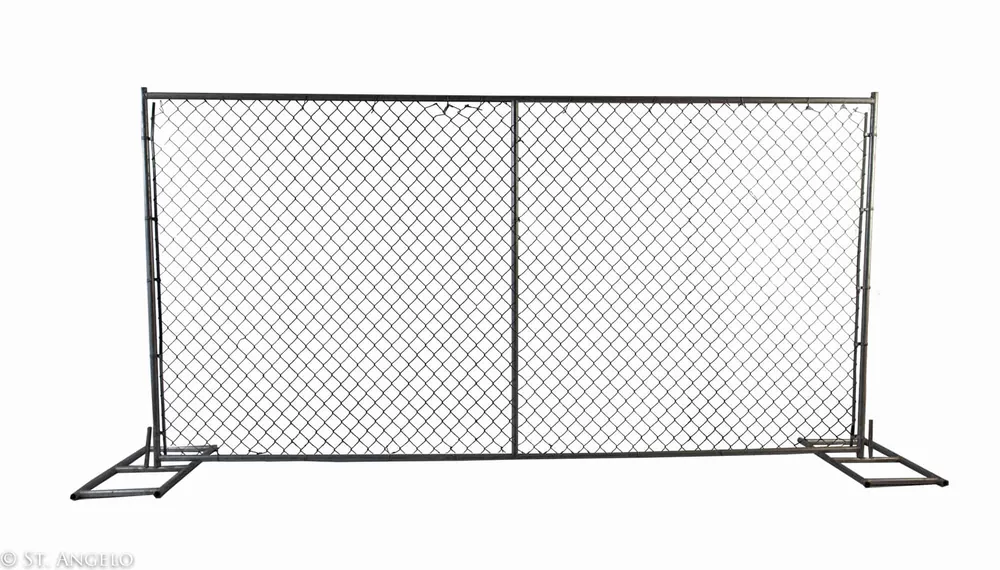
We are Hebei Leeter Import and Export Co., Ltd ("Leeter"), a construction wire, mesh and fencing manufacturer in Dingzhou, Hebei, China, exporting since 2006 to buyers across North America and Europe. We build both panel types on the same tube frames, so many importers order a mix of each in one container to serve different job types.
Side-by-side comparison
Both panels do the same basic job — a temporary, movable perimeter — but they behave differently in the field. This table sums up the trade-offs from a sourcing and site-management view.
| Factor | Welded mesh | Chain-link (woven) |
|---|---|---|
| Wire diameter | 2.5–6.0 mm (0.10–0.24 in) | 1.5–4.0 mm (0.06–0.16 in) |
| Mesh openings | 50×100, 75×150, 80×160 mm | 50×50, 60×60, 70×70 mm |
| Security / anti-climb | High (rigid, hard to cut) | Moderate (flexible, cuttable) |
| Panel weight | Heavier | Lighter |
| Unit cost | Higher | Lower |
| Visibility / sightlines | Good (open grid) | Good (diamond mesh) |
| Appearance | Neat, uniform | Utilitarian |
| Repairs on site | Replace panel | Re-tension or patch |
When to choose welded mesh
Welded mesh panels are made from straight wires resistance-welded at every intersection, so the sheet is rigid and cannot be peeled back or pushed through easily. That rigidity is why they dominate secure and long-duration applications:
- Long-term construction perimeters where the fence stays up for months and must resist tampering.
- High-value or high-liability sites — plant yards, substations, data-center builds — where anti-climb and anti-cut performance matters.
- Public-facing or urban projects where a clean, uniform look reflects on the contractor.
Heavier 4.0–6.0 mm wire with a hot-dip galvanized or powder-sprayed finish gives the longest service life and the best rental return over many redeployments. This is the same welded construction covered in our welded vs woven wire mesh guide, applied to a portable frame.
When to choose chain-link
Chain-link temporary fence uses woven diamond mesh hung in a tube frame. It flexes rather than staying rigid, which makes it lighter to carry, cheaper to buy, and forgiving if a panel is knocked. It is the right call when:
- Cost per panel is the priority — large runs, tight budgets, or short hire periods.
- Crews reposition panels often by hand and value the lower weight.
- Events and crowd control need a fast, low-cost barrier rather than a hardened one.
Chain-link is the traditional US and Canadian "construction fence panel," typically 6 ft × 9.5 ft or 6 ft × 12 ft. Wire diameters of 2.0–3.0 mm cover most demand; go heavier only where you need more resistance to sagging.
Cost and shipping considerations
For most specifications, chain-link panels land cheaper per unit both to manufacture and to ship, because they use thinner wire and weigh less. Welded mesh costs more but carries a higher perceived value in rental fleets and lasts longer under rough handling. Since fencing is dense steel that "weights out" a container before it "cubes out," a lighter chain-link load lets you fit more panels under the same weight limit — a real factor in container economics. Whichever you choose, standardize the bases and feet and couplers so both panel types share hardware across your fleet.
Frequently asked questions
Is chain-link or welded-mesh temporary fencing cheaper?
Chain-link is generally cheaper, both to manufacture and to ship, because it uses thinner wire (1.5–4.0 mm) and weighs less than welded mesh (2.5–6.0 mm). Welded mesh costs more per panel but offers higher security and a longer service life, so it often gives better value in rental fleets that redeploy panels many times.
Which temporary fence is more secure?
Welded mesh is more secure. Its wires are welded at every intersection, creating a rigid sheet that resists cutting, climbing and peeling far better than woven chain-link, which flexes and can be cut or pried open more easily. For high-value sites, choose welded mesh with heavier 4.0–6.0 mm wire.
Can I mix welded mesh and chain-link panels in one order?
Yes. Both panel types use the same tube frames, feet and clamps, so importers commonly order a mix in a single container — welded mesh for secure long-term sites and chain-link for budget or event work. As an OEM manufacturer we build both to your specified height, length, wire gauge and coating.
What wire gauge should I specify for a construction perimeter?
For a secure construction perimeter, welded panels with 4.0–6.0 mm wire give the best anti-climb rigidity, while chain-link at 2.5–3.0 mm suits general or short-term perimeters. Pair either with a hot-dip galvanized or powder-sprayed finish for outdoor durability across multiple redeployments.
