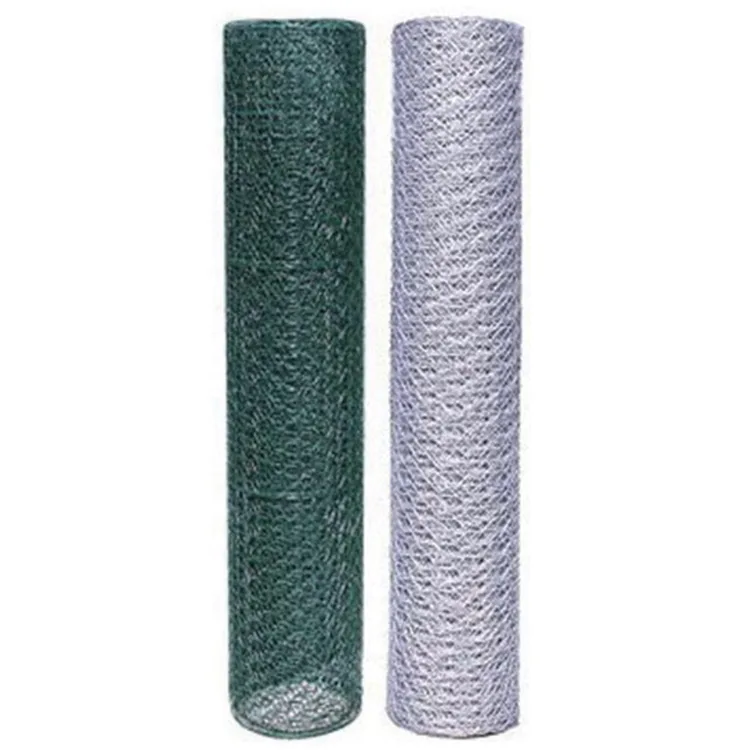
We are Hebei Leeter Import and Export Co., Ltd ("Leeter"), a wire mesh and fencing manufacturer in Dingzhou, Hebei, China, exporting since 2006 to hardware chains, farm-store distributors and construction buyers across North America and Europe. Hexagonal netting is one of our founding product lines, and every spec in this guide is from our own looms — see the product page for hexagonal wire netting.
How hex netting is measured
Three numbers define any roll of chicken wire:
- Mesh opening — the flat-to-flat distance across one hexagon, quoted in inches in North America and millimeters elsewhere. Smaller opening = more wire per square meter = higher cost and better exclusion.
- Wire diameter (gauge) — the drawn wire the mesh is twisted from. Heavier wire for a given opening means a stiffer, stronger, longer-lived mesh.
- Twist type — normal (positive) twist, where wires wrap each other in one direction, is the standard; reverse twist alternates the twist direction between rows, which helps the mesh lie flatter and grip plaster better in stucco and insulation applications.
Roll width runs 0.3–2.0m and roll length is typically quoted per order (25m and 50m are common export lengths). Because hex netting is a twisted — not welded — mesh, it stays flexible, follows curves, and tolerates the tension of hand installation without popping joints.
Standard openings, wire sizes and what each is for
| Mesh opening | Metric | Typical wire diameter | Approx. gauge | Common uses |
|---|---|---|---|---|
| 1/2" | 13mm | 0.4–0.8mm | 27–21 BWG | Chick brooders, rodent/snake exclusion, craft |
| 5/8" | 16mm | 0.4–0.8mm | 27–21 BWG | Small-vermin screens, stucco netting |
| 3/4" | 19mm | 0.5–0.9mm | 25–20 BWG | Aviaries, small poultry, plaster backing |
| 1" | 25mm | 0.6–1.0mm | 23–19 BWG | Standard chicken runs and coops, tree guards |
| 1-1/4" | 30mm | 0.7–1.1mm | 22–18 BWG | Poultry fencing, garden protection |
| 1-1/2" | 40mm | 0.8–1.2mm | 21–18 BWG | Garden fencing, insulation support |
| 2" | 50mm | 0.8–1.2mm (up to 1.6mm) | 21–16 BWG | Perimeter runs, stone-facing support, gabion-style wrap |
Gauge equivalents are approximate BWG; always order in millimeters to avoid gauge-table disputes. The rule of thumb inside the table: the larger the opening, the heavier the wire needs to be for the mesh to hold its shape, which is why 2" mesh runs up to 1.2mm standard and 1.6mm for heavy-duty rolls.
Two buying notes from the poultry trade. First, 1" (25mm) is the classic "chicken wire" — it keeps adult birds in, but determined predators (raccoons, foxes) can tear light-gauge netting, so predator-side walls are better in heavier wire or backed with welded wire mesh. Second, if the job is keeping wild birds out of fruit rather than hens in a run, 3/4" netting in light wire is the cost-effective choice.
Finishes: galvanized before or after weaving, PVC, stainless
The finish decides how long the mesh lasts outdoors, and it is where cheap and quality rolls quietly diverge.
| Finish | How it is made | Corrosion performance | Best for |
|---|---|---|---|
| Galvanized before weaving (GBW) | Mesh woven from pre-galvanized wire | Good; twist points share the wire's coating | General indoor/outdoor use, best price |
| Galvanized after weaving (GAW) | Woven mesh hot-dip galvanized as a sheet | Best bare-metal option; zinc seals every twist | Permanent outdoor runs, humid climates |
| PVC-coated | Colored PVC extruded over galvanized core | Excellent; plastic barrier plus zinc | Coastal sites, gardens, visible fencing |
| Stainless steel | Woven from stainless wire | Outstanding, no coating to consume | Chemical, marine, architectural uses |
Galvanizing after weaving costs more because the finished mesh passes through the zinc bath, but the twisted joints — the first place rust starts on GBW mesh — come out fully sealed. The same before-vs-after logic applies across our mesh range and is explained in our galvanized before vs after welding guide.
PVC-coated hex netting is specified by core/overall diameter: from 0.4mm core / 0.8mm overall up to 1.2mm core / 1.6mm overall. The jacket adds UV-stable color (green and black are stock) and a second corrosion barrier over the galvanized core — the same construction logic as our PVC-coated wire. For the underlying zinc chemistry and coating weights, see our galvanized wire page.
Roll sizes, packing and export logistics
Standard export widths are 0.3, 0.5, 0.6, 0.9, 1.0, 1.2, 1.5, 1.8 and 2.0m (roughly 1–6.6 ft), with 3 ft (0.9m) and 4 ft (1.2m) the volume sellers for North American retail. Rolls ship wrapped in waterproof paper with a plastic cloth outer layer, which protects the zinc from ocean-air condensation in the container; compressed or pallet-stacked packing is available for retail-ready programs. When you request a quote, specify: opening (mm), wire diameter (mm), twist type, finish (GBW / GAW / PVC core-overall / stainless), roll width and length, and rolls per pallet or container. A 20 ft container typically carries a mixed program of widths and openings, so most of our hex netting buyers consolidate several SKUs per shipment.
Which size should you buy?
- Chicks and brooders: 1/2" (13mm) — chicks pass through anything larger.
- Rodents, snakes, stucco and plaster backing: 1/2"–5/8" in light wire; reverse twist lies flatter under render.
- Aviaries and songbird protection: 3/4" (19mm).
- Standard hen runs and coops: 1" (25mm), 0.7–1.0mm wire, GAW or PVC if the run is permanent.
- Garden and general fencing: 1-1/4"–1-1/2", balancing cost and exclusion.
- Perimeter and support jobs (insulation, stone facing, erosion wrap): 2" (50mm) in 1.0–1.2mm wire, or heavy-duty 1.6mm.
If the threat is digging or tearing predators rather than containment, upgrade the vulnerable faces to welded mesh, and treat hex netting as the economical containment layer.
Three installation points stretch the life of whatever size you choose. First, support the mesh every 2–3m (6.6–10 ft) with posts or a tensioned top and bottom wire — hex netting is a flexible fabric, not a self-supporting panel, and unsupported spans sag and work-harden at the staples. Second, against digging predators, bury a 200–300mm (8–12 in) skirt of mesh turned outward at the base, or pin an apron flat to the ground. Third, fix with galvanized staples or tie wire, never bare steel — a bright staple becomes the first rust point on an otherwise galvanized fence line.
Frequently asked questions
What size chicken wire do I need for a chicken coop?
Use 1" (25mm) mesh for the run and walls of a standard coop — it contains adult birds at the best cost per square meter. Use 1/2" (13mm) around brooders and anywhere chicks live, and consider heavier wire (1.0mm+) or a welded-mesh backing on faces exposed to raccoons and foxes.
What gauge is standard chicken wire?
Most retail chicken wire is woven from roughly 0.6–1.0mm wire (about 23–19 BWG), with 20 gauge (0.9mm) the common mid-point for 1" mesh. Larger 2" openings run 0.8–1.2mm, and heavy-duty rolls go up to 1.6mm. Order in millimeters — gauge tables vary between systems.
Will chicken wire keep out predators?
It reliably keeps poultry in and casual intruders out, but light-gauge hex netting can be torn by strong predators such as raccoons and foxes and dug under by anything determined. For predator-proofing, use heavier wire, bury a skirt of mesh, and back critical faces with welded wire mesh; keep hex netting as the containment layer.
What is the difference between normal twist and reverse twist?
Normal (positive) twist wraps the paired wires in one continuous direction and is the standard for fencing rolls. Reverse twist alternates twist direction row by row, producing a flatter, more dimensionally stable sheet that grips plaster well — it is preferred for stucco netting and insulation support.
Is PVC-coated chicken wire better than galvanized?
For coastal, humid or high-visibility settings, yes: the PVC jacket (0.4/0.8 up to 1.2/1.6mm core/overall) adds a sealed barrier and color over an already-galvanized core, so it outlasts bare zinc. For dry inland use, galvanized-after-weaving netting is usually the best value, since the zinc bath seals the twisted joints where rust starts first.
